NFM Choir, Lionel Sow - Dialogue (2026) [Hi-Res]
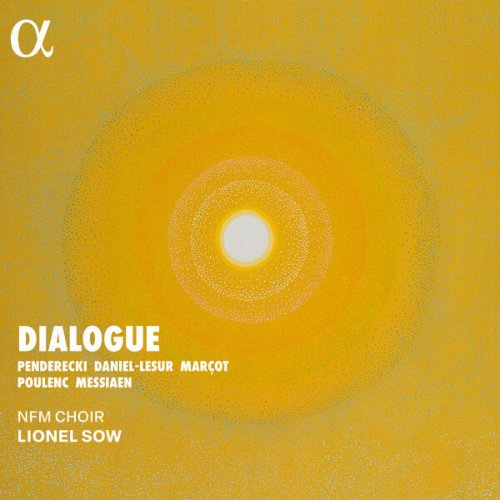
Artist: NFM Choir, Lionel Sow
Title: Dialogue
Year Of Release: 2026
Label: Alpha Classics
Genre: Classical
Quality: flac lossless (tracks) / flac 24bits - 96.0kHz +Booklet
Total Time: 01:03:38
Total Size: 262 mb / 1.0 gb
WebSite: Album Preview
TracklistTitle: Dialogue
Year Of Release: 2026
Label: Alpha Classics
Genre: Classical
Quality: flac lossless (tracks) / flac 24bits - 96.0kHz +Booklet
Total Time: 01:03:38
Total Size: 262 mb / 1.0 gb
WebSite: Album Preview
01. Pieśń Cherubinów
02. Le Cantique des cantiques: I. Dialogue
03. Le Cantique des cantiques: II. La voix du bien-aimé
04. Le Cantique des cantiques: III. Le songe
05. Le Cantique des cantiques: IV. Le roi Salomon
06. Le Cantique des cantiques: V. Le jardin clos
07. Le Cantique des cantiques: VI. La Sulamite
08. Le Cantique des cantiques: VII. Épithalame
09. Stabat Mater
10. Nigra sum
11. O gloriosa virginum
12. Salve Regina, FP 110
13. Agnus Dei
The NFM choir from Wrocław juxtaposes Penderecki and French composers, creating a dialogue between Polish and French music of the 20th century, between the singers from Wrocław, where the choir is based, and Frenchman Lionel Sow, its conductor since 2021.
The program opens with Krzysztof Penderecki's Le Chant des chérubins, a piece composed in 1986 based on a text from the Orthodox liturgy. This is followed by a composition by French composer Yves Daniel-Lesur, a twelve-part Cantique des Cantiques composed in 1953. In 1962, Penderecki completed a Stabat Mater of a purely religious nature, a declaration of opposition to the communist system and its visceral atheism, but also to Western avant-garde circles, which were equally uninterested in the sacred.
Fast forward to the 2000s with Nigra sum by composer and mezzo-soprano Caroline Marçot, who is very interested in Renaissance music. If there is one thing that Poulenc's Salve Regina, composed in 1941, and Penderecki's Agnus Dei, written forty years later, have in common, it is simplicity and a form of contemplation that can also be found in Olivier Messiaen's O sacrum convivium, composed in 1937.
![True East - This Place is a Message (2026) [Hi-Res]](https://img.israbox.com/img/2026-07/13/0u90l9fwl5q9kwdf4vk1269ev.jpg "True East - This Place is a Message (2026) [Hi-Res]")
![Tyler Sabbag - Novella (2026) [Hi-Res]](https://img.israbox.com/img/2026-07/14/56rz34zifatovi3ae5ru29o27.jpg "Tyler Sabbag - Novella (2026) [Hi-Res]")
![Stan Getz, Gerry Mulligan, Harry Edison, Louis Bellson & The Oscar Peterson Trio - Jazz Giants '58 (Remastered Edition) (2026) [Hi-Res]](https://www.dibpic.com/uploads/posts/2026-07/1784035918_folder.jpg "Stan Getz, Gerry Mulligan, Harry Edison, Louis Bellson & The Oscar Peterson Trio - Jazz Giants '58 (Remastered Edition) (2026) [Hi-Res]")