Clément Saunier, Sinfonia Varsovia, Wilson Hermanto - Bernd Alois Zimmermann, Péter Eötvös, Heinz Karl "Nali" GruberGruber (2026) [Hi-Res]
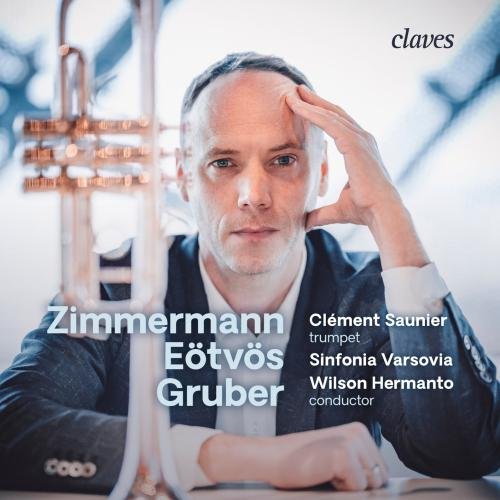
Artist: Clément Saunier, Sinfonia Varsovia, Wilson Hermanto
Title: Bernd Alois Zimmermann, Péter Eötvös, Heinz Karl "Nali" GruberGruber
Year Of Release: 2026
Label: Claves Records
Genre: Classical
Quality: flac lossless (tracks) / flac 24bits - 96.0kHz +Booklet
Total Time: 01:01:46
Total Size: 275 / 921 mb
WebSite: Album Preview
TracklistTitle: Bernd Alois Zimmermann, Péter Eötvös, Heinz Karl "Nali" GruberGruber
Year Of Release: 2026
Label: Claves Records
Genre: Classical
Quality: flac lossless (tracks) / flac 24bits - 96.0kHz +Booklet
Total Time: 01:01:46
Total Size: 275 / 921 mb
WebSite: Album Preview
01. Nobody knows de trouble I see - Concerto for Trumpet in C and Orchestra
02. Jet Stream for trumpet in B-Flat and Orchestra (Cadenzas 1, 2, 3 by Clément Saunier, Cadenza 4 by Péter Eötvös)
03. Aerial - Concerto for Trumpet (doubling piccolo Trumpet and cow Horn) and Orchestra: I. Done with the Compass - Done with the Chart (after Wild Nights by Emily Dickinson)
04. Aerial - Concerto for Trumpet (doubling piccolo Trumpet and cow Horn) and Orchestra: II. Gone Dancing
The spectacular blossoming of the trumpet concerto in the second half of the 20th century was directly inspired by the tradition of jazz trumpet playing, and by the genius of Louis Armstrong in particular[i]. Armstrong, and other jazz trumpeters like Dizzy Gillespie and Miles Davis after him, introduced an entirely new way of trumpet playing that proved game-changing in the classical world as well.
It will hardly come as a surprise, then, that all three concertos on this CD have explicit connections to jazz, while speaking the language (or languages) of contemporary classical music. The three works, and their composers, are also connected to one another through personal channels. Pétér Eötvös studied composition with Bernd Alois Zimmermann. As a conductor, he recorded both HK Gruber’s Aerial and his own Jet Stream–with Håkan Hardenberger as soloist. Hardenberger, for whom Aerial was written and Jet Stream revised, was also one of those responsible for reviving Zimmermann’s Nobody knows de trouble I see after decades of neglect. This trio of concertos certainly deserves to be heard side by side; as a group, they attest to the wide expressive range of the trumpet at the intersection of the classical and jazz traditions. In recent years, younger players like Clément Saunier have taken on these important works, which have now truly entered the trumpet repertoire as they have found an ever-growing number of new champions among players, and new fans among listeners.
It is significant that none of the three compositions is called simply “Trumpet Concerto.” Each has a descriptive title that may well be called “programmatic “–although not in the sense of 19th-century program music which was, in most cases, inspired by pre-existent literary or artistic sources. Our three works are programmatic in a different way. Zimmermann’s concerto, the earliest of the three, uses a well-known spiritual–a musical source–and takes it where it has never gone before. The two more recent works are based on extra-musical images and ideas that are the composers’ own. Through a multiplicity of allusions to other music, each composer created a special associative network, and, by placing the borrowed elements in new contexts, each work communicates something highly original.
Jazz, while clearly at the center of all three “programs,” meant something different to each composer. These Europeans have not simply written music influenced by American jazz, as Stravinsky, Ravel and so many others had done a hundred years ago. They offer, instead, their own emotional responses to the art form. Zimmermann’s piece is, more than anything, a personal meditation on the spiritual. Gruber uses jazz rhythms to evoke a kind of apocalyptic, end-of-the-world vision, while in Eötvös’s work, jazz appears as a mysterious new world in the process of being discovered. - Dr. Peter Laki
Clément Saunier, trumpet
Sinfonia Varsovia
Wilson Hermanto, conductor
![VA - The Art of HiFi Vol. 3: Percussion (2023) [DSD256]](https://www.dibpic.com/uploads/posts/2026-08/1787844328_oct0043.jpg "VA - The Art of HiFi Vol. 3: Percussion (2023) [DSD256]")
![Julia Vari, Negroni’s Trio - Somos (2026) [Hi-Res]](https://www.dibpic.com/uploads/posts/2026-08/1788167588_h86bc0h0nd7sa_600.jpg "Julia Vari, Negroni’s Trio - Somos (2026) [Hi-Res]")

![PAKT - Live Recordings 2024 (2025) [Hi-Res]](https://www.dibpic.com/uploads/posts/2026-08/1788183716_cover.jpg "PAKT - Live Recordings 2024 (2025) [Hi-Res]")