Polish National Radio Symphony Orchestra, Antoni Wit - Lutoslawski: Symphony No. 1 (1999)
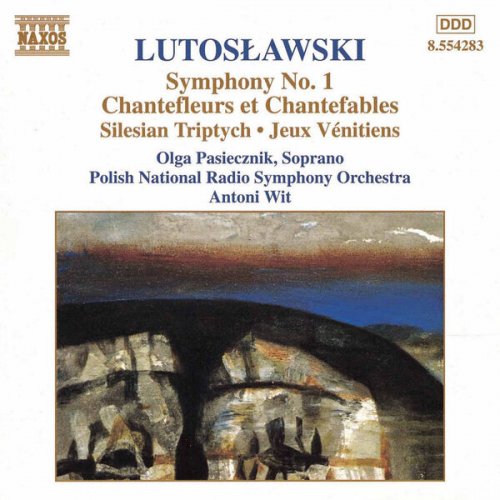
Artist: Polish National Radio Symphony Orchestra, Antoni Wit
Title: Lutoslawski: Symphony No. 1
Year Of Release: 1999
Label: Naxos
Genre: Classical
Quality: FLAC (tracks)
Total Time: 01:12:25
Total Size: 286 Mb
WebSite: Album Preview
Tracklist:Title: Lutoslawski: Symphony No. 1
Year Of Release: 1999
Label: Naxos
Genre: Classical
Quality: FLAC (tracks)
Total Time: 01:12:25
Total Size: 286 Mb
WebSite: Album Preview
Symphony No. 1 (Witold Lutosławski)
01. Allegro giusto (00:05:30)
02. Poco adagio (00:09:52)
03. Allegretto misterioso (00:04:33)
04. Allegro vivace (00:05:21)
Silesian Triptych (Witold Lutosławski)
05. Oj, mi sie owiesek (00:03:01)
06. Ich, w tej studni (00:03:31)
07. Kukuleczka kuka (00:03:08)
Jeux vénitiens (Witold Lutosławski)
08. Pt. I (00:03:06)
09. Pt. II (00:01:58)
10. Pt. Iii (00:03:14)
11. Pt. IV (00:04:54)
Chantefleurs et Chantefables (Witold Lutosławski)
12. I La belle-de-nuit (the Marvel of Peru) (00:02:44)
13. II La sauterelle (the Grasshopper) (00:01:32)
14. III La veronique (the Speedwell) (00:02:23)
15. IV L' eglantine, l' aubepine et la glycine (the Wild Rose, the Hawthorn and the Wisteria) (00:01:41)
16. V La tortue ( the Tortoise) (00:02:05)
17. VI La rose (the Rose) (00:02:32)
18. VII L' alligator (the Alligator) (00:02:47)
19. VIII L' angelique (the Angelica) (00:02:43)
20. IX Le papillon (the Butterfly) (00:01:52)
3 Postludes (Witold Lutosławski)
21. Postludium I (00:03:58)
Total length: 01:12:25
Label: Naxos
Performers:
Olga Pasiecznik (soprano)
Polish National Radio Symphony Orchestra
Antoni Wit
Juxtaposing Lutospawski's early Symphony No 1 with the late Chantefleurset Chantefables reinforces the fundamentally French associations of this composer's very personal musical voice; to contemplate how the symphony's exuberant embrace of a Roussel-like idiom was complemented, more than 40 years later, by the subtle Ravellian overtones of Chantefleurs et Chantefables is to recognise that the radical gestures of Jeuxvénetiens (1961) have worn less well than Lutospawski's more 'conservative' qualities.
Indeed, the wild piano cadenza in Jeux vénetiens now evokes the high jinks of Ibert's Divertissement rather than the liberated avant-garde ethos of more determinedly progressive musical minds.
The downbeat ending is far more memorable.
Olga Pasiecznik's singing is outstanding, especially in Chantefleurs, where she easily surpasses Dawn Upshaw in subtlety and Antoni Wit turns in strongly characterised, wellshaped accounts of all the scores. The playing is eloquent as well as energetic, and although, as with earlier Naxos volumes, the recordings are rather glassy and generalised, the music's range of colour and variety of texture is never in doubt. With such a well-filled disc, why did Naxos decide to include the first of the Three Postludes? The composer himself was clearly happy for the piece to appear on its own, but in a series with pretensions to completeness the full set is surely a must.
Indeed, the wild piano cadenza in Jeux vénetiens now evokes the high jinks of Ibert's Divertissement rather than the liberated avant-garde ethos of more determinedly progressive musical minds.
The downbeat ending is far more memorable.
Olga Pasiecznik's singing is outstanding, especially in Chantefleurs, where she easily surpasses Dawn Upshaw in subtlety and Antoni Wit turns in strongly characterised, wellshaped accounts of all the scores. The playing is eloquent as well as energetic, and although, as with earlier Naxos volumes, the recordings are rather glassy and generalised, the music's range of colour and variety of texture is never in doubt. With such a well-filled disc, why did Naxos decide to include the first of the Three Postludes? The composer himself was clearly happy for the piece to appear on its own, but in a series with pretensions to completeness the full set is surely a must.
![Nils Landgren - Nils Landgren 70 - Jazz at Berlin Philharmonic XIX (2026) [Hi-Res]](https://www.dibpic.com/uploads/posts/2026-08/1787665260_folder.jpg "Nils Landgren - Nils Landgren 70 - Jazz at Berlin Philharmonic XIX (2026) [Hi-Res]")