Daniel Matejča, Martin Šulc - Piazzolla - Café 1930 (2026) [Hi-Res]
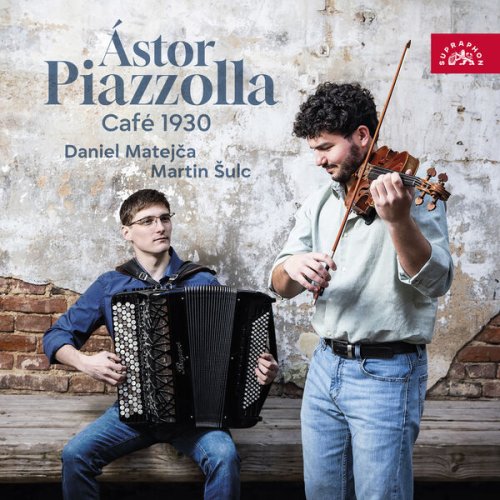
Artist: Daniel Matejča, Martin Šulc
Title: Piazzolla - Café 1930
Year Of Release: 2026
Label: SUPRAPHON a.s.
Genre: Classical
Quality: flac lossless (tracks) / flac 24bits - 192.0kHz +Booklet
Total Time: 00:56:45
Total Size: 263 mb / 1.95 gb
WebSite: Album Preview
TracklistTitle: Piazzolla - Café 1930
Year Of Release: 2026
Label: SUPRAPHON a.s.
Genre: Classical
Quality: flac lossless (tracks) / flac 24bits - 192.0kHz +Booklet
Total Time: 00:56:45
Total Size: 263 mb / 1.95 gb
WebSite: Album Preview
01. Ave Maria (Tanti anni prima)
02. Suite del Ángel: I. Introducción del Ángel
03. Suite del Ángel: II. Milonga del Ángel
04. Suite del Ángel: III. La Muerte del Ángel
05. Suite del Ángel: IV. Resurrección del Ángel
06. Histoire du Tango: I. Bordel 1900
07. Histoire du Tango: II. Café 1930
08. Histoire du Tango: III. Nightclub 1960
09. Histoire du Tango: IV. Concert d'aujourd'hui
10. Oblivion
12. Escualo
The fourth Supraphon album by the 21-year-old performer Daniel Matejča brings a change of genre. Following virtuosic sonatas by Eugène Ysaÿe (2023), a chamber music album with pianist Jan Schulmeister (Suk, Martinů, Fišer, 2025), and exciting concertos by Shostakovich and Prokofiev with the Prague Radio Symphony Orchestra and Tomáš Netopil (2025), the focus now turns to tango nuevo, inseparably associated with Ástor Piazzolla.
Besides the Argentine tango, his language as a composer reflects not only the contemporary classical music he studied in Paris under Nadia Boulanger, but also jazz and especially the music of Bach, which Piazzolla played on the bandoneon to the surprise of many people. On a map, Piazzolla would lie along an imaginary axis between Buenos Aires, Paris, and New York. It may well have been this breadth of inspiration that captivated Daniel Matejča, who plays piano and percussion as well as violin (not to mention the wide range of genres he performs) and the exceptional accordion player Martin Šulc, whose palette of colours ranges from intimacy to an almost orchestra fullness at times.
Their flawless ensemble is a given; what is more striking is the degree of freedom and expressivity they bring to it. Both suites (Suite del Ángel, Histoire du Tango) contain clearly audible echoes of Piazzolla’s studies in Paris. Of course, the album could not omit Ave Maria, Oblivion, Escualo, and Finale, irresistible works that alone would be enough to secure Piazzolla’s immortality. This recording by two young musicians captivated by the Argentine legend may well contribute to that lasting legacy.
![The Music Man 2022 Company & Orchestra & Patrick Vaccariello - Meredith Willson: The Music Man (The 2022 Broadway Cast Recording) (2022) [Hi-Res]](https://www.dibpic.com/uploads/posts/2026-08/1787894723_cover.jpg "The Music Man 2022 Company & Orchestra & Patrick Vaccariello - Meredith Willson: The Music Man (The 2022 Broadway Cast Recording) (2022) [Hi-Res]")
![Henry Threadgill - Cut You Where You Was (2026) [Hi-Res]](https://www.dibpic.com/uploads/posts/2026-08/1787757260_a2094249576_10.jpg "Henry Threadgill - Cut You Where You Was (2026) [Hi-Res]")
![Diego Figueiredo - Horse Blues (2026) [Hi-Res]](https://img.israbox.com/img/2026-08/27/vd30ixqwl41lb9x9mj2l0nh79.png "Diego Figueiredo - Horse Blues (2026) [Hi-Res]")