Kei Koito - J.S. Bach: Organ Masterworks, Vol. 6 (2026) [Hi-Res]
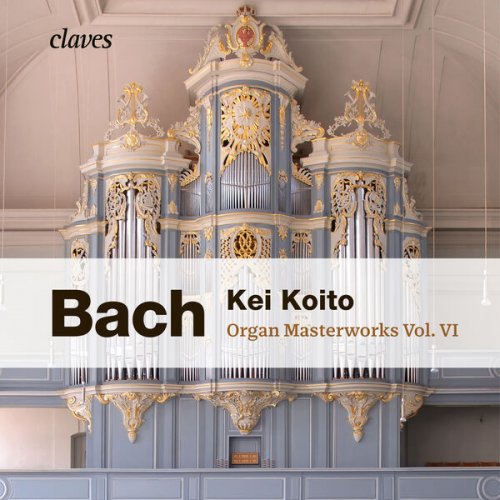
Artist: Kei Koito
Title: J.S. Bach: Organ Masterworks, Vol. 6
Year Of Release: 2026
Label: Claves Records
Genre: Classical Щкпфт
Quality: flac lossless (tracks) / flac 24bits - 192.0kHz
Total Time: 01:01:35
Total Size: 305 mb / 1.5 gb
WebSite: Album Preview
TracklistTitle: J.S. Bach: Organ Masterworks, Vol. 6
Year Of Release: 2026
Label: Claves Records
Genre: Classical Щкпфт
Quality: flac lossless (tracks) / flac 24bits - 192.0kHz
Total Time: 01:01:35
Total Size: 305 mb / 1.5 gb
WebSite: Album Preview
01. Fantasia in G Major, BWV 572 Pièce d'orgue: I. Trés vitement - II. Gravement - III. Lentement
02. Fugue in C Minor, BWV 575
03. 6 Schübler-Chorales, BWV 645–650 (Transcr. for Organ by J.S. Bach): No. 6, Kommst du nun, Jesu vom Himmel herunter auf Erden, BWV 650
04. 6 Schübler-Chorales, BWV 645–650 (Transcr. for Organ by J.S. Bach): No. 3, Wer nur den lieben Gott läßt walten, BWV 647
05. Prelude & Fugue in C Minor, BWV 546: I. Prelude
06. Prelude & Fugue in C Minor, BWV 546: II. Fugue
07. 6 Schübler-Chorales, BWV 645–650 (Transcr. for Organ by J.S. Bach): No. 1, Wachet auf, ruft uns die Stimme, BWV 645
08. 6 Schübler-Chorales, BWV 645–650 (Transcr. for Organ by J.S. Bach): No. 5, Ach, bleib’ bei uns, Herr Jesu Christ, BWV 649
09. Canonic Variations on Vom Himmel hoch, da komm’ ich her in C Major (Autograph Manuscript Version), BWV 769a: No. 1, Canon all’ottava
10. Canonic Variations on Vom Himmel hoch, da komm’ ich her in C Major (Autograph Manuscript Version), BWV 769a: No. 2, Canon alla quinta
11. Canonic Variations on Vom Himmel hoch, da komm’ ich her in C Major (Autograph Manuscript Version), BWV 769a: No. 3, Canto fermo in canone
12. Canonic Variations on Vom Himmel hoch, da komm’ ich her in C Major (Autograph Manuscript Version), BWV 769a: No. 4, Canon alla settima, Cantabile
13. Canonic Variations on Vom Himmel hoch, da komm’ ich her in C Major (Autograph Manuscript Version), BWV 769a: No. 5, Canon per augmentationem
14. Prelude & Fugue in C Major, BWV 545: I. Prelude
15. Prelude & Fugue in C Major, BWV 545: II. Fugue
16. 6 Schübler-Chorales, BWV 645–650 (Transcr. for Organ by J.S. Bach): No. 2, Wo soll ich fliehen hin, BWV 646
17. 6 Schübler-Chorales, BWV 645–650 (Transcr. for Organ by J.S. Bach): No. 4, Meine Seele erhebt den Herren, BWV 648
18. Fugue on Magnificat, Meine Seele erhebt den Herren, tonus peregrinus, BWV 733
19. Magnificat, BWV 243: No. 10, Suscepit Israel (Arr. for Organ by Kei Koito)
This work stands as a sublime testament to the young Bach during his Weimar period. Among the various sources, this recording is based on the title “Pièce d’Orgue à 5 avec la pedalle continu [sic]”. The date of this composition is subject to debate: G.B. Stauffer places the first version of the work between 1708 and 1712, J.-Cl. Zehnder during the first three years in Weimar (1708–1711), and S. Rampe even later. The revised version dates from around 1720, the main difference compared to the first version being an expansion of the first part of the triptych.
The work consists of three parts. The first part of the original version contains no tempo indication, but in the revised version, it is marked “très vitement” (very quickly). It is a manual solo, akin to a toccata introduction. Here, a long, sustained monodic melody – already containing the principal subject of the entire work – features a hexachord scale in diminution. This writing is in an improvised style, reminiscent of a passagio.
The second part begins with a surprising entry: a pedal attack on the tonic G. In the first version, it bears the indication Gayement (gaily), and in the revised version, Gravement (gravely). The manual part enters immediately after the initial pedal attack, weaving a five-voice polyphony over an alla breve pulse characterised by harmonic audacity featuring numerous appoggiaturas, likely inspired by French models, and including, among other things, the indication Grand plein jeu suggested by Jacques Boyvin in his two Livres d’orgue (Books of Organ Music, Paris, 1690 and 1700). This is a classic example of French stop combination emphasizing harmonic development while avoiding contrapuntal writing. However, in order to highlight the underlying counterpoint, particularly in the extraordinary tenor solo (successively baritenor/taille/haute-contre, bars 118 to 127), the performer opted rather for a combination of a mixture stop and a reed stop.
Several passages here reveal the connection between France and Italy. Also present is the great tradition of the “hexachord fantasy” from the 16th and 17th centuries, as found in the works by English virginalists, as well as in those of Sweelinck, Frescobaldi and Froberger with passages in durezze e ligature, creating rich, dissonant suspensions in a style of the “réunion des goûts” (union of tastes).
Harmonic tension increases from bar 157, reaching a climax on the dominant that spans nine bars and rises over two octaves. This section comes to a dramatic, abrupt end with a broken cadence on a diminished seventh chord.
The low B note on the pedal (bar 94) was not present on all organs known to Bach. It existed on French organs with an extended pedalboard (ravalement) or on many harpsichords. It reappears later in the Ricercare a 6 from The Musical Offering and in The Art of Fugue.
The third part consists of broken-chord arpeggios with acciaccatura, accompanied by a chromatic descent in long values played on the pedal. This section leads to a climax on the dominant before the long-awaited final cadence triumphs with the main subject of the hexachord scale in diminution. This third part bears the indication Lentement (slowly), whereas in the revised version, there is no tempo indication.
This final section is a creation unique to the young Bach. His bold use of repetitive motifs, as well as the idea of mobility within immobility and/or immobility within mobility, foreshadows some of today’s minimalist composers. It is plausible that this highly original idea might be a kind of response to the music-theoretical disputes between J. Mattheson and J.H. Buttstedt in the second decade of the 18th century, with a view to promoting the modern system. With the Pièce d’orgue, Bach could thus be supporting Mattheson’s progressive stance.
![101 Strings Orchestra - 60's Style (2014-2026 Remaster from the Original Alshire Tapes) (1976) [Hi-Res]](https://img.israbox.com/img/2026-08/30/0hwcqz4gwqfp1wc4d9hgqm2uf.jpg "101 Strings Orchestra - 60's Style (2014-2026 Remaster from the Original Alshire Tapes) (1976) [Hi-Res]")
![Candice Hoyes - Expecting (2026) [Hi-Res]](https://www.dibpic.com/uploads/posts/2026-08/1787889790_cover.jpg "Candice Hoyes - Expecting (2026) [Hi-Res]")