Roberto Gini, Guido Andreolli, Mara Galassi - Viola Da Gamba - Diego Ortiz: Glosas (1553) (2026) [Hi-Res]
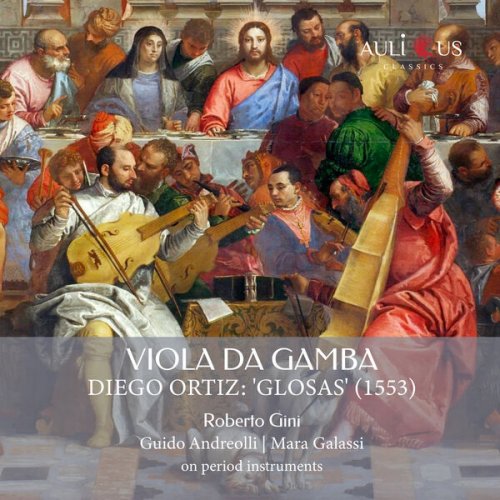
Artist: Roberto Gini, Guido Andreolli, Mara Galassi
Title: Diego Ortiz: Glosas (1553)
Year Of Release: 2026
Label: Aulicus Classics
Genre: Classical
Quality: flac lossless (tracks) / flac 24bits - 48.0kHz +Booklet
Total Time: 01:12:38
Total Size: 437 / 852 mb
WebSite: Album Preview
TracklistTitle: Diego Ortiz: Glosas (1553)
Year Of Release: 2026
Label: Aulicus Classics
Genre: Classical
Quality: flac lossless (tracks) / flac 24bits - 48.0kHz +Booklet
Total Time: 01:12:38
Total Size: 437 / 852 mb
WebSite: Album Preview
01. Recercada Fantasia Primera
02. Recercada Fantasia Segunda
03. Recercada Fantasia Tercera
04. Recercada Fantasia Quarta
05. Recercada Primera sobre La Spagna
06. Recercada Segunda sobre La Spagna
07. Recercada Tercera sobre La Spagna
08. Recercada Quarta sobre La Spagna
09. Recercada Quinta sobre La Spagna
10. Recercada Sesta sobre La Spagna
11. Recercada Primera sobre O felici occhi miei
12. Recercada Segunda sobre O felici occhi miei
13. Recercada Tercera sobre O felici occhi miei
14. Recercada Quarta, que es una quinta boz, sobre O felici occhi miei
15. Recercada Primera sobre Doulce memorie
16. Recercada Segunda sobre Doulce memorie
17. Recercada Tercera sobre Doulce memorie
18. Recercada Quarta, que es una quinta boz, sobre Doulce memorie
19. Recercada Primera sobre Tenores Italianos, Pass'e mezzo antico
20. Recercada Segunda sobre Tenores Italianos, Pass'e mezzo moderno
21. Recercada Tercera sobre Tenores Italianos
22. Recercada Quarta sobre Tenores Italianos, Guardame las vacas
23. Recercada Quinta sobre Tenores Italianos, Pass'e mezzo antico
24. Recercada Sesta sobre Tenores Italianos
25. Recercada Settima sobre Tenores Italianos, Romanesca
26. Recercada Ottava sobre Tenores Italianos, Guardame las vacas
27. Quinta pars sobre l'Aria di Ruggiero
28. Diferencias sobre el Canto del Caballero
29. Recercada sobre Donne leggiadre e belle (after Jacques Arcadelt)
30. Recercada sobre Con lagrime e sospir (after Jacques Arcadelt)
31. Recercada sobre Ancidetemi pur (after Jacques Arcadelt)
32. Recercada sobre Ancor che col partire (after Cipriano De Rore)
If we do not place musical studies within the broader context of the History of Art (adding them to the figurative or fine arts such as rhetoric, poetry, architecture, theatre, as well as cinema), our perception of musical language remains limited, and our understanding of what we perform or listen to will be incomplete. This is especially true for distant historical periods such as the Renaissance and the early Baroque, when the close kinship of the sister-arts was decisive and should not be overlooked by us musicians. Within the European urban landscape, historical buildings of all types, both monumental and ordinary, have recognizable forms and proportions, but are characterised above all by different types of ornamentation. Without such features, walls are ultimately reduced to the flat vertical surfaces of a covered, multi-level structure, in both form and function; these, in turn, are subdivided into rooms connected by access passages, with openings to the outside world for air and light. Unadorned buildings, therefore, present constant functional features that make them similar, if not identical, to one another. They are distinguished, however, by the style with which such openings and apertures are designed and decorated in various eras, by the materials used, by the forms given to the openings in the walls (main doorways, internal doors, and windows), by the decorative ornaments, and by the mural adornments.
![Heidi Martin - ATTUNEMENT (2026) [Hi-Res]](https://www.dibpic.com/uploads/posts/2026-08/1787748479_zqr4b1f9lp366_600.jpg "Heidi Martin - ATTUNEMENT (2026) [Hi-Res]")
![Miguel Zenón & Luis Perdomo - El Arte Del Bolero, Vol. 3 (2026) [Hi-Res]](https://www.dibpic.com/uploads/posts/2026-08/1787856549_cover.jpg "Miguel Zenón & Luis Perdomo - El Arte Del Bolero, Vol. 3 (2026) [Hi-Res]")
![Dos Santos - Es Amor (2026) [Hi-Res]](https://img.israbox.com/img/2026-08/27/01zwg61342s1i48xgyhm7u1fv.jpg "Dos Santos - Es Amor (2026) [Hi-Res]")

![Blossom Dearie - Saga All Stars: Plus je t'embrasse (Selected Tracks 1956-1958) (2026) [Hi-Res]](https://img.israbox.com/img/2026-08/27/esnkc9fjbzylc6gfu7ykbrijk.jpg "Blossom Dearie - Saga All Stars: Plus je t'embrasse (Selected Tracks 1956-1958) (2026) [Hi-Res]")