August Seider - Edition Singers of the Past: Arien, Szenen und Lieder (2026) [Hi-Res]
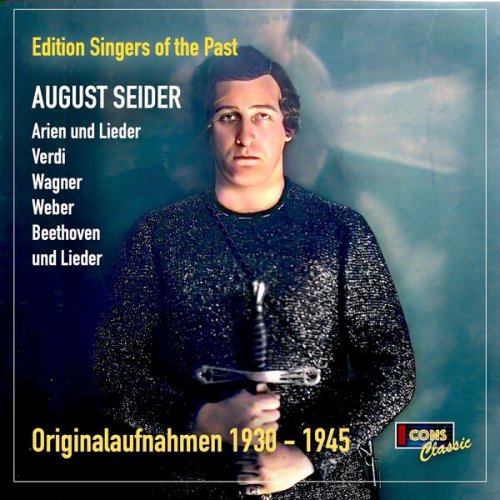
Artist: August Seider
Title: Edition Singers of the Past: Arien, Szenen und Lieder
Year Of Release: 2026
Label: Icons
Genre: Classical
Quality: FLAC (tracks) [48kHz/24bit]
Total Time: 1:58:35
Total Size: 999 / 426 MB
WebSite: Album Preview
Tracklist:Title: Edition Singers of the Past: Arien, Szenen und Lieder
Year Of Release: 2026
Label: Icons
Genre: Classical
Quality: FLAC (tracks) [48kHz/24bit]
Total Time: 1:58:35
Total Size: 999 / 426 MB
WebSite: Album Preview
Disc 1
1. Lohengrin, WWV 75 (Excerpts): Grahlserzählung (05:18)
2. Tristan und Isolde, WWV 90 (Excerpts): Szene aus dem 2. Akt: Soll ich lauschen? (26:55)
3. Fidelio, Op. 72 (Excerpts): Szene und Arie des Florestan: Gott, welch Dunkel hier (06:13)
4. Fidelio, Op. 72 (Excerpts): Euch werde Lohn in bessern Welten (06:28)
5. Fidelio, Op. 72 (Excerpts): Finale: Heil sei dem Tag, heil sei der Stunde (13:54)
Disc 2
1. Aïda (Excerpts): Holde Aida (04:38)
2. Rigoletto (Excerpts): Freundlich blick ich (01:33)
3. Rigoletto (Excerpts): Ich seh' die heißen Zähren (02:13)
4. Rigoletto: O wie so trügerisch (02:02)
5. Der Troubadour (Excerpts) [Sung in German]: Stretta: Lodern zum Himmel (01:21)
6. Cavalleria rusticana (Excerpts): Siciliana: O Lola rosengleich blüh'n deine Wangen (01:48)
7. Cavalleria rusticana (Excerpts): Trinklied: Schäumt der süße Wein im Becher (01:33)
8. Cavalleria rusticana (Excerpts): Abschied von der Mutter: Mutter, der Rote war allzu feurig (03:01)
9. Tosca (Excerpts): Wie sich die Bilder gleichen (02:01)
10. Tosca (Excerpts): Und es blitzten die Sterne (03:08)
11. Carmen (Excerpts): Blumenarie: Hier an dem Herz treu geborgen (02:55)
12. Margarethe (Excerpts): Cavatine: Gegrüßt sei mir, o heil'ge Stätte (03:45)
13. Mignon (Excerpts): Leb wohl, Mignon (02:46)
14. Der Postillon von Lonjumeau (Excerpts): Freunde, vernehmet die Geschichte (02:44)
15. Der Freischütz (Excerpts), Op. 277: Arie des Max: Nein, länger trag' ich nicht die Qualen - Durch die Wälder, durch die Auen (07:01)
16. Die lustigen Weiber von Windsor (Excerpts): Arie des Fenton: Horch, die Lerche singt im Hain (02:28)
17. Am Rhein bei Sankt Goar (02:23)
18. Ein rheinisches Mädchen bei rheinischem Wein (03:17)
19. Rheinische Rebe, rheinischer Wein (02:35)
20. Die große Attraktion: Was wär' ich ohne euch, ihr wunderschönen Frau'n (03:30)
21. Die große Attraktion: Du warst mir ein Roman (02:55)
August Seider was one of those brilliant heldentenors whose powerful yet refined voices defined the great opera stages of the 20th century. He is often described as a "singer of the golden mean"—someone who possessed the monumental force of a Wagnerian tenor without sacrificing lyrical grace.
From 1930 to 1945, he was the celebrated principal heldentenor of the Leipzig Opera, where he was awarded the title of Kammersänger (chamber singer). He made guest appearances at the Vienna State Opera, the Salzburg Festival, and even at the legendary Teatro Colón in Buenos Aires. Later, as a long-standing member of the Bavarian State Opera in Munich, he was a pillar of the ensemble until his retirement from the stage.
August Seider left a particularly lasting impression in the roles of Richard Wagner. Whether as the radiant Lohengrin, the passionate Walther von Stolzing in Die Meistersinger von Nürnberg, or the tragic Erik in Der Fliegende Holländer – Seider understood how to imbue heroic figures with human depth and warmth.
He also shone outside of Wagner, for example as Max in Carl Maria von Weber's Der Freischütz, a role in which he was praised for his "noble and well-balanced" interpretation.
His unmistakable voice is characterized by its clear diction and an almost forgotten, aristocratic serenity. August Seider may be a name known only to connoisseurs today, but in the history of German tenor singing, he remains one of the great, reliable, and profoundly musical figures.
From 1930 to 1945, he was the celebrated principal heldentenor of the Leipzig Opera, where he was awarded the title of Kammersänger (chamber singer). He made guest appearances at the Vienna State Opera, the Salzburg Festival, and even at the legendary Teatro Colón in Buenos Aires. Later, as a long-standing member of the Bavarian State Opera in Munich, he was a pillar of the ensemble until his retirement from the stage.
August Seider left a particularly lasting impression in the roles of Richard Wagner. Whether as the radiant Lohengrin, the passionate Walther von Stolzing in Die Meistersinger von Nürnberg, or the tragic Erik in Der Fliegende Holländer – Seider understood how to imbue heroic figures with human depth and warmth.
He also shone outside of Wagner, for example as Max in Carl Maria von Weber's Der Freischütz, a role in which he was praised for his "noble and well-balanced" interpretation.
His unmistakable voice is characterized by its clear diction and an almost forgotten, aristocratic serenity. August Seider may be a name known only to connoisseurs today, but in the history of German tenor singing, he remains one of the great, reliable, and profoundly musical figures.
![Morgan Noise - Something built, Something remembered (2026) [Hi-Res]](https://img.israbox.com/img/2026-08/30/zni7k6ltgry3j6mxyts52q2ob.jpg "Morgan Noise - Something built, Something remembered (2026) [Hi-Res]")
![VA - The Art of HiFi Vol. 6: Guitars (2024) [DXD]](https://www.dibpic.com/uploads/posts/2026-08/1787932559_oct0054.jpg "VA - The Art of HiFi Vol. 6: Guitars (2024) [DXD]")

![VA - The Art of HiFi Vol. 2: Soundstage (2023) [DSD256]](https://www.dibpic.com/uploads/posts/2026-08/1787843549_oct0034.jpg "VA - The Art of HiFi Vol. 2: Soundstage (2023) [DSD256]")
![Oscar Peterson - World Tour (2026) [Hi-Res]](https://www.dibpic.com/uploads/posts/2026-08/1787665953_folder.jpg "Oscar Peterson - World Tour (2026) [Hi-Res]")