Berliner Philharmoniker, Herbert von Karajan - Bruckner: Symphony No. 4 "Romantic", Symphony No. 7 (Remastered 2026) [SACD]
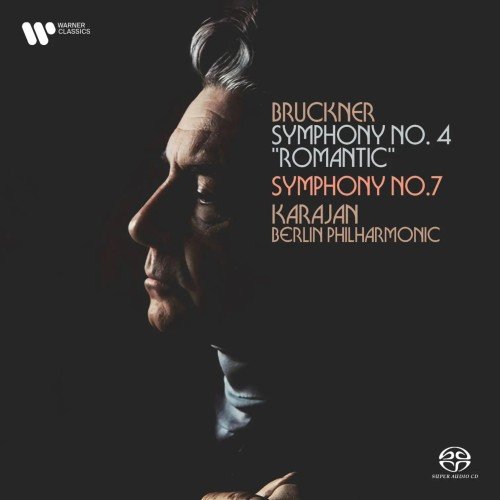
Artist: Berliner Philharmoniker, Herbert von Karajan
Title: Bruckner: Symphony No. 4 "Romantic", Symphony No. 7
Year Of Release: 2026
Label: Warner Classics
Genre: Classical
Quality: DSD64 image (*.iso) / 2.0 (2,8 MHz/1 Bit)
Total Time: 02:18:06
Total Size: 5.5 GB
WebSite: Album Preview
Tracklist:Title: Bruckner: Symphony No. 4 "Romantic", Symphony No. 7
Year Of Release: 2026
Label: Warner Classics
Genre: Classical
Quality: DSD64 image (*.iso) / 2.0 (2,8 MHz/1 Bit)
Total Time: 02:18:06
Total Size: 5.5 GB
WebSite: Album Preview
Disc 1
Symphony No. 4 in E-flat major "Romantic" (1880 Version, Ed. Haas)
01. I. Bewegt, nicht zu schnell (20:49)
02. II. Andante quasi allegretto (15:35)
03. III. Scherzo: Bewegt - Trio: Nicht zu schnell (10:41)
04. IV. Finale: Bewegt, doch nicht zu schnell (23:08)
Disc 2
Symphony No. 7 in E major, WAB 107 (Ed. Haas)
01. I. Allegro moderato (21:41)
02. II. Adagio: Sehr feierlich und sehr langsam (22:52)
03. III. Scherzo: Sehr schnell - Trio: Etwas langsamer (10:28)
04. IV. Finale: Bewegt, doch nicht schnell (12:52)
These recordings exemplify Karajan’s mastery of the expansive forms and extensive forces of late Romanticism. The two Bruckner symphonies recorded in 1970 and 1971 show just how much the orchestra’s musical signature had changed since the recordings of the 195
These recordings exemplify Karajan’s mastery of the expansive forms and extensive forces of late Romanticism. The two Bruckner symphonies recorded in 1970 and 1971 show just how much the orchestra’s musical signature had changed since the recordings of the 1950s. The pitch had historically always been a little higher in Berlin, but under Karajan’s leadership the orchestra critically lightened its palette, finding a balance in the medium high range that was absolutely foreign to the Germanic tradition. In Berlin, Karajan was drawing straight lines, unbending verticals, clear designs, smooth slopes, and building his orchestra up layer by layer, developing a strategy for the sound he was after, aided by the supremely legato playing of his string section. In addition to this, any soloistic leanings had been eliminated: the Philharmonic now played as a single instrument, and when the recordings of the 1970s were released more than one music-lover compared it to an organ. Absolute harmony was achieved in the above-mentioned Bruckner symphonies Nos. 4 and 7, the sheer perfection of whose sound is almost unearthly.
These recordings exemplify Karajan’s mastery of the expansive forms and extensive forces of late Romanticism. The two Bruckner symphonies recorded in 1970 and 1971 show just how much the orchestra’s musical signature had changed since the recordings of the 1950s. The pitch had historically always been a little higher in Berlin, but under Karajan’s leadership the orchestra critically lightened its palette, finding a balance in the medium high range that was absolutely foreign to the Germanic tradition. In Berlin, Karajan was drawing straight lines, unbending verticals, clear designs, smooth slopes, and building his orchestra up layer by layer, developing a strategy for the sound he was after, aided by the supremely legato playing of his string section. In addition to this, any soloistic leanings had been eliminated: the Philharmonic now played as a single instrument, and when the recordings of the 1970s were released more than one music-lover compared it to an organ. Absolute harmony was achieved in the above-mentioned Bruckner symphonies Nos. 4 and 7, the sheer perfection of whose sound is almost unearthly.
![Berliner Philharmoniker, Herbert von Karajan - Bruckner: Symphony No. 4 "Romantic", Symphony No. 7 (Remastered 2026) [SACD]](https://www.dibpic.com/uploads/posts/2026-07/1783319900_back.jpg)
![Adam Bałdych - Endless (2026) [Hi-Res]](https://www.dibpic.com/uploads/posts/2026-08/1787664423_folder.jpg "Adam Bałdych - Endless (2026) [Hi-Res]")
![The John Payne Band - Bedtime Stories (1976) [Hi-Res]](https://www.dibpic.com/uploads/posts/2026-08/1787861782_cover.jpg "The John Payne Band - Bedtime Stories (1976) [Hi-Res]")
![Cuadra Collective, Christian Cuadra - Väst (2026) [Hi-Res]](https://www.dibpic.com/uploads/posts/2026-08/1787745959_o026jqwpy6vj5_600.jpg "Cuadra Collective, Christian Cuadra - Väst (2026) [Hi-Res]")
![Elipsis, Michael League, Pedrito Martinez, Antonio Sánchez - Elipsis (2026) [Hi-Res]](https://www.dibpic.com/uploads/posts/2026-08/1787636927_u117d6w7oejvc_600.jpg "Elipsis, Michael League, Pedrito Martinez, Antonio Sánchez - Elipsis (2026) [Hi-Res]")
![matahari sons - Sol en Berlin (2026) [Hi-Res]](https://img.israbox.com/img/2026-08/27/liphdh62asdoa57stjteqmcdz.jpg "matahari sons - Sol en Berlin (2026) [Hi-Res]")