Richard Lester - Haydn: Six Keyboard Works (2009)
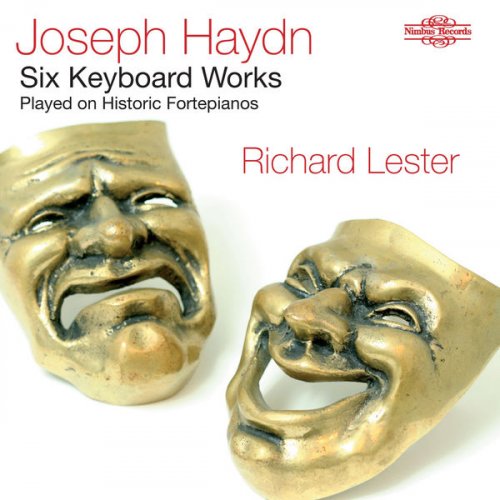
Artist: Richard Lester
Title: Haydn: Six Keyboard Works
Year Of Release: 2009
Label: Nimbus Records
Genre: Classical
Quality: flac lossless (tracks)
Total Time: 01:14:22
Total Size: 297 mb
WebSite: Album Preview
TracklistTitle: Haydn: Six Keyboard Works
Year Of Release: 2009
Label: Nimbus Records
Genre: Classical
Quality: flac lossless (tracks)
Total Time: 01:14:22
Total Size: 297 mb
WebSite: Album Preview
01. Keyboard Sonata in D Major, Hob.XVI:37: I. Allegro con brio
02. Keyboard Sonata in D Major, Hob.XVI:37: II. Largo e sostenuto
03. Keyboard Sonata in D Major, Hob.XVI:37: III. Finale. Presto ma non troppo
04. Keyboard Sonata in G Major, Hob.XVI:27: I. Allegro con brio
05. Keyboard Sonata in G Major, Hob.XVI:27: II. Menuet
06. Keyboard Sonata in G Major, Hob.XVI:27: III. Presto
07. Keyboard Sonata in C Major, Hob.XVI:35: I. Allegro con brio
08. Keyboard Sonata in C Major, Hob.XVI:35: II. Adagio
09. Keyboard Sonata in C Major, Hob.XVI:35: III. Finale. Allegro
10. Keyboard Sonata in F Major, Hob.XVI:23: I. Moderato
11. Keyboard Sonata in F Major, Hob.XVI:23: II. Adagio
12. Keyboard Sonata in F Major, Hob.XVI:23: III. Finale. Presto
13. Parthia in E-Flat Major, Hob. XVI Es3: I. Moderato
14. Parthia in E-Flat Major, Hob. XVI Es3: II. Menuetto
15. Divertimento in A-Flat Major, Hob.XVI:46: I. Allegro moderato
16. Divertimento in A-Flat Major, Hob.XVI:46: II. Adagio
17. Divertimento in A-Flat Major, Hob.XVI:46: III. Finale. Presto
British keyboardist Richard Lester, known above all for his superb cycle of Scarlatti's sonatas, tends to use a variety of instruments, even when covering a unified repertoire. He is one of the few performers to have occasionally played Scarlatti on the organ, for instance, and he gave good reasons, both historical and musical, for doing so. He doesn't so much try to match an instrument to the one the composer would have been using in creating the piece as use different instruments to illuminate currents in the music. There's a lot to be said for this approach, for musical ideas can often precede the technical means builders to devise to execute them, rather than the other way around. Ike Turner, it is said, played a guitar into an inverted toilet bowl on recordings well in advance of the invention of the reverb pedal. At any rate, it's not clear when Haydn began using a fortepiano, although he probably heard them sooner than Mozart did. The earlier sonatas among this group probably lack dynamic markings in their scores, which would seem to suggest that they were played on the harpsichord, or at least that publishers wanted to make sure they could be marketed that way. Yet Lester's recordings make a good case for the idea that, whether Haydn was using a fortepiano or not, he was writing music that could benefit from one. Examples occur in both the outer movements of these sonatas, where Lester punctuates Haydn's well-defined sonata forms with sharp little flourishes at the sectional junctures, and in the slow movements, where sustained, natural Italianate melody is made to seem perfectly comfortable on the fortepiano keyboard. Lester uses two fortepianos, one by Viennese maker Johann Schanz with a nicely exploited knee-activated volume moderato, and one an earlier Italian model with an especially gentle voice. Several of the pieces are rarities; the early Parthia in E flat major, Hob. 16/Es3, does not even claim a consensus that Haydn was the composer, but in Lester's hands its compact forms and sudden modulations seem to make him a very likely candidate. Lester's brilliant passagework makes Haydn sound a bit like Scarlatti sometimes, and there are other ways of phrasing these early- and middle-period sonatas. But these performances are musically persuasive all the way through.
![Emma Rawicz - Paintbox (2026) [Hi-Res]](https://www.dibpic.com/uploads/posts/2026-08/1787846835_cover.jpg "Emma Rawicz - Paintbox (2026) [Hi-Res]")
![The Music Man 2022 Company & Orchestra & Patrick Vaccariello - Meredith Willson: The Music Man (The 2022 Broadway Cast Recording) (2022) [Hi-Res]](https://www.dibpic.com/uploads/posts/2026-08/1787894723_cover.jpg "The Music Man 2022 Company & Orchestra & Patrick Vaccariello - Meredith Willson: The Music Man (The 2022 Broadway Cast Recording) (2022) [Hi-Res]")
![Marcelo Galter - Marcelo Galter investiga a beleza sem fim de Dorival Caymmi (2026) [Hi-Res]](https://www.dibpic.com/uploads/posts/2026-08/1787803994_dvycawhe2s4gg_600.jpg "Marcelo Galter - Marcelo Galter investiga a beleza sem fim de Dorival Caymmi (2026) [Hi-Res]")
![Blossom Dearie - Saga All Stars: Plus je t'embrasse (Selected Tracks 1956-1958) (2026) [Hi-Res]](https://img.israbox.com/img/2026-08/27/esnkc9fjbzylc6gfu7ykbrijk.jpg "Blossom Dearie - Saga All Stars: Plus je t'embrasse (Selected Tracks 1956-1958) (2026) [Hi-Res]")
![Tony Bennett - Saga All Stars: Jazz! (Selected Tracks 1954-1959) (2026) [Hi-Res]](https://img.israbox.com/img/2026-08/27/a7hmylo96sui0vk8lkh0zyk4f.jpg "Tony Bennett - Saga All Stars: Jazz! (Selected Tracks 1954-1959) (2026) [Hi-Res]")