Lionel Desmeules - Froberger: Organiste de l’Empereur (2026) [Hi-Res]
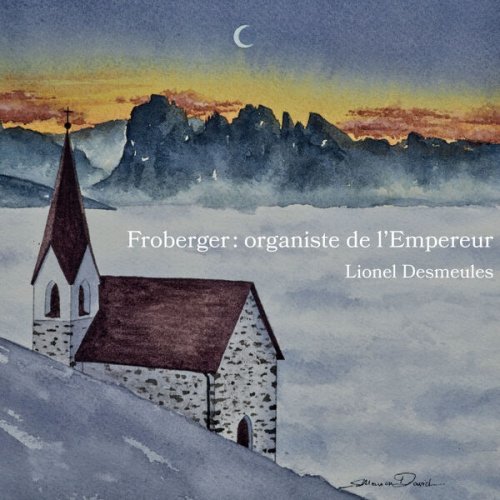
Artist: Lionel Desmeules
Title: Froberger: Organiste de l’Empereur
Year Of Release: 2026
Label: VDE-GALLO
Genre: Classical Organ
Quality: flac lossless (tracks) / flac 24bits - 96.0kHz
Total Time: 01:02:23
Total Size: 311 mb / 1.1 gb
WebSite: Album Preview
TracklistTitle: Froberger: Organiste de l’Empereur
Year Of Release: 2026
Label: VDE-GALLO
Genre: Classical Organ
Quality: flac lossless (tracks) / flac 24bits - 96.0kHz
Total Time: 01:02:23
Total Size: 311 mb / 1.1 gb
WebSite: Album Preview
01. Toccata II in D Minor, FbWV 102
02. Canzona II in G Minor, FbWV 302
03. Toccata XX in A Minor, FbWV 120
04. Ricercar VII in D Minor, FbWV 407
05. Capriccio XVI in F Major, FbWV 516
06. Fantasia I sopra Ut-Re-Mi-Fa-Sol-La, FbWV 201
07. Canzona V in C Major, FbWV 305
08. Toccata XI in E Minor, FbWV 111
09. Fantasia IV sopra Sol-La-Re, FbWV 204
10. Capriccio VI in C Major, FbWV 506
11. Toccata XVI in C Major, FbWV 116
Aside from a few vocal pieces, Johann Jakob Froberger’s work is divided into two categories: on the one hand, pieces of French inspiration, usually played on the harpsichord, and on the other, pieces of Italian inspiration, performed on both the harpsichord and the organ. The works featured in our programme are drawn from this latter category.
Our aim is by no means to be exhaustive—although it so happens that every musical form explored by the composer is represented here—but rather to admire each piece as a work in itself. The whole programme is also a coherent entity. Rather than describing every detail, we are invited to traverse the programme as though it were a path through a mountain landscape… a monticidium Frobergeri. Let us take up our Alpenstock and set out.
Everything begins with the luminous Toccata in D, FbWV 102. It follows the typical structure of the toccatas Froberger encountered during his stays in Rome. One of the composer’s charming quirks is the unmarked notation of the battuta allegra. At its heart, the piece resembles a magnificent oak tree sculpted by time.
Two more extravagant works follow. The Canzona in G, FbWV 302, while moving away from the Canzona alla francese—whose subject traditionally derives from the French decasyllabic verse—introduces chromatic writing from its very first section. The Toccata in A, FbWV 120 extends the preceding Canzona by enclosing its extravagances within a grave form. The second fugued section leads the listener into a maze of branches and leaves stirred by the wind. Around the oak’s trunk, ivy has entwined itself.
![Warne Marsh Quartet - Music For Prancing (1957) [2009] Hi-Res](https://www.dibpic.com/uploads/posts/2026-10/1791823835_cover.jpg "Warne Marsh Quartet - Music For Prancing (1957) [2009] Hi-Res")
![Johnny Hartman - I Just Dropped By To Say Hello (1963) [2026 SACD]](https://www.dibpic.com/uploads/posts/2026-10/1791717737_ff.jpg "Johnny Hartman - I Just Dropped By To Say Hello (1963) [2026 SACD]")