Paul Harrison - Encontros (2026)
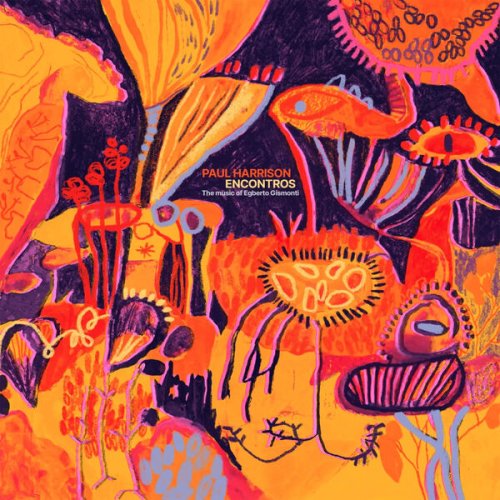
Artist: Paul Harrison
Title: Encontros
Year Of Release: 2026
Label: Harriphonic
Genre: Jazz
Quality: mp3 320 kbps / flac lossless (tracks)
Total Time: 00:52:23
Total Size: 122 / 266 mb
WebSite: Album Preview
TracklistTitle: Encontros
Year Of Release: 2026
Label: Harriphonic
Genre: Jazz
Quality: mp3 320 kbps / flac lossless (tracks)
Total Time: 00:52:23
Total Size: 122 / 266 mb
WebSite: Album Preview
01. Ano Zero
02. Palhaço
03. Transition
04. Lôro
05. Meninas
06. Karatê
07. Bianca
08. O Sonho
09. Illuminada
10. Sete Aneis
11. A Fala Da Paixão
To understand the gravity of what Paul Harrison has attempted on Encontros, you first have to reckon with Egberto Gismonti himself. Now in his late seventies, the Brazilian composer sits among the most singular figures in twentieth-century music — a Carmo-born polymath who studied piano in Rio from age six, then went to Paris to learn modernism with Jean Barraqué (a Webern disciple) and Nadia Boulanger, the legendary teacher of Copland, Glass and Piazzolla. Boulanger famously sent him home: write Brazil, she said. He did, and the result was a body of work — more than seventy albums, many on ECM — that braids Amazonian batuque, Carioca samba and choro, northeastern frevo and baião with classical rigour and jazz freedom. Yo-Yo Ma, John McLaughlin, Charlie Haden and Jan Garbarek have all played his music. To take it on, as producer George Klabin put it when commissioning Eddie Daniels’ Grammy-nominated Heart of Brazil (2018), is like trying to repaint a Picasso.
That Daniels record stands as the most prominent recent tribute, with Ted Nash’s arrangements and the Harlem Quartet hauling Gismonti’s pre-ECM EMI material into a chamber-jazz idiom — his ‘Maracatu’, opening with col legno strings and Mauricio Zottarelli’s drumming, was indeed spectacular. Bianca Gismonti’s Gismonti 70, recorded for her father’s seventieth and released in 2025, took a daughter’s view. Harrison’s project sits between those poles: neither American studio polish nor familial intimacy, but a Scottish jazz pianist’s honest grappling with material that, as he readily admits, isn’t jazz in the standard melody-solo-melody sense.
Harrison’s qualifications for this are deeper than they look. A Manchester-born, Edinburgh-educated classical pianist (Tovey Memorial Prize) who turned to jazz, he has spent two decades at the level where technique becomes invisible — sideman to Chris Potter, David Binney and Bobby Watson, a long association with Tommy Smith’s SNJO, the 2009 Scottish Jazz Award for Best Pianist, the Hospitalfield Suite, William Soutar settings, and the freely improvised electronics of Herschel 36. Gramophone has placed him alongside Gwilym Simcock and Ivo Neame. He also teaches at the Royal Conservatoire of Scotland — and you can hear that pedagogical patience in how he refuses to flatten Gismonti’s structures into bop convention.
The Trio Magico nucleus — Harrison with Brazilian bassist Mario Lima Caribé and drummer Stu Brown — anchors the record, but the guests transform it. Paris-based percussionist Edmundo Carneiro (a Tania Maria, Ivan Lins and Baden Powell veteran) brings the rhythmic literacy a non-Brazilian band needs, and his presence is felt immediately on the opening Ano Zero, which Harrison sets up as a statement of intent rather than a warm-up. Palhaço, the clown-themed piece Gismonti has recorded countless times on both piano and guitar (most famously in solo form), is here pared back to a duet between Harrison and saxophonist Laura Macdonald — a former Berklee student of Bill Pierce, recent Scottish Jazz Instrumentalist of the Year and now Head of Jazz at the Conservatoire — whose work with Venezuelan pianist Leo Blanco taught her exactly the idiomatic care this melody demands. Lôro, originally a centrepiece of Gismonti’s 1981 Sanfona with the Academia de Danças band, becomes an exhilarating canter under Rachel Lightbody’s wordless vocal — Flora Purim territory, glided rather than scatted. Meninas allows Macdonald the freedom to expand the group; Karatê, a guitar-driven folk dance in the original, is reimagined on Harrison’s melodica, all manic, bursting energy before the piano joins the chase with those expected folkloric rhythms of Brazil.
Side B opens with O Sonho, a delicately uplifting vocal piece from Gismonti’s 1969 self-titled debut, here pushed firmly into ensemble jazz with Macdonald’s bluesy alto trading against Harrison’s bouncing piano — the most overtly jazz moment on a record that mostly resists the label. Bianca — originally taken from Gismonti’s 1984 duo album Duas Vozes with Naná Vasconcelos, which featured nothing but voice and clapping — receives the album’s most radical re-imagining, with Fraser Fifield’s low D whistle giving it an ethereal, almost Celtic plaintiveness that quietly acknowledges Harrison’s adopted home. Cellist Su-a Lee adds further textural depth across the record. Sete Aneis lets the trio stretch out before Harrison closes alone with A Fala Da Paixão, a mysterious, tender solo piano reading, caught in the studio before the other musicians arrived — a private moment that Gismonti himself, in his endorsement of the album, recognised as having ‘humour, grace, freedom to play’.
That endorsement matters. Encontros succeeds because Harrison has done the unglamorous work: studied the source recordings, resisted the temptation to jazz up structures that already work, and trusted his collaborators to bring their own histories to the music. Less a tribute than a conversation, it earns its place beside Daniels and Bianca Gismonti without competing with either.
![Warne Marsh Quartet - Music For Prancing (1957) [2009] Hi-Res](https://www.dibpic.com/uploads/posts/2026-10/1791823835_cover.jpg "Warne Marsh Quartet - Music For Prancing (1957) [2009] Hi-Res")