Hyperion Knight - Gershwin by Knight (2015) [DSD]
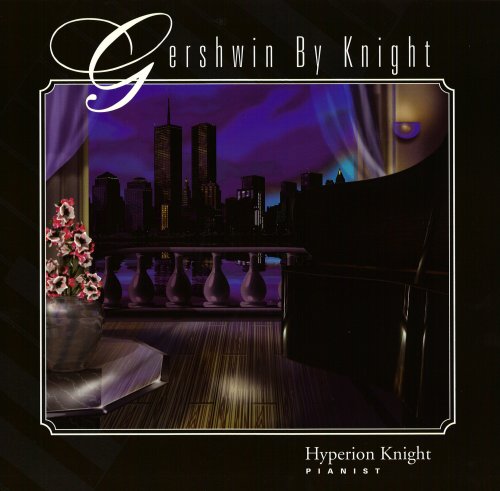
Artist: Hyperion Knight
Title: Gershwin by Knight
Year Of Release: 2015
Label: Wilson Audiophile Recordings
Genre: Classical, Jazz
Quality: DSD64 (*.dsf) tracks / 2.0 > 1-bit/2.8224 MHz
Total Time: 00:48:54
Total Size: 1,0 GB (+3%rec.)
WebSite: Album Preview
Gershwin by Knight with pianist Hyperion Knight is an Analog Master Tape to Stereo DSD transfer from Wilson Audio. The transfer was done by Bruce Brown at Puget Sound Studios using an EMM Labs Inc. Analog to Digital Converter designed by Ed Meitner.Title: Gershwin by Knight
Year Of Release: 2015
Label: Wilson Audiophile Recordings
Genre: Classical, Jazz
Quality: DSD64 (*.dsf) tracks / 2.0 > 1-bit/2.8224 MHz
Total Time: 00:48:54
Total Size: 1,0 GB (+3%rec.)
WebSite: Album Preview
The music brought together on Gershwin by Knight represents many of the most popular of George Gershwin’s creations. Earl Wild’s Virtuoso Etudes are transcriptions of some of the most beloved Gershwin songs of the early American theatre. These, along with Wild’s “Fantasy on Porgy and Bess,” and Gershwin’s own arrangement of “Rhapsody In Blue,” trace Gershwin’s evolution from a commercially successful song writer to a composer of serious intent who was quite conscious of his posterity.
The songs “I Got Rhythm” and “Embraceable You” (from the 1930 show “Girl Crazy”), as well as “The Man I Love” and “Fascinating Rhythm” (written for “Lady Be Good” of 1924), were conceived for a musical theatre which had yet to achieve its current level of sophistication. There was no real relationship between the songs used and the narrative of the show (songs were, in fact, often used interchangeably). The American musical theatre as we know it today, a synthesis of music, dialogue, and song (much like early German comic opera), was foreshadowed in Showboat, but only came to maturity with the work of Rodgers and Hammerstein.
“Rhapsody In Blue” (1924) and the opera Porgy and Bess (1935), on the other hand, were written for a concert audience by a self-conscious Gershwin who wanted to legitimize American music. Often doubting his own abilities, Gershwin, at one point, felt compelled to approach Maurice Ravel for lessons in “serious” composition. Instead, Gershwin received the famous reply: “Why would you want to be a second-rate Ravel when you are already a first-rate Gershwin?” Gershwin’s larger purpose in these works was to establish the credibility of jazz (and hence his own credibility), as music worthy of the concert hall and opera house.
“Rhapsody In Blue” was conceived with the idea of correcting a misconception on the part of the American audience. While the word “jazz” implies to modern listeners a widely varied brand of music, in Gershwin’s day the name implied little more than syncopation. For the critics of jazz, this meant rhythmic monotony. It was Gershwin’s desire to demonstrate that jazz rhythms could be more flexible, as varied as those of concert music; the result has been a staple of the concert hall ever since.
The creation of Porgy and Bess took several years of planning and two years of active composition (as opposed to the three weeks which produced “Rhapsody In Blue”). Gershwin was now concerned with a wider variety of aesthetic questions: How to make jazz seem a natural musical language for opera singers? How to use a libretto which required a Black cast? How to avoid the strong emotional associations of Black spirituals? Use only original music (although cast in the form of hymns or spirituals)? What to do with the dialogue of the White characters? Has it spoken while the Black dialogue continues in musical recitative? Gershwin’s success with the difficult aesthetic questions was sufficient to eventually find his opera staged at La Scala.
With both “Rhapsody In Blue” and Porgy and Bess now firmly established in the mainstream repertoire, Gershwin’s presence in the world of “Classical” music is now permanent. Still, the larger question remains — are these works “serious” compositions, or are they “popular” music in concert attire? While this question may be indicative of the confusion of the “post-modern” world. it seems doubly perplexing with the output of Gershwin. “Rhapsody In Blue” has been accepted into “serious” concert repertoire because it is so “popular” with audiences. Is the song “Summertime” somehow a more “serious” work than the song “I Got Rhythm” because it was conceived as part of a full opera? Indeed, Porgy and Bess was criticized for being not a “true” opera, but rather a collection of songs (to which Gershwin replied: “so was Carmen”).
Tracks:
01. Porgy and Bess (version for piano) - Introduction — 1:53
02. Porgy and Bess (version for piano) - Act I: Summertime — 3:02
03. Porgy and Bess (version for piano) - Act II: Oh, I can't sit down — 1:20
04. Porgy and Bess (version for piano) - Act I: My Man's Gone Now — 3:40
05. Porgy and Bess (version for piano) - Act II: I Got Plenty O' Nuttin' — 2:32
06. Porgy and Bess (version for piano) - Act II: Buzzard Song — 2:10
07. Porgy and Bess (version for piano) - Act II: It Ain't Necessarily So — 3:26
08. Porgy and Bess (version for piano) - Act II: Bess, You is My Woman Now — 4:10
09. Porgy and Bess (version for piano) - Act III: There's a Boat Dat's Leavin' Soon for New York — 2:19
10. Porgy and Bess (version for piano) - Act III: Oh Lawd, I'm on my way — 1:18
11. Rhapsody in Blue (version for piano) — 13:50
12. Girl Crazy: Embraceable you (version for piano) — 2:44
13. Lady, be Good! (version for piano) - Fascinating Rhythm (version for piano) — 1:40
14. Lady, be Good! (version for piano) - The Man I Love — 2:36
15. Girl Crazy: I got rhythm (version for piano) — 2:07
Personnel:
Hyperion Knight, Piano

![Raphael Jost - Over the Moon (2026) [Hi-Res]](https://www.dibpic.com/uploads/posts/2026-10/1792498812_folder.jpg "Raphael Jost - Over the Moon (2026) [Hi-Res]")