Ensemble132 - Masques and Marionettes (2026) [Hi-Res]
Artist: Ensemble132
Title: Masques and Marionettes
Year Of Release: 2026
Label: Steinway & Sons
Genre: Classical
Quality: flac lossless (tracks) / flac 24bits - 96.0kHz
Total Time: 01:16:44
Total Size: 375 mb / 1.4 gb
WebSite: Album Preview
TracklistTitle: Masques and Marionettes
Year Of Release: 2026
Label: Steinway & Sons
Genre: Classical
Quality: flac lossless (tracks) / flac 24bits - 96.0kHz
Total Time: 01:16:44
Total Size: 375 mb / 1.4 gb
WebSite: Album Preview
01. Two Poems of Konstantin Balmont: Forget-me-nots (Arr: Sahun Hong)
02. Two Poems of Konstantin Balmont: The Dove (Arr: Sahun Hong)
03. Petrushka, Scene I: The Shrovetide Fair (Arr: Sahun Hong)
04. Petrushka, Scene I (The Magic Trick) (Arr: Sahun Hong)
05. Petrushka, Scene I (Russian Dance) (Arr: Sahun Hong)
06. Petrushka, Scene II: Petrushka's Room (Arr: Sahun Hong)
07. Scene III: The Moor's Room (Arr: Sahun Hong)
08. Petrushka, Scene III (Dance of the Ballerina) (Arr: Sahun Hong)
09. Petrushka, Scene III (Waltz) (Arr: Sahun Hong)
10. Petrushka, Scene IV: The Fair Towards Evening (Arr: Sahun Hong)
11. Petrushka, Scene IV (Wet-Nurses' Dance) (Arr: Sahun Hong)
12. Petrushka, Scene IV (Peasant with Bear) (Arr: Sahun Hong)
13. Petrushka, Scene IV (Gypsies) (Arr: Sahun Hong)
14. Petrushka, Scene IV (Dance of the Coachmen) (Arr: Sahun Hong)
15. Petrushka, Scene IV (Masqueraders) (Arr: Sahun Hong)
16. Three Romances for Violin and Piano, Op. 22: I. Andante molto
17. Three Romances for Violin and Piano, Op. 22: II. Allegretto
18. Three Romances for Violin and Piano, Op. 22: III. Leidenschaftlich schnell
19. Carnaval, Op. 9: Préambule (Arr: Sahun Hong)
20. Carnaval, Op. 9: Pierrot (Arr: Sahun Hong)
21. Carnaval, Op. 9: Arlequin (Arr: Sahun Hong)
22. Carnaval, Op. 9: Valse noble (Arr: Sahun Hong)
23. Carnaval, Op. 9: Eusebius (Arr: Sahun Hong)
24. Carnaval, Op. 9: Florestan (Arr: Sahun Hong)
25. Carnaval, Op. 9: Coquette (Arr: Sahun Hong)
26. Carnaval, Op. 9: Réplique (Arr: Sahun Hong)
27. Carnaval, Op. 9: Sphinxes (Arr: Sahun Hong)
28. Carnaval, Op. 9: Papillons (Arr: Sahun Hong)
29. Carnaval, Op. 9: A.S.C.H.S.C.H.A. (Lettres dansantes) (Arr: Sahun Hong)
30. Carnaval, Op. 9: Chiarina (Arr: Sahun Hong)
31. Carnaval, Op. 9: Chopin (Arr: Sahun Hong)
32. Carnaval, Op. 9: Estrella (Arr: Sahun Hong)
33. Carnaval, Op. 9: Reconnaissance (Arr: Sahun Hong)
34. Carnaval, Op. 9: Pantalon et Colombine (Arr: Sahun Hong)
35. Carnaval, Op. 9: Valse allemande (Arr: Sahun Hong)
36. Carnaval, Op. 9: Paganini – Tempo I ma piu vivo (Arr: Sahun Hong)
37. Carnaval, Op. 9: Aveu (Arr: Sahun Hong)
38. Carnaval, Op. 9: Promenade (Arr: Sahun Hong)
39. Carnaval, Op. 9: Pause (Arr: Sahun Hong)
40. Carnaval, Op. 9: Marche des Davidsbündler contre les Philistins (Arr: Sahun Hong)
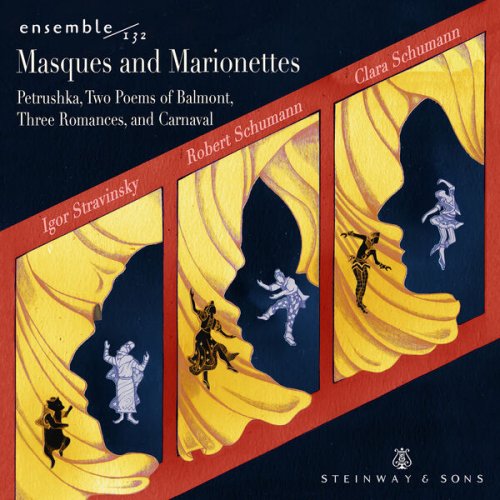
SONS releases ensemble132's debut album, Masques and Marionettes (STNS 30254). The program showcases the group’s electricity and dynamism in their original chamber arrangements of Igor Stravinsky’s enchanting Petrushka and Two Poems of Balmont arranged for piano quintet, Clara Schumann’s intimate Three Romances, and Robert Schumann’s boisterous Carnaval arranged for piano quartet.
In his program notes for the album, ensemble132's Co-Artistic Director Zachary Mowitz writes:
The works on this album capture vivid stories and characters from the imaginations and lives of their authors, all unified by universal experiences of love, longing, celebration, and friendship – with a touch of mystery and humor. Each piece is also inextricably linked to the piano and its most magical qualities, which Co-Artistic Director Sahun Sam Hong’s visionary arrangements explore through the endless possibilities of texture and color of the piano and string instruments. Masques and Marionettes combines ensemble132’s richness of character and nuance with the exhilaration of retelling each of these musical narratives.
Igor Stravinsky’s Petrushka (1911), arranged for piano quintet by Sahun Sam Hong, was originally performed as a large-scale ballet by Diaghilev’s Ballet Russe. It tells the story of a puppet magically brought to life by a mysterious sorcerer, naïvely navigating intensely human emotions and dynamics as he adoringly pursues the Ballerina – also under the sorcerer’s spell. Petrushka revels in Russian folk melodies and stories, but it also signals Stravinsky’s growing desire to experiment and push the boundaries of Western music. The arrangement is a faithful re-working of the intricate textures and boundless energy of the original large-format 1911 orchestration, expressed with the versatility of the piano quintet.
Stravinsky’s Two Poems for Balmont, written the same year as Petrushka, was originally a diptych of two short but moving songs setting the poetry of Konstantin Balmont. «Незабудочка‑цветочек» (Nezabudochka‑tsvetochek, “Forget‑me‑not blossom”) and «Голубь» (Golub, “The Pigeon”) turn seemingly mundane snapshots from nature into vividly emotional vignettes centered around a pigeon and a flower. If you listen carefully, you may find musical fragments from Petrushka, which Hong illuminates in this piano quintet rendition.
Clara Wieck-Schumann wrote her radiantly intimate Three Romances, Op. 22 (1853) in dedication to violinist Joseph Joachim, her life-long friend. Schumann, one of the most remarkable pianists of the Romantic era, premiered it herself with Joachim. To honor her artistry and legacy, we recorded each of the three movements as a different duo combination, featuring the violin, viola, and cello paired with piano, exploring the many shades of Clara Schumann’s great artistry and humanity.
Robert Schuman’s Carnaval, Op. 9 (1835) is one of the most well-loved pieces in the solo piano canon. With this set of colorful and animated character pieces, Schumann manifested a unique vision: a musical exhibition of scenes depicting both real-life and imaginary characters, transformed into masked revelers at a Carnival celebration. Like Petrushka, many of these characters derive from the Commedia dell’arte, although just as many come from Schumann’s own relationships, including Clara Schumann. In this new version, the original piano solo part has been expanded to the ensemble of piano quartet, affording newfound hues of humor, sparkle, and intensity.
While Masques and Marionettes explores the entrancing worlds that each of these composers creates, it also tells the story of our collective. We first found our footing as an ensemble as we developed these arrangements and explored great chamber music together as friends. As we have lived with these pieces, we have found ways to breathe new life into each one of these four works, hopefully giving them new homes in the chamber music repertoire.