The Young Danish String Quartet - Carl Nielsen: String Quartets Vol. 1 (2007) Hi-Res
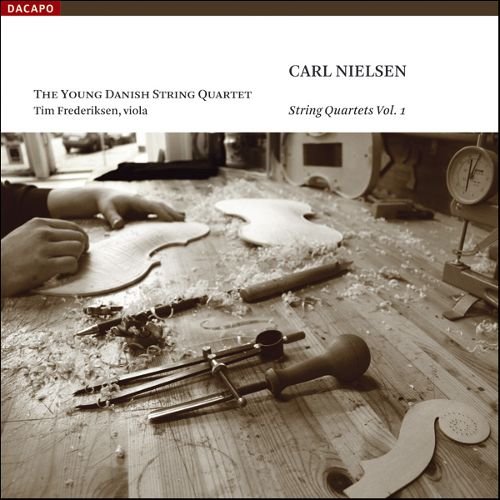
Artist: The Young Danish String Quartet
Title: Carl Nielsen: String Quartets Vol. 1
Year Of Release: 2007
Label: Dacapo Records
Genre: Classical
Quality: FLAC (tracks) 24/96
Total Time: 01:18:00
Total Size: 1,75 Gb
WebSite: Album Preview
Tracklist: Title: Carl Nielsen: String Quartets Vol. 1
Year Of Release: 2007
Label: Dacapo Records
Genre: Classical
Quality: FLAC (tracks) 24/96
Total Time: 01:18:00
Total Size: 1,75 Gb
WebSite: Album Preview
String Quartet in G minor, Op.13 (1887-88/1897-98)
1. I. Allegro energico 9:48
2. II. Andante amoroso 5:45
3. III. Scherzo: Allegro molto 4:56
4. IV. Finale: Allegro (inquieto) 5:42
String Quartet in F major, Op.44 (1906)
5. I. Allegro non tanto e comodo 7:52
6. II. Adagio con sentimento religioso 7:50
7. III. Allegretto moderato ed innocente 3:39
8. IV. Finale: Molto adagio - Allegro non tanto, ma molto scherzoso 6:39
String Quintet in G major (1888)*
9. I. Allegro pastorale 8:22
10. II. Adagio 7:10
11. III. Allegretto scherzando 4:30
12. IV. Finale: Allegro molto 5:20
Performers:
The Young Danish String Quartet
Frederik Øland, violin (1st in op. 13 and op. 44)
Rune Sørensen, violin (1st in String Quintet)
Asbjørn Nørgaard, viola (1st in String Quintet)
Carl-Oscar Østerlind, cello
Tim Frederiksen, viola*
I’m not sure what the members of the Danish Quartet, who recorded the Nielsen quartets more than effectively in 1992 (Kontrapunkt, 10/93), think about a “young” incarnation appearing 15 years later. But I hope they would doff their caps in admiration, because these new recordings are top-notch, and I’m happy to echo and endorse the enthusiasm they have already generated in Denmark.
The benchmark recording has been that of the Kontra Quartet (BIS, 4/92 – nla), sympathetic interpretations of works which do not enshrine the absolute finest of Nielsen, for all that he was an orchestral violinist and an experienced and enthusiastic performer of string quartets. But the new Quartet, all in their early twenties, bring a freshness and energy plus a level of sheer accomplishment that I don’t ever remember hearing in these works. Far from defensiveness or special pleading, they simply assume that they are playing high quality music and that their job is therefore to give it their all. The results are joyous, effervescent.
The First Quartet is the most striking beneficiary, since it can too easily sound texturally over-written and structurally effortful, as in the finale’s contrived “Résumé”. Such reservations are hard to entertain while listening to this thoroughly infectious account. Nielsen asks for energy in the first movement, and that is what the Young Danish Quartet give him, along with large-scale sweep and mellifluous tone throughout. The Fourth Quartet, a tough-minded cousin to the comic opera Maskarade, is interpretatively more challenging, and the Young Danish Quartet may in future find more subtly shaded routes through it; in the meantime their expressive candour and passion are entirely to the good. They are joined in the Quintet by Tim Frederiksen, under whom they studied at the Royal Conservatory in Copenhagen, and without quite transmuting base metal into gold, they display the various facets of what was a breakthrough piece for the young Nielsen to their best advantage.
The benchmark recording has been that of the Kontra Quartet (BIS, 4/92 – nla), sympathetic interpretations of works which do not enshrine the absolute finest of Nielsen, for all that he was an orchestral violinist and an experienced and enthusiastic performer of string quartets. But the new Quartet, all in their early twenties, bring a freshness and energy plus a level of sheer accomplishment that I don’t ever remember hearing in these works. Far from defensiveness or special pleading, they simply assume that they are playing high quality music and that their job is therefore to give it their all. The results are joyous, effervescent.
The First Quartet is the most striking beneficiary, since it can too easily sound texturally over-written and structurally effortful, as in the finale’s contrived “Résumé”. Such reservations are hard to entertain while listening to this thoroughly infectious account. Nielsen asks for energy in the first movement, and that is what the Young Danish Quartet give him, along with large-scale sweep and mellifluous tone throughout. The Fourth Quartet, a tough-minded cousin to the comic opera Maskarade, is interpretatively more challenging, and the Young Danish Quartet may in future find more subtly shaded routes through it; in the meantime their expressive candour and passion are entirely to the good. They are joined in the Quintet by Tim Frederiksen, under whom they studied at the Royal Conservatory in Copenhagen, and without quite transmuting base metal into gold, they display the various facets of what was a breakthrough piece for the young Nielsen to their best advantage.
![Velez - Luz In The Night (2026) [Hi-Res]](https://www.dibpic.com/uploads/posts/2026-08/1786948618_cover.jpg "Velez - Luz In The Night (2026) [Hi-Res]")
![Carlos Malta, Alexandre Elias - Vento no aço (2026) [Hi-Res]](https://www.dibpic.com/uploads/posts/2026-08/1786814051_ec61627pv7z99_600.jpg "Carlos Malta, Alexandre Elias - Vento no aço (2026) [Hi-Res]")
![Reuben Hoch - Of Recent Time (2011) [Hi-Res]](https://www.dibpic.com/uploads/posts/2026-08/1786813524_cover.jpg "Reuben Hoch - Of Recent Time (2011) [Hi-Res]")