Pierre-Laurent Aimard - Mozart: Piano Concertos Nos. 6, 15 & 27 (2005)
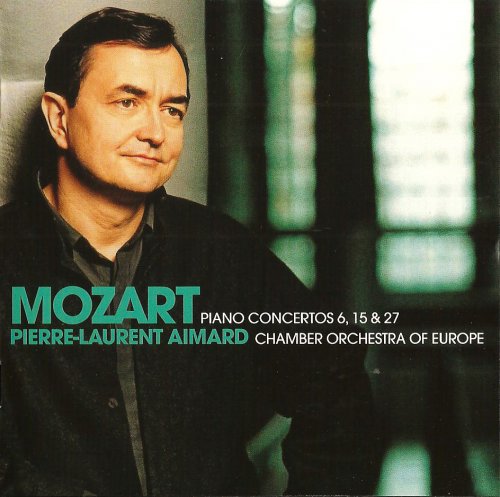
Artist: Pierre-Laurent Aimard
Title: Mozart: Piano Concertos Nos. 6, 15 & 27
Year Of Release: 2005
Label: Warner Classics
Genre: Classical
Quality: FLAC (image+.cue,log,scans)
Total Time: 01:16:45
Total Size: 353 Mb
WebSite: Album Preview
Tracklist: Title: Mozart: Piano Concertos Nos. 6, 15 & 27
Year Of Release: 2005
Label: Warner Classics
Genre: Classical
Quality: FLAC (image+.cue,log,scans)
Total Time: 01:16:45
Total Size: 353 Mb
WebSite: Album Preview
Piano Concerto No. 6 In B Flat Major, K238 (20:03)
1. I Allegro Aperto 7:00
2. II Andante Un Poco Adagio 5:53
3. III Rondeau: Allegro 7:10
Piano Concerto No. 15 In B Flat Major, K450 (24:55)
4. I Allegro 11:07
5. II [Andante] 6:02
6. III Allegro 7:46
Piano Concerto No. 27 In B Flat Major, K595 (31:35)
7. I Allegro 14:25
8. II Larghetto 7:49
9. III Allegro 9:21
Performers:
Pierre-Laurent Aimard - piano & direction
Chamber Orchestra of Europe
The French pianist Pierre-Laurent Aimard, renowned for his traversals of massive twentieth-century works feared even by virtuosi, among them Ravel's Gaspard de la Nuit, Ives' Concord Sonata and Messiaen's Vingt Regards, all of which he has committed to disc, here essays three of Mozart's four piano concertos in the key of B-flat major (K. 456 is not included). This is an appealing concept for a collection, in particular the inclusion of the elegant early work, K. 238, a bit on the surface compared to his mature works but with considerable charm, particularly as played here. K. 450 is early in the sequence of the great concertos of Mozart's maturity, and features one of the composer's most brilliant piano parts and highlighting of the orchestral winds, while K. 595, Mozart's final piano concerto, essays an intimacy of emotion and technique more often found in chamber music. Aimard of course is an impeccable technician, performing expressively as well as brilliantly when required. Although one never has the feeling he is condescending to this music in any way, occasionally the comparative sparseness of notes in Mozart seems to catch him short, especially in the eloquent slow movement of K. 595, where he overornaments some of the barer passages and overplays others. The Chamber Orchestra of Europe, which Aimard conducts as well, plays with a lightness and sparely applied vibrato in the strings which suggests a historical-style approach, unfortunately at odds with the very modern sound of the solo piano and the close recording acoustic.



![Stochelo Rosenberg, Mozes Rosenberg, Matheus Nicolaiewsky - The Chaplin Project (2026) [Hi-Res]](https://www.dibpic.com/uploads/posts/2026-09/1789481832_folder.jpg "Stochelo Rosenberg, Mozes Rosenberg, Matheus Nicolaiewsky - The Chaplin Project (2026) [Hi-Res]")
![BRAINTEASER ORCHESTRA & Tyn Wybenga - Tonepool Paradox (2026) [Hi-Res]](https://www.dibpic.com/uploads/posts/2026-09/1789481148_folder.jpg "BRAINTEASER ORCHESTRA & Tyn Wybenga - Tonepool Paradox (2026) [Hi-Res]")

![HUG, Gyan Riley, Devendra Banhart and Noah Georgeson - HUG (2026) [Hi-Res]](https://www.dibpic.com/uploads/posts/2026-09/1788948895_a1529682104_10.jpg "HUG, Gyan Riley, Devendra Banhart and Noah Georgeson - HUG (2026) [Hi-Res]")