Jean-Christophe Candau - Trésors des Couvents (Nouvelle Espagne, Xviie Siècle) (2020)
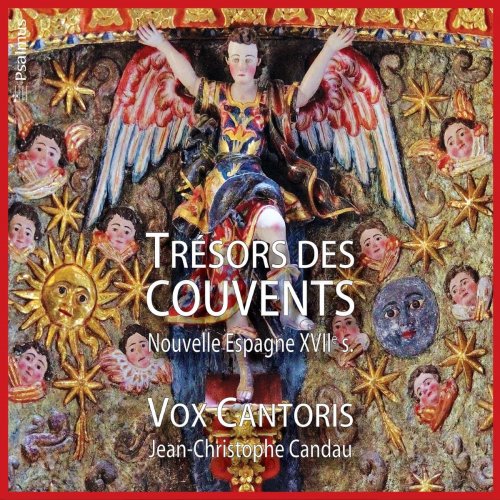
Artist: Jean-Christophe Candau
Title: Trésors des Couvents (Nouvelle Espagne, Xviie Siècle)
Year Of Release: 2020
Label: Psalmus
Genre: Classical
Quality: FLAC (tracks)
Total Time: 58:20 min
Total Size: 268 MB
WebSite: Album Preview
Tracklist:Title: Trésors des Couvents (Nouvelle Espagne, Xviie Siècle)
Year Of Release: 2020
Label: Psalmus
Genre: Classical
Quality: FLAC (tracks)
Total Time: 58:20 min
Total Size: 268 MB
WebSite: Album Preview
01. Missa Suzanne un jour: Kyrie
02. Missa Suzanne un jour: Gloria
03. Missa Suzanne un jour: Alleluia Senex puerum
04. Missa Suzanne un jour: Credo
05. Missa Suzanne un jour: Preface & Sanctus
06. Missa Suzanne un jour: Agnus Dei
07. Miserere mihi & Psaume 133: Ecce nunc benedicite
08. Te lucis ante terminum
09. In manus tuas
10. Salva nos & Nunc dimittis
11. Salve Regina
For several years, Jean-Christophe Candau and his Vox Cantoris ensemble (5 voices) have been exploring the baroque vocal repertoire of the New World. As the title of the album suggests evoking the musical treasures of New Spain (old Mexico), this disc reveals in all their splendor a selected set of polyphonies from convents.
What are these musics, taken from the liturgical repertoires of Mexico and contained in six books of polyphonies which belonged to the Convent of the Incarnation in Mexico City? As often in these cases, these are various compilations of pieces useful for offices copied in 1648 and bringing together various composers, some known, others less, Spanish, French and Mexican. There are naturally masses, hymns, psalms, magnificat, and other antiphons from 3 to 11 voices.
The disc begins with an anonymous 5-part “Parody Mass” on the theme “Susanne ung jour”, a famous Renaissance song, on a poem by François Guéroult and music by Didier Lupi Second. This melody is found in other masses (Roland de Lassus, Claudio Merulo and Marc Antonio Ingegneri). What characterizes this work here is the distribution of tessitura, favoring high voices for the female choir of the convent. During major festivals, cantors from the cathedral could reinforce the lower voices as well as a bassoon, as shown by other examples in Europe with the snake or the double bass. The study of the manuscript reveals a high level of writing and therefore also that of the vocal technique of the nuns.
The second work on the program is an Office for the Complines of an Amerindian composer Juan de Lienas who lived in the early 17th century. He was undoubtedly the first to compose in the Spanish style, close to Morales or Victoria. This office of Compline offers as for vespers a succession of antiphons, psalms and the anthem Te lucis. The writing is scholarly and takes place in a peaceful atmosphere, in harmony with the late hour of its unfolding. Lienas is at the crossroads of the stilo antico and a new art of writing that develops polychoral tones.
The interpretation of these works is of a very high level. Jean-Christophe Candau went to Mexico to study these texts closely but also in what environment they could have been performed. The old church of the Convent of the Incarnation, although transformed, still offers a certain original layout with its two superposed galleries. The female choir was reinforced by cantors or a bassoon for the low voice. This instrument was developed in Mexico at that time, hence the use of a doucaine, ancestor of the modern bassoon, magnificently held by Isaure Lavergne. The Vox Cantoris ensemble offers a beautiful musical quality, creating a heavenly, soaring atmosphere, close to works from other horizons. We think of Titelouze with his masses found, and even the English, all capable of vibrating these stone architectures, and projecting voices to infinity.
Here is a realization which is an excellent introduction to these rich repertoires, influenced by old Europe and turned towards flamboyant climates, specific to the New World.
What are these musics, taken from the liturgical repertoires of Mexico and contained in six books of polyphonies which belonged to the Convent of the Incarnation in Mexico City? As often in these cases, these are various compilations of pieces useful for offices copied in 1648 and bringing together various composers, some known, others less, Spanish, French and Mexican. There are naturally masses, hymns, psalms, magnificat, and other antiphons from 3 to 11 voices.
The disc begins with an anonymous 5-part “Parody Mass” on the theme “Susanne ung jour”, a famous Renaissance song, on a poem by François Guéroult and music by Didier Lupi Second. This melody is found in other masses (Roland de Lassus, Claudio Merulo and Marc Antonio Ingegneri). What characterizes this work here is the distribution of tessitura, favoring high voices for the female choir of the convent. During major festivals, cantors from the cathedral could reinforce the lower voices as well as a bassoon, as shown by other examples in Europe with the snake or the double bass. The study of the manuscript reveals a high level of writing and therefore also that of the vocal technique of the nuns.
The second work on the program is an Office for the Complines of an Amerindian composer Juan de Lienas who lived in the early 17th century. He was undoubtedly the first to compose in the Spanish style, close to Morales or Victoria. This office of Compline offers as for vespers a succession of antiphons, psalms and the anthem Te lucis. The writing is scholarly and takes place in a peaceful atmosphere, in harmony with the late hour of its unfolding. Lienas is at the crossroads of the stilo antico and a new art of writing that develops polychoral tones.
The interpretation of these works is of a very high level. Jean-Christophe Candau went to Mexico to study these texts closely but also in what environment they could have been performed. The old church of the Convent of the Incarnation, although transformed, still offers a certain original layout with its two superposed galleries. The female choir was reinforced by cantors or a bassoon for the low voice. This instrument was developed in Mexico at that time, hence the use of a doucaine, ancestor of the modern bassoon, magnificently held by Isaure Lavergne. The Vox Cantoris ensemble offers a beautiful musical quality, creating a heavenly, soaring atmosphere, close to works from other horizons. We think of Titelouze with his masses found, and even the English, all capable of vibrating these stone architectures, and projecting voices to infinity.
Here is a realization which is an excellent introduction to these rich repertoires, influenced by old Europe and turned towards flamboyant climates, specific to the New World.
![Doug Webb - Watch Your Step (2026) [Hi-Res]](https://img.israbox.com/img/2026-09/24/eusfw4z2nox1auxehaho13alc.jpg "Doug Webb - Watch Your Step (2026) [Hi-Res]")


![Connie Kay - My Blue Heaven (1990) [Hi-Res]](https://www.dibpic.com/uploads/posts/2026-09/1790152757_cover.jpg "Connie Kay - My Blue Heaven (1990) [Hi-Res]")
![Megiapa - Intentions (2026) [Hi-Res]](https://img.israbox.com/img/2026-09/24/q4beu5vuz2n5fio9ckyoe0a4e.jpg "Megiapa - Intentions (2026) [Hi-Res]")
![Peter Knight, Jannis Anastasakis - Feather (2026) [Hi-Res]](https://img.israbox.com/img/2026-09/24/cl5ywh8nazfr3muk2auhbaih8.jpg "Peter Knight, Jannis Anastasakis - Feather (2026) [Hi-Res]")