Annikka Konttori-Gustafsson & Jan Lehtola - Sigfrid Karg-Elert: Music for Piano and Organ (2017)
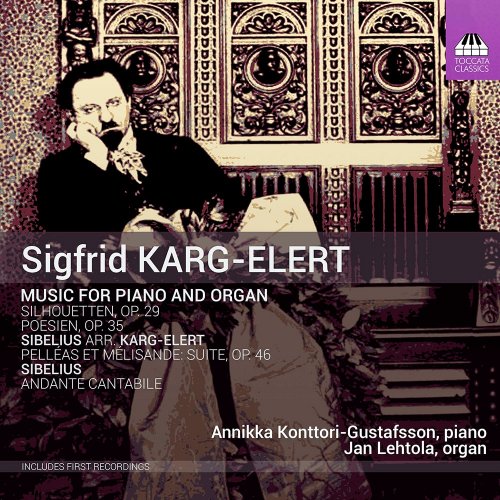
Artist: Annikka Konttori-Gustafsson, Jan Lehtola
Title: Sigfrid Karg-Elert: Music for Piano & Organ
Year Of Release: 2017
Label: Toccata Classics
Genre: Classical
Quality: FLAC (image + .cue, log, booklet)
Total Time: 1:25:30
Total Size: 292 MB
WebSite: Album Preview
Tracklist:Title: Sigfrid Karg-Elert: Music for Piano & Organ
Year Of Release: 2017
Label: Toccata Classics
Genre: Classical
Quality: FLAC (image + .cue, log, booklet)
Total Time: 1:25:30
Total Size: 292 MB
WebSite: Album Preview
Pelléas And Mélisande, Op. 46
1 I. At The Castle Gate
2 II. Mélisande
3 III. A Spring In The Park
4 IV. The Three Blind Sisters
5 V. Pastorale
6 VI. Mélisande At The Spinning Wheel
7 VII. Entr'acte
8 VIII. The Death Of Mélisande
Poesien, Op. 35
9 I. In Memoriam
10 2. Dialog
11 3. Epigramm
12 4. Parabel
13 5. Ideale
Silhouetten. Op. 29
14 1. Cantilene (Schlichte Weise)
15 2. Aubade (Morgenständchen)
16 3. Alte Tanzweise
17 4. Berceuse Mignonne (Wiegenliedchen)
18 5. Quasi Minuetto
19 6. Tempo Di Ballo
20 7. Scherzino
21 Andante Cantabile, JS30b
This recording revives long-forgotten sonorities that once would have beenvery familiar: the sound of piano and organ being played together.
It also presents a Sibelius premiere: the arrangement by Sigfird Karg-Elert ofthe suite from Pelléas and Mélisande.
As the popularity of domestic music-making grew through the nineteenthcentury, it brought first the piano and, then, often the harmonium into well-offliving-rooms across the western world.
Composers naturally responded, with original works and arrangements:Sibelius’ Andante cantabile was written after a visit to relatives who had bothinstruments in their salon.
Karg-Elert, by contrast, was one of the world’s outstanding virtuosi on bothharmonium and organ and composed with his concert public in mind.
It also presents a Sibelius premiere: the arrangement by Sigfird Karg-Elert ofthe suite from Pelléas and Mélisande.
As the popularity of domestic music-making grew through the nineteenthcentury, it brought first the piano and, then, often the harmonium into well-offliving-rooms across the western world.
Composers naturally responded, with original works and arrangements:Sibelius’ Andante cantabile was written after a visit to relatives who had bothinstruments in their salon.
Karg-Elert, by contrast, was one of the world’s outstanding virtuosi on bothharmonium and organ and composed with his concert public in mind.
![Winter Family - Chevaliers (2021) [Hi-Res]](https://img.israbox.com/img/2026-09/15/b8xshvhdzrukvjw3ry8yun9q0.jpg "Winter Family - Chevaliers (2021) [Hi-Res]")
![Life Force - Fearless Warriors (1981) [2007]](https://www.dibpic.com/uploads/posts/2026-09/1789570834_fearless-warriors.jpg "Life Force - Fearless Warriors (1981) [2007]")