Mikhail Pletnev - Rachmaninov: The Bells, Taneyev: John of Damascus (2001)

Artist: Mikhail Pletnev
Title: Rachmaninov: The Bells, Taneyev: John of Damascus
Year Of Release: 2001
Label: Deutsche Grammophon
Genre: Classical
Quality: FLAC (image+.cue,log,scans)
Total Time: 01:00:20
Total Size: 275 Mb
WebSite: Album Preview
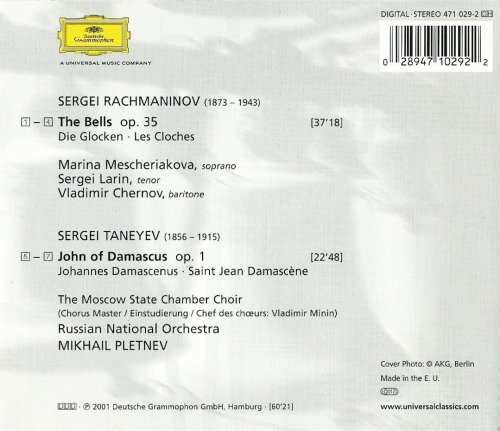
Tracklist: Title: Rachmaninov: The Bells, Taneyev: John of Damascus
Year Of Release: 2001
Label: Deutsche Grammophon
Genre: Classical
Quality: FLAC (image+.cue,log,scans)
Total Time: 01:00:20
Total Size: 275 Mb
WebSite: Album Preview
Sergei Rachmaninov (1873-1943):
01. The Bells, choral symphony for soprano, tenor, baritone, chorus & orchestra, Op. 35- I. Allegro, Ma Non Tanto [0:06:41.74]
02. The Bells, choral symphony for soprano, tenor, baritone, chorus & orchestra, Op. 35- II. Lento - Adagio [0:10:20.00]
03. The Bells, choral symphony for soprano, tenor, baritone, chorus & orchestra, Op. 35- III. Presto [0:08:10.00]
04. The Bells, choral symphony for soprano, tenor, baritone, chorus & orchestra, Op. 35- IV. Lento Lugubre - Allegro - Andante [0:12:21.00]
Sergey Ivanovich Taneyev (1856-1915):
05. Saint John of Damaskus, cantata for chorus & orchestra, Op. 1- Adagio ma non troppo [0:13:03.00]
06. Saint John of Damaskus, cantata for chorus & orchestra, Op. 1- Andante sostenuto - (attacca) [0:02:40.62]
07. Saint John of Damaskus, cantata for chorus & orchestra, Op. 1- Fuga. Allegro - Moderato [0:07:04.14]
Performers:
Marina Mescheriakova - soprano
Sergei Larin - tenor
Vladimir Chernov - baritone
The Moscow Chamber Choir
Russian National Orchestra
Mikhail Pletnev – conductor
Rachmaninov allegedly considered The Bells to be his best work, and it is not difficult to hear why. Written in 1913, it has a freshness of invention that is irresistible. Perhaps the text (an adaptation of an Edgar Allan Poe poem) struck a chord with this composer's sensibilities: different bells symbolize different facets of existence. The piece deserves more frequent airing, and it is to be hoped that Mikhail Pletnev and his Russian forces help raise awareness of it. The soloists are superb (Mescheriakova is particularly impressive), but the real star is the Moscow State Chamber Choir. This is a worthy companion to Pletnev's accounts of Rachmaninov orchestral works. Also included is a piece by Sergei Taneyev, a composer who should be more widely appreciated. Too often castigated in the textbooks for being overly academic, his works nevertheless demonstrate a creative originality that has immediate appeal. The cantata John of Damascus is something of a find. The Russian National Orchestra creates a superbly chilly atmosphere in the first movement, and once again the choir triumphs with fervent singing that conveys belief in the quality of this music. The Bells ranks as a fine modern performance, but the Taneyev might prove even more fascinating. -- Colin Clarke
Just as it is hard to imagine a non-English-speaking choir doing full justice to Vaughan Williams's Sea Symphony, so its near-contemporary Russian cousin ideally needs all-Russian forces in order to do it full justice. This is just what we have here, and the results are superb, thanks in large part to the resonant voices of the Moscow State Chamber Choir. As Pletnev's DG recordings of the numbered symphonies have already shown, he knows just how to blend Rachmaninov's characteristic moods to their best advantage the delicacy, the sensuousness, the wild enthusiasm, the over-arching sadness, all are faithfully captured. Behind the 'mellow wedding bells' of the second movement Pletnev finds a deep longing, and he holds the mood of the sombre finale marvellously.Sergei Larin's tenor may not be ideally mellifluous, and Vladimir Chernov's baritone has a stronger beat in the voice than some may like, but these two at least set the right tone for the outer movements. And Marina Mescheriakova is a name to watch among the burgeoning ranks of new bel canto Russian sopranos she produces some wonderfully heartfelt and tender sounds in the second movement.There is strong competition from the listed comparisons. Polyansky's choir is if anything even finer than Pletnev's, but his soloists let him down, and the Chandos recording quality sounds artificially glamorous. Now economically packaged on three discs, Ashkenazy's fine Rachmaninov cycle (the three numbered symphonies plus The Bells, The isle of the dead and the Symphonic Dances) makes a splendid bargain. His choir and soloists may be a fraction less idiomatic than Pletnev's; but I do prefer Decca/London's more open sound as with DG's previous Russian National Orchestra recordings, this one does feel just a little constricted. Taneyev's Op. 1 cantata makes an adventurous coupling, though a less startling one now that Polyansky's fine recent recording is also in the catalogue (saddled, however, with a soggy account of Tchaikovsky's Fourth Symphony). It is, to be frank, no better or worse a piece than you would expect from an exceptionally studious 24-year-old with a penchant for counterpoint (the last movement is a neo-Handelian fugue). But collectors of rare Russian repertoire will be grateful for it, nonetheless, and Pletnev directs a stirring performance.David Fanning -- From International Record Review
Just as it is hard to imagine a non-English-speaking choir doing full justice to Vaughan Williams's Sea Symphony, so its near-contemporary Russian cousin ideally needs all-Russian forces in order to do it full justice. This is just what we have here, and the results are superb, thanks in large part to the resonant voices of the Moscow State Chamber Choir. As Pletnev's DG recordings of the numbered symphonies have already shown, he knows just how to blend Rachmaninov's characteristic moods to their best advantage the delicacy, the sensuousness, the wild enthusiasm, the over-arching sadness, all are faithfully captured. Behind the 'mellow wedding bells' of the second movement Pletnev finds a deep longing, and he holds the mood of the sombre finale marvellously.Sergei Larin's tenor may not be ideally mellifluous, and Vladimir Chernov's baritone has a stronger beat in the voice than some may like, but these two at least set the right tone for the outer movements. And Marina Mescheriakova is a name to watch among the burgeoning ranks of new bel canto Russian sopranos she produces some wonderfully heartfelt and tender sounds in the second movement.There is strong competition from the listed comparisons. Polyansky's choir is if anything even finer than Pletnev's, but his soloists let him down, and the Chandos recording quality sounds artificially glamorous. Now economically packaged on three discs, Ashkenazy's fine Rachmaninov cycle (the three numbered symphonies plus The Bells, The isle of the dead and the Symphonic Dances) makes a splendid bargain. His choir and soloists may be a fraction less idiomatic than Pletnev's; but I do prefer Decca/London's more open sound as with DG's previous Russian National Orchestra recordings, this one does feel just a little constricted. Taneyev's Op. 1 cantata makes an adventurous coupling, though a less startling one now that Polyansky's fine recent recording is also in the catalogue (saddled, however, with a soggy account of Tchaikovsky's Fourth Symphony). It is, to be frank, no better or worse a piece than you would expect from an exceptionally studious 24-year-old with a penchant for counterpoint (the last movement is a neo-Handelian fugue). But collectors of rare Russian repertoire will be grateful for it, nonetheless, and Pletnev directs a stirring performance.David Fanning -- From International Record Review
DOWNLOAD FROM ISRA.CLOUD
Mikhail Pletnev Rachmaninov The Bells Taneyev John of Damascus 01 0303.rar - 275.8 MB
Mikhail Pletnev Rachmaninov The Bells Taneyev John of Damascus 01 0303.rar - 275.8 MB