Concert Royal Köln - Jauchzt, ihr frohen Christenscharen (2020)
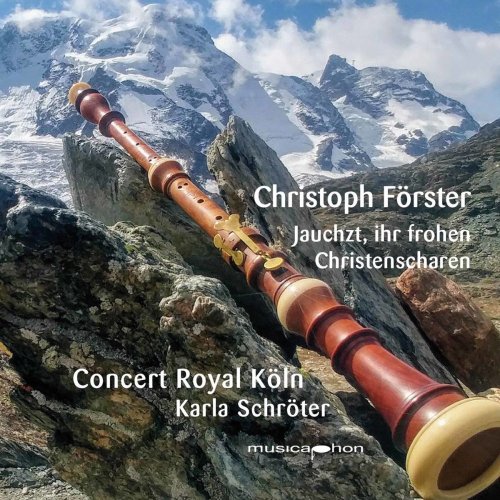
Artist: Concert Royal Köln
Title: Jauchzt, ihr frohen Christenscharen
Year Of Release: 2020
Label: Musicaphon
Genre: Classical
Quality: FLAC (tracks+booklet)
Total Time: 70:56 min
Total Size: 314 MB
WebSite: Album Preview
Title: Jauchzt, ihr frohen Christenscharen
Year Of Release: 2020
Label: Musicaphon
Genre: Classical
Quality: FLAC (tracks+booklet)
Total Time: 70:56 min
Total Size: 314 MB
WebSite: Album Preview
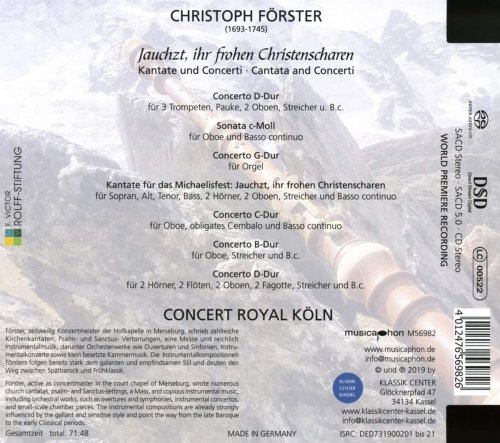
Tracklist:
01. Concerto in D Major, Schrank II/4/22: I. Allegro
02. Concerto in D Major, Schrank II/4/22: II. Adagio ma non troppo
03. Concerto in D Major, Schrank II/4/22: III. Allegro
04. Oboe Sonata in C Minor: I. Adagio
05. Oboe Sonata in C Minor: II. Allegro
06. Oboe Sonata in C Minor: III. Adagio
07. Oboe Sonata in C Minor: IV. Gigue
08. Organ Concerto in G Major: I. Allegro
09. Organ Concerto in G Major: II. Larghetto
10. Organ Concerto in G Major: III. Allegro
11. Jauchzt, ihr frohen Christenscharen: No. 1, Jauchzt, ihr frohen Christenscharen
12. Jauchzt, ihr frohen Christenscharen: No. 2, Ja, ja, des höchsten Liebe wird uns decken
13. Jauchzt, ihr frohen Christenscharen: No. 3, Eröffnet euch, erfreute Herzen
14. Jauchzt, ihr frohen Christenscharen: No. 4, Wohlan, du werthe Christenschar
15. Jauchzt, ihr frohen Christenscharen: No. 5, Lass durch der Engel Macht
16. Concerto in C Major: I. Allegro - Adagio - Allegro
17. Concerto in C Major: II. Menuet. Moderato - Variations 1-6
18. Oboe Concerto in B-Flat Major: I. Allegro
19. Oboe Concerto in B-Flat Major: II. Adagio
20. Oboe Concerto in B-Flat Major: III. Allegro
21. Concerto Grosso in D Major, Schrank II/4/24
The Thuringian composer Christoph Förster was born on 30 November 1693 in Bibra. He received his first musical education with the organist Pitzler. From 1710 he studied with Johann David Heinichen in Weißenfels and then with Georg Friedrich Kaufmann in Merseburg, where he soon became concertmaster in the Hofkapelle. Trips to Leipzig and Dresden are documented for the year 1719. In 1723 Förster travelled from Bohemia to Prague for the coronation of Charles VII and met important musical personalities such as Johann Joseph Fux, Antonio Caldara, Francesco Conti and others.
After the death of the Duke of Saxony-Merseburg, he applied in 1743 for the office of the Vice-Kapellmeister in Rudolstadt - but in the absence of a vacancy without remuneration - which he held until his imminent death on 6 December 1745. According to a list from 1743, the Rudolstädter Hofkapelle was quite large with about 25 musicians and had flutes, oboes, bassoons, trumpets, timpani and French horns as well as chorale boys in addition to strings and keyboard instruments. His compositional oeuvre includes numerous church cantatas, psalm and Sanctus settings, a mass and abundant instrumental music, including orchestral works such as overtures and symphonies, instrumental concertos and small chamber music.
Gerber describes his church cantatas as: "...perhaps the most pleasant and pleasing church pieces one had around the middle of the century" Förster's instrumental compositions already strongly follow the gallant and sensitive style and point the way between late Baroque and early Classical. The change in style can be clearly seen in the individual works.
His works were well known during his lifetime and recognized by the musical world; Marpurg, in his legend of some music saints (1786), put him among the first finer melodists of his time: "..." Förster was a subscriber to Georg Philipp Telemann's Tafelmusik and his Paris quartets in 1730. It was also Telemann who published Förster's Sei Duetti op. 1 in Paris in 1737.
After the death of the Duke of Saxony-Merseburg, he applied in 1743 for the office of the Vice-Kapellmeister in Rudolstadt - but in the absence of a vacancy without remuneration - which he held until his imminent death on 6 December 1745. According to a list from 1743, the Rudolstädter Hofkapelle was quite large with about 25 musicians and had flutes, oboes, bassoons, trumpets, timpani and French horns as well as chorale boys in addition to strings and keyboard instruments. His compositional oeuvre includes numerous church cantatas, psalm and Sanctus settings, a mass and abundant instrumental music, including orchestral works such as overtures and symphonies, instrumental concertos and small chamber music.
Gerber describes his church cantatas as: "...perhaps the most pleasant and pleasing church pieces one had around the middle of the century" Förster's instrumental compositions already strongly follow the gallant and sensitive style and point the way between late Baroque and early Classical. The change in style can be clearly seen in the individual works.
His works were well known during his lifetime and recognized by the musical world; Marpurg, in his legend of some music saints (1786), put him among the first finer melodists of his time: "..." Förster was a subscriber to Georg Philipp Telemann's Tafelmusik and his Paris quartets in 1730. It was also Telemann who published Förster's Sei Duetti op. 1 in Paris in 1737.
![Ben Wilcock, John Rae - March Of The Octopus (2025) [Hi-Res]](https://www.dibpic.com/uploads/posts/2026-08/1787738284_ben-wilcock-john-rae-march-of-the-octopus-2025.jpg "Ben Wilcock, John Rae - March Of The Octopus (2025) [Hi-Res]")
![Frank London - Touzle Your Kurchy (2026) [Hi-Res]](https://img.israbox.com/img/2026-08/27/nf9uayoqarytzfnp6xv9qz4uk.jpg "Frank London - Touzle Your Kurchy (2026) [Hi-Res]")

![Lalo Schifrin - The Lalo Schifrin Collection, Vol. 2 (Original Motion Picture Soundtrack) (2026) [Hi-Res]](https://img.israbox.com/img/2026-08/25/e6evki0mzwvemyi94ypbkbt5r.jpg "Lalo Schifrin - The Lalo Schifrin Collection, Vol. 2 (Original Motion Picture Soundtrack) (2026) [Hi-Res]")