Proscenio-Ensemble - Braga, Donizetti, Lachner, Massenet, Obiols, Proch: Ô doux printemps d'autrefois (Soprano, Baritone and Mezzosoprano Arias with Clarinet and Piano) (2020)
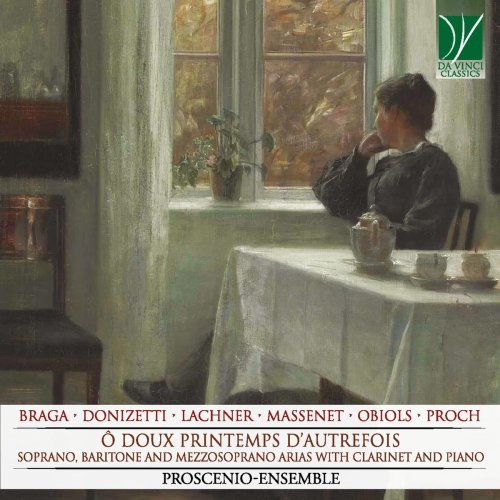
Artist: Proscenio-Ensemble
Title: Braga, Donizetti, Lachner, Massenet, Obiols, Proch: Ô doux printemps d'autrefois (Soprano, Baritone and Mezzosoprano Arias with Clarinet and Piano)
Year Of Release: 2020
Label: Da Vinci Classics
Genre: Classical
Quality: FLAC (tracks)
Total Time: 50:08 min
Total Size: 179 MB
WebSite: Album Preview
Title: Braga, Donizetti, Lachner, Massenet, Obiols, Proch: Ô doux printemps d'autrefois (Soprano, Baritone and Mezzosoprano Arias with Clarinet and Piano)
Year Of Release: 2020
Label: Da Vinci Classics
Genre: Classical
Quality: FLAC (tracks)
Total Time: 50:08 min
Total Size: 179 MB
WebSite: Album Preview
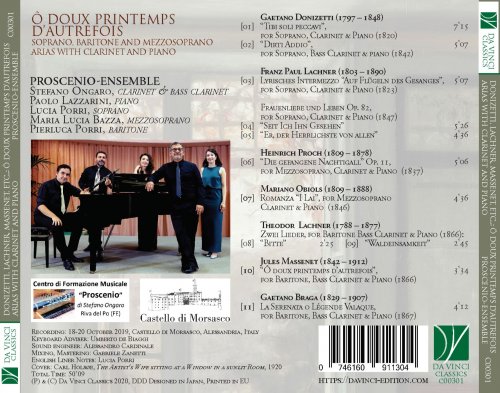
Tracklist:
01. Miserere: Tibi soli peccavi in G Minor (For Soprano, Clarinet & Piano)
02. "Dirti Addio" (For Soprano, Bass Clarinet & piano)
03. Lyrisches Intermezzo: Auf Flügeln des Gesanges (For Soprano, Clarinet & Piano)
04. Frauen-Liebe und Leben, Op. 82: I. Seit Ich Ihn Gesehen (For Soprano, Clarinet & Piano)
05. Frauen-Liebe und Leben, Op. 82: II. Er, der Herrlichste von allen (For Soprano, Clarinet & Piano)
06. Die gefangene Nachtigall, Op. 11 (For Mezzosoprano, Clarinet & Piano)
07. Romanza: I Lai (For Mezzosoprano, Clarinet & Piano)
08. Zwei Lieder: No. 1, Bitte (For Baritone, Bass Clarinet & Piano)
09. Zwei Lieder: No. 2, Waldeinsamkeit (For Baritone, Bass Clarinet & Piano)
10. Élégie: Ô doux printemps d’autrefois (For Baritone, Bass Clarinet & Piano)
11. La serenata (For Baritone, Bass Clarinet & Piano)
The musical project “Ô doux printemps d’autrefois” was born from an accurate research on the vocal repertoire that concerns the clarinet as a second voice. The central part of the work concerns the German lieder repertoire, which was followed and followed by other authors from Northern and Central Europe. Extremely interesting was the search for clarinet sounds in union with the various vocal registers involved, in particular the bass clarinet, which replaced the horn and the cello with transcriptions written by the clarinet player. The choice of the pieces with the bass clarinet wanted to emphasize the softness and ductility of the sound of an instrument just little known in the chamber vocal repertoire of the period (its origins date back to 1838).
The “journey” begins with two pieces by Gaetano Donizetti: an orchestral reduction of the Tibi soli peccavi from the Miserere in G minor (A. 703), where the clarinet is an “obbligato” instrument as in the original version: this definition means that one instrument emerges and takes on a concerting function together with the voice. In this passage, the clarinet seems to undertake (in the Allegro) a sort of “duet of agility” together with the soprano where both show off their technical virtuosity. The second Donizetti’s piece is Dirti addio, a purely chamber composition originally written for female voice and horn, here replaced by the bass clarinet. The timbre of the soprano deliberately becomes warmer and softer in order to get closer to the sound of the instrument.
The central body of the research consists of the works of the Lachner brothers, German composers contemporary of Beethoven and Schubert from which (Franz in particular) were strongly influenced. The cycle of the Two German Songs by Franz Lachner, whose poetic texts are written by Heine (Auf Flügeln des Gesanges) and Chamisso (Seit Ich Ihn Gesehen), is characterized by the obbligato clarinet and the voice of the soprano and describes the love between two young lovers and the explosion of sentiment that overwhelms them. The Franz Lachner’s second piece for the soprano Er, der Herrlichste von allen is included in the same poetic cycle by Chamisso (Frauenliebe und Leben), but presents itself as a piece apart perhaps due to the unusual long duration, the harmonic variety that expresse by the Piano in a duet alternately with the two soprano voices, and for the almost “opera final” that makes the composition more similar to an aria than a Lied.
The second cycle of two lieders was composed by Franz’s older brother, Theodor Lachner and instead concerns the baritone register accompanied by the bass clarinet that takes the place of the horn. The most meditative is certainly Waldeinsamkeit which describes solitude as a dense and obscure forest. The warm pastosity of the bass clarinet’s timbre is a valid support for the baritone, whose burnished color makes the sound amalgam perfectly balanced, pleasant and homogeneous to listening.
The tonal mix of the two voices is even more evident with the other two pieces performed with the baritone: the Serenata o Leggenda valacca of Gaetano Braga, late Romantic Italian cellist and composer, a pupil of Saverio Mercadante, whose production ranges from lyrical works to “Living room romances”. The particularity of this score is a dialogue between a mother and her daughter narrated in first person by the performer; in this case the bass clarinet takes on the part of the cello which, especially in the lower registers, has a range of extremely warm medium – low sounds and a genuinely “Italian” flavor.
Jules Massenet’s Elegy is perhaps the apex of the union/communion between the two solo instruments. Accompanied by an intense piano, with simple writing but full of dynamics and nuances on the Piano and Pianissimo, the bass clarinet (replacing the cello) opens the way to the baritone with a long and intense introduction where the long and full of breath phrases they reach an impressive proximity to the human voice. The French language lends itself perfectly to the elegance of the phrase and the emphasis of the harmonics typical of dark voices: in this living room romance the baritone sings a melancholy farewell to spring and “green seasons”.
Another famous composer, little known today but highly quoted during his time (so much so that he won a First Performance at Teatro alla Scala in Milan with the opera Odio e Amore in 1837) is the Catalan Mariano Obiols. He was a student of Mercadante during his studies in Italy and was lucky enough to be introduced by him to the circle of Rossini (whose influence he will feel a lot), Donizetti and Meyerbeer. His great versatility allowed him to have a very large production and the chamber music industry occupies a considerable part. I Lai was written when Obiols had already returned to Barcelona. Dedicated to Cirilla Branca, sister-in-law of the opera’s librettist Felice Romani, this cantata is the evidence of the affection and the bond that binds him to Italy and the harmonious grace of Rossini’s flavor that makes the clarinet (favorite instrument of the Pesaro’s master) the perfect counter-song for the voice of mezzo-soprano. This vocal choice is no accident: in fact this is the female vocal register that Rossini exalts in almost all his compositions and which in this case serves as a perfect alter ego of the clarinet. The lieder production for clarinet has its pleasant and appreciated example in Heinrich Proch, conductor and prolific author of Viennese origin also for the musical theater with various operas and operettas.
Die Gefangene Nachtigall represents a small jewel among its more than 200 chamber vocal compositions: it is the lament of a small nightingale who pines from the bars of his cage dreaming of freedom of the forest. The small overture of the piano and the clarinet (a series of short syncopations on the same high notes) make the nightingale’s melancholy chirping extremely vivid and truthful and pave the way for the entry of the voice.
Liner Notes by Lucia Porri
The “journey” begins with two pieces by Gaetano Donizetti: an orchestral reduction of the Tibi soli peccavi from the Miserere in G minor (A. 703), where the clarinet is an “obbligato” instrument as in the original version: this definition means that one instrument emerges and takes on a concerting function together with the voice. In this passage, the clarinet seems to undertake (in the Allegro) a sort of “duet of agility” together with the soprano where both show off their technical virtuosity. The second Donizetti’s piece is Dirti addio, a purely chamber composition originally written for female voice and horn, here replaced by the bass clarinet. The timbre of the soprano deliberately becomes warmer and softer in order to get closer to the sound of the instrument.
The central body of the research consists of the works of the Lachner brothers, German composers contemporary of Beethoven and Schubert from which (Franz in particular) were strongly influenced. The cycle of the Two German Songs by Franz Lachner, whose poetic texts are written by Heine (Auf Flügeln des Gesanges) and Chamisso (Seit Ich Ihn Gesehen), is characterized by the obbligato clarinet and the voice of the soprano and describes the love between two young lovers and the explosion of sentiment that overwhelms them. The Franz Lachner’s second piece for the soprano Er, der Herrlichste von allen is included in the same poetic cycle by Chamisso (Frauenliebe und Leben), but presents itself as a piece apart perhaps due to the unusual long duration, the harmonic variety that expresse by the Piano in a duet alternately with the two soprano voices, and for the almost “opera final” that makes the composition more similar to an aria than a Lied.
The second cycle of two lieders was composed by Franz’s older brother, Theodor Lachner and instead concerns the baritone register accompanied by the bass clarinet that takes the place of the horn. The most meditative is certainly Waldeinsamkeit which describes solitude as a dense and obscure forest. The warm pastosity of the bass clarinet’s timbre is a valid support for the baritone, whose burnished color makes the sound amalgam perfectly balanced, pleasant and homogeneous to listening.
The tonal mix of the two voices is even more evident with the other two pieces performed with the baritone: the Serenata o Leggenda valacca of Gaetano Braga, late Romantic Italian cellist and composer, a pupil of Saverio Mercadante, whose production ranges from lyrical works to “Living room romances”. The particularity of this score is a dialogue between a mother and her daughter narrated in first person by the performer; in this case the bass clarinet takes on the part of the cello which, especially in the lower registers, has a range of extremely warm medium – low sounds and a genuinely “Italian” flavor.
Jules Massenet’s Elegy is perhaps the apex of the union/communion between the two solo instruments. Accompanied by an intense piano, with simple writing but full of dynamics and nuances on the Piano and Pianissimo, the bass clarinet (replacing the cello) opens the way to the baritone with a long and intense introduction where the long and full of breath phrases they reach an impressive proximity to the human voice. The French language lends itself perfectly to the elegance of the phrase and the emphasis of the harmonics typical of dark voices: in this living room romance the baritone sings a melancholy farewell to spring and “green seasons”.
Another famous composer, little known today but highly quoted during his time (so much so that he won a First Performance at Teatro alla Scala in Milan with the opera Odio e Amore in 1837) is the Catalan Mariano Obiols. He was a student of Mercadante during his studies in Italy and was lucky enough to be introduced by him to the circle of Rossini (whose influence he will feel a lot), Donizetti and Meyerbeer. His great versatility allowed him to have a very large production and the chamber music industry occupies a considerable part. I Lai was written when Obiols had already returned to Barcelona. Dedicated to Cirilla Branca, sister-in-law of the opera’s librettist Felice Romani, this cantata is the evidence of the affection and the bond that binds him to Italy and the harmonious grace of Rossini’s flavor that makes the clarinet (favorite instrument of the Pesaro’s master) the perfect counter-song for the voice of mezzo-soprano. This vocal choice is no accident: in fact this is the female vocal register that Rossini exalts in almost all his compositions and which in this case serves as a perfect alter ego of the clarinet. The lieder production for clarinet has its pleasant and appreciated example in Heinrich Proch, conductor and prolific author of Viennese origin also for the musical theater with various operas and operettas.
Die Gefangene Nachtigall represents a small jewel among its more than 200 chamber vocal compositions: it is the lament of a small nightingale who pines from the bars of his cage dreaming of freedom of the forest. The small overture of the piano and the clarinet (a series of short syncopations on the same high notes) make the nightingale’s melancholy chirping extremely vivid and truthful and pave the way for the entry of the voice.
Liner Notes by Lucia Porri
![Kevin Sun - Kevin Sun, II (2026) [Hi-Res]](https://img.israbox.com/img/2026-09/27/pzwaczrg0dxw87hagkc04824e.jpg "Kevin Sun - Kevin Sun, II (2026) [Hi-Res]")


![Espen Eriksen Trio - Almost There (2026) [Hi-Res]](https://www.dibpic.com/uploads/posts/2026-09/1790277183_cover.jpg "Espen Eriksen Trio - Almost There (2026) [Hi-Res]")
![Margaret Singana - Tribal Fence (2026) [Hi-Res]](https://www.dibpic.com/uploads/posts/2026-09/1790315409_cover.jpg "Margaret Singana - Tribal Fence (2026) [Hi-Res]")