Jean Kleeb - Kleeb, Handel, Bach , Marpurg, Dowland: Clavicolors (2020)
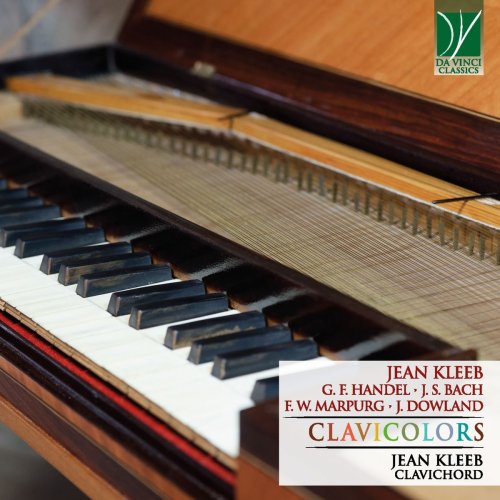
Artist: Jean Kleeb
Title: Kleeb, Handel, Bach , Marpurg, Dowland: Clavicolors
Year Of Release: 2020
Label: Da Vinci Classics
Genre: Classical
Quality: FLAC (tracks)
Total Time: 59:45 min
Total Size: 289 MB
WebSite: Album Preview
Title: Kleeb, Handel, Bach , Marpurg, Dowland: Clavicolors
Year Of Release: 2020
Label: Da Vinci Classics
Genre: Classical
Quality: FLAC (tracks)
Total Time: 59:45 min
Total Size: 289 MB
WebSite: Album Preview
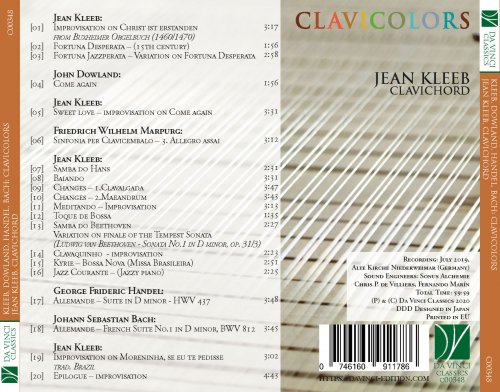
Tracklist:
01. Improvisation on Christ ist erstanden from Buxheimer Orgelbuch
02. Fortuna Desperata
03. Fortuna Jazzperata - Variation on Fortuna Desperata
04. Come Again, Sweet Love Doth Now Invite
05. Sweet love - Improvisation on Come Again
06. Sinfonia for Keyboard (Partita XII): III. Allegro assai
07. Samba do Hans
08. Baiando
09. Changes: No. 1, Clavalgada
10. Changes: No. 2, Maeandrum
11. Meditando - Improvisation
12. Toque de Bossa
13. Samba do Beethoven - Variation on Finale of the Tempest Sonata
14. Clavaquinho - improvisation
15. Kyrie - Bossa Nova (Missa Brasileira)
16. Jazz Courante
17. Suite in D Minor, HWV 437: I. Allemande
18. French Suite No. 1 in D Minor, BWV 812: I. Allemande
19. Improvisation on Moreninha, se eu te pedisse
20. Epilogue - improvisation
The CD Clavicolors tells the story of a historic Iberian clavichord built in Madrid before 1800. Feeling the keys of this clavichord, getting to know its strings, and the soundboard made of fine wood that developed through its long life, this CD is an approach to recreate the history of this instrument. Original instruments are not just museum objects, they should also be played. So we learn about the clarity and abundance of their sounds. Clavichord is a very old stringed European keyboard instrument, which was invented in the early fourteenth century. It was used until the classical era, mostly for composing or for small audiences. Clavichord is not loud and has fascinating timbres, many possibilities of articulation, and a rich dynamic spectrum among the quiet sounds, which are not playable with a piano or a harpsichord. Furthermore, it is possible to change the pitch, which gives the keyboardists new possibilities of playing. Parallel to the desire for the old sounds, there is also the search for the new ones. Some of them, perhaps not heard yet, take the listener to unique and anachronistic musical moments, through different times in the history of music, ending in Jazz, samba, and modern music. The most important impulse for me to produce this CD is the particular and wonderful sound of this Iberian clavichord. (Only two original instruments like this exist in the whole world). About the aesthetics and beauty of the clavichord, it is enough to quote what Christian Friedrich Daniel Schubart wrote in 1806 in his book Ideen einer Ästhetik der Tonkunst (Ideas of a musical art aesthetic):
“The clavichord, this lonely, melancholic, and sweet instrument, when made by a master, has advantages over the grand piano and fortepiano. With the pressure of the fingers, the swinging and trembling of the strings, and the strong or soft touching of the keys, special timbres, swelling and dying of the tones, the melting trill breathing out under the fingers, and the portamento, in a word, every trait can be set, of which the feelings consist. Whoever likes his/her heart to be filled with sweet feelings instead of rambling, speeding, and storming, should forget the grand piano and fortepiano and choose a clavichord … . There are many pianists and fortepianists, but very few clavichordists.” (translation: Jean Kleeb)
This CD begins with a piece from the Buxheim Organ Book (1460/1470) Christ is risen combined with jazz. It follows a variation on the well-known secular Italian song Fortuna Desperata, a theme that has been arranged by many composers of the Renaissance era. The improvisation of Sweet love reminds us of the wonderful piece Come again by John Dowland. The Sinfonia for Clavicembalo written by the German composer from the 18th century, Friedrich Wilhelm Marpurg, was specially composed for the clavichord, with the typical articulations and phrases of the classic era.
Then the journey goes to South America with samba and baião. Samba rhythms make the clavichord sound transparent and full of light; thanks to the softly articulated polyrhythm, the melody, the chords, and the bass can be heard clearly at the same time. Clavichord fits very well to the samba, imitating the guitar timbres, combined with the very staccato chords that remind us of the rhythms of the samba drums. The old temperaments and timbres of this instrument make the jazz dissonances milder.
The two pieces Changes are composed in modern style. Clavalgada explores the idea of virtuosity like “horse-riding” on the keyboard. Maeandrum develops small atonal meandering movements around the tones.
The next pieces go back to the Brazilian music: bossa nova with Toque de Bossa (feeling of bossa); Samba do Beethoven (Samba of Beethoven), a rhythmic variation on the 3rd movement of the Tempest Sonata by Beethoven; Clavaquinho, an allusion to the cavaquinho, the characteristic Brazilian samba string instrument; at the end of this part the Kyrie in bossa nova style from my Brazilian Mass (originally for soprano, choir, and band).
After the jazzy piece Jazz Courante, I play two pieces by G. F. Handel and by J. S. Bach, both Allemandes in D minor with the typical baroque articulations on the clavichord. At the end, I improvise on a Brazilian folksong of Mato Grosso (West Brazil). The CD ends with free improvisation to represent the experimental characteristic of this album and the free spirit of this instrument.
Album Notes by Jean Kleeb
“The clavichord, this lonely, melancholic, and sweet instrument, when made by a master, has advantages over the grand piano and fortepiano. With the pressure of the fingers, the swinging and trembling of the strings, and the strong or soft touching of the keys, special timbres, swelling and dying of the tones, the melting trill breathing out under the fingers, and the portamento, in a word, every trait can be set, of which the feelings consist. Whoever likes his/her heart to be filled with sweet feelings instead of rambling, speeding, and storming, should forget the grand piano and fortepiano and choose a clavichord … . There are many pianists and fortepianists, but very few clavichordists.” (translation: Jean Kleeb)
This CD begins with a piece from the Buxheim Organ Book (1460/1470) Christ is risen combined with jazz. It follows a variation on the well-known secular Italian song Fortuna Desperata, a theme that has been arranged by many composers of the Renaissance era. The improvisation of Sweet love reminds us of the wonderful piece Come again by John Dowland. The Sinfonia for Clavicembalo written by the German composer from the 18th century, Friedrich Wilhelm Marpurg, was specially composed for the clavichord, with the typical articulations and phrases of the classic era.
Then the journey goes to South America with samba and baião. Samba rhythms make the clavichord sound transparent and full of light; thanks to the softly articulated polyrhythm, the melody, the chords, and the bass can be heard clearly at the same time. Clavichord fits very well to the samba, imitating the guitar timbres, combined with the very staccato chords that remind us of the rhythms of the samba drums. The old temperaments and timbres of this instrument make the jazz dissonances milder.
The two pieces Changes are composed in modern style. Clavalgada explores the idea of virtuosity like “horse-riding” on the keyboard. Maeandrum develops small atonal meandering movements around the tones.
The next pieces go back to the Brazilian music: bossa nova with Toque de Bossa (feeling of bossa); Samba do Beethoven (Samba of Beethoven), a rhythmic variation on the 3rd movement of the Tempest Sonata by Beethoven; Clavaquinho, an allusion to the cavaquinho, the characteristic Brazilian samba string instrument; at the end of this part the Kyrie in bossa nova style from my Brazilian Mass (originally for soprano, choir, and band).
After the jazzy piece Jazz Courante, I play two pieces by G. F. Handel and by J. S. Bach, both Allemandes in D minor with the typical baroque articulations on the clavichord. At the end, I improvise on a Brazilian folksong of Mato Grosso (West Brazil). The CD ends with free improvisation to represent the experimental characteristic of this album and the free spirit of this instrument.
Album Notes by Jean Kleeb

![Barbra Streisand - A Collection (Greatest Hits...And More) (1989) [Japanese Edition]](https://www.dibpic.com/uploads/posts/2026-08/1787638479_front.jpg "Barbra Streisand - A Collection (Greatest Hits...And More) (1989) [Japanese Edition]")
![Jaime Chirif Watanabe - Garabatos (2026) [Hi-Res]](https://img.israbox.com/img/2026-08/23/2mgvafqycl2jbchyeajoqbhae.jpg "Jaime Chirif Watanabe - Garabatos (2026) [Hi-Res]")