Royal Philharmonic Orchestra, Yuri Simonov, Susan Gritton - Górecki: Symphony No. 3 for Soprano and Orchesra, Op. 36 "Symphony of Sorrowful Songs" (2005) [SACD]
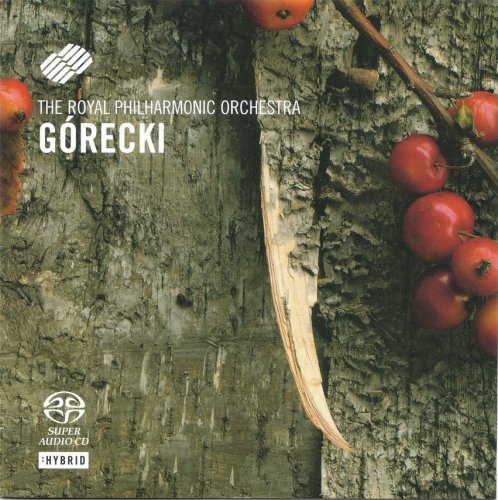
Artist: Royal Philharmonic Orchestra, Yuri Simonov, Susan Gritton
Title: Górecki: Symphony No. 3 for Soprano and Orchesra, Op. 36 "Symphony of Sorrowful Songs"
Year Of Release: 2005
Label: Membran
Genre: Classical Orchestral
Quality: DSD64 image (*.iso) / 2.0, 5.1 (2,8 MHz/1 Bit)
Total Time: 00:62:55
Total Size: 3.38 GB
WebSite: Album Preview
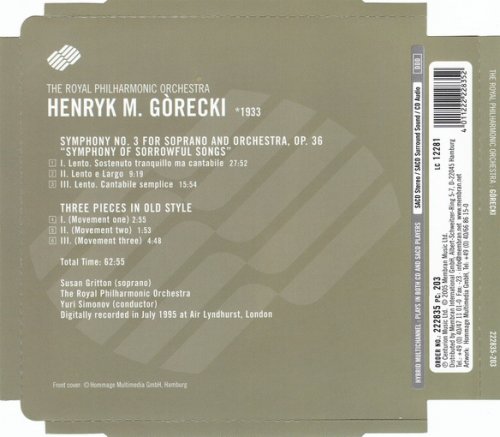
Tracklist:Title: Górecki: Symphony No. 3 for Soprano and Orchesra, Op. 36 "Symphony of Sorrowful Songs"
Year Of Release: 2005
Label: Membran
Genre: Classical Orchestral
Quality: DSD64 image (*.iso) / 2.0, 5.1 (2,8 MHz/1 Bit)
Total Time: 00:62:55
Total Size: 3.38 GB
WebSite: Album Preview
Symphony No. 3 for Soprano and Orchesra, Op. 36 "Symphony of Sorrowful Songs"
1. I. Lento. Sostenuto tranquillo ma cantabile
2. II. Lento e Largo
3. III. Lento. Cantabile semplice
Three Pieces in Old Style
4. I. (Movement One)
5. II. (Movement Two)
6. III. (Movement Three)
What a find,- easily the best of the RPO discs I’ve heard so far and a performance which doesn’t deserve to have fallen from the catalogues in the first place. For those who don’t know this (almost ubiquitous) work, it was written in soviet-era Poland in 1975s and is characterised as a Symphony of Sorrowful Songs. It is based on Orthodox lament as well as folk song and uses minimal(ist) material to create tapestries of sound, sometimes soaring and sometimes dark and reverberant, which feature long sustained notes as well as gently dissonant clusters of notes. Imagine the Tallis fantasia accompanied by a Slavic Basso Profundo-sound (from the double basses and cellos) and suggestions of tolling bells (by the strings) and you’ll be on the right track, but its only a partial picture. The Symphony features three song sections, one in each movement: a mother’s lamentation, the words of an 18 year old female prisoner of the Gestapo and a mother’s confirmation of the loss of her son.
Of course, there’s strong competition (on RBCD) from the original Nonesuch recording with Zinman and Dawn Upshaw and the Wit (on Naxos), both of which I’ve heard, and from another half-dozen recordings I haven’t heard. In the face of that competition, I’m not sure that Simonov has anything new to “say” but he provides no less of a performance than either Zinman or Wit. Indeed, he falls about half way between the two, being less sweet and glossy than Zinman and less austere than Wit. His pulse is just about right, except towards the end of the first movement after the soprano’s first song, where I felt the tension winding down, something not helped by the very abrupt arrival of the second movement (something that’s a real pain about all these RPO releases). A shame in view of the marvellous build-up of tension before the song.
Zinman’s slightly quicker tempi are beautiful, but Simonov’s slower tempi are marvellously tense (up until the end of the first song, anyway). The wind and brass creep in from the first song onwards, and Simonov uses them (and the piano and harp) with subtlety.
The second and third movements are even more successful, maintaining more disciplined, clear headed tempi and tread. After all the sorrow, pain, death and repression of the rest of the Symphony the work ends on a gentle A major chord, – a sort of “dare to hope for better” message in 1975 for an end to repression. Alas, this wonderful conclusion is followed immediately on the disc by the three Songs in the Olden Style, which, whilst lovely in their own right, prevent you (the listener) from completely absorbing what you’ve just heard. My recommendation is to program and play only the Symphony’s three tracks, let it stop, let yourself pause for breath (you’ll need it) and then press play and go straight to track 4 and the three songs (which are, despite the title, movements for string orchestra.
The Soprano in the Symphony is the marvelous Susan Gritton, making her first recording after winning the Ferrier prize in the previous year. She is excellent, dark toned and Polish sounding, – not in diction, which I couldn’t comment on, but in mood. She is perhaps a little severe at times, such as in the opening of the second movement, where more tenderness would not have gone astray, but I think that her choices are legitimised by the basis of the work in antique Orthodox chant and folk music and a universal humanity which underscores all three songs.
The sound is also by far the best of the series (i.e. of the four I’ve heard so far). The double basses provide the right canonic depth and rumble without being over-reverberant and balances and soundstaging seem very real, especially in Surround. The disc is cut at a good volume too, which permits warmth and overcomes the shrillness of the other releases.
All in all, this is the equal of the Zinman and Wit, with some swings and roundabouts. I would have been happy to have paid a lot more than my 5 euros (at jpc), and that makes up for other disappointments in the RPO series. If you only get one of these re-releases, this would have to be my recommendation, despite all my minor caveats.
Of course, there’s strong competition (on RBCD) from the original Nonesuch recording with Zinman and Dawn Upshaw and the Wit (on Naxos), both of which I’ve heard, and from another half-dozen recordings I haven’t heard. In the face of that competition, I’m not sure that Simonov has anything new to “say” but he provides no less of a performance than either Zinman or Wit. Indeed, he falls about half way between the two, being less sweet and glossy than Zinman and less austere than Wit. His pulse is just about right, except towards the end of the first movement after the soprano’s first song, where I felt the tension winding down, something not helped by the very abrupt arrival of the second movement (something that’s a real pain about all these RPO releases). A shame in view of the marvellous build-up of tension before the song.
Zinman’s slightly quicker tempi are beautiful, but Simonov’s slower tempi are marvellously tense (up until the end of the first song, anyway). The wind and brass creep in from the first song onwards, and Simonov uses them (and the piano and harp) with subtlety.
The second and third movements are even more successful, maintaining more disciplined, clear headed tempi and tread. After all the sorrow, pain, death and repression of the rest of the Symphony the work ends on a gentle A major chord, – a sort of “dare to hope for better” message in 1975 for an end to repression. Alas, this wonderful conclusion is followed immediately on the disc by the three Songs in the Olden Style, which, whilst lovely in their own right, prevent you (the listener) from completely absorbing what you’ve just heard. My recommendation is to program and play only the Symphony’s three tracks, let it stop, let yourself pause for breath (you’ll need it) and then press play and go straight to track 4 and the three songs (which are, despite the title, movements for string orchestra.
The Soprano in the Symphony is the marvelous Susan Gritton, making her first recording after winning the Ferrier prize in the previous year. She is excellent, dark toned and Polish sounding, – not in diction, which I couldn’t comment on, but in mood. She is perhaps a little severe at times, such as in the opening of the second movement, where more tenderness would not have gone astray, but I think that her choices are legitimised by the basis of the work in antique Orthodox chant and folk music and a universal humanity which underscores all three songs.
The sound is also by far the best of the series (i.e. of the four I’ve heard so far). The double basses provide the right canonic depth and rumble without being over-reverberant and balances and soundstaging seem very real, especially in Surround. The disc is cut at a good volume too, which permits warmth and overcomes the shrillness of the other releases.
All in all, this is the equal of the Zinman and Wit, with some swings and roundabouts. I would have been happy to have paid a lot more than my 5 euros (at jpc), and that makes up for other disappointments in the RPO series. If you only get one of these re-releases, this would have to be my recommendation, despite all my minor caveats.
![Royal Philharmonic Orchestra, Yuri Simonov, Susan Gritton - Górecki: Symphony No. 3 for Soprano and Orchesra, Op. 36 "Symphony of Sorrowful Songs" (2005) [SACD]](https://www.dibpic.com/uploads/posts/2021-02/1612252853_gorecki12.jpg)
Download Link Isra.Cloud
Royal Philharmonic Orchestra, Yuri Simonov, Susan Gritton - Górecki: Symphony No. 3 for Soprano and Orchesra, Op. 36 "Symphony of Sorrowful Songs" (2005) - 1
Royal Philharmonic Orchestra, Yuri Simonov, Susan Gritton - Górecki: Symphony No. 3 for Soprano and Orchesra, Op. 36 "Symphony of Sorrowful Songs" (2005) - 2
My blog
Royal Philharmonic Orchestra, Yuri Simonov, Susan Gritton - Górecki: Symphony No. 3 for Soprano and Orchesra, Op. 36 "Symphony of Sorrowful Songs" (2005) - 1
Royal Philharmonic Orchestra, Yuri Simonov, Susan Gritton - Górecki: Symphony No. 3 for Soprano and Orchesra, Op. 36 "Symphony of Sorrowful Songs" (2005) - 2
My blog
![Nicola Dal Bo, Gianluca Carollo & Marco Carlesso - Hand To Hand (2026) [Hi-Res]](https://www.dibpic.com/uploads/posts/2026-09/1790489198_600.jpg "Nicola Dal Bo, Gianluca Carollo & Marco Carlesso - Hand To Hand (2026) [Hi-Res]")
![La Sirena - The Sorceress Dreaming (2026) [Hi-Res]](https://img.israbox.com/img/2026-09/28/w7df1c5gx6yilw1u4hbk0zxn9.jpg "La Sirena - The Sorceress Dreaming (2026) [Hi-Res]")

![OkoŃski - Additions (2026) [Hi-Res]](https://www.dibpic.com/uploads/posts/2026-09/1790603476_cover.jpg "OkoŃski - Additions (2026) [Hi-Res]")