Wiener Jenesse Chor, ORF Vienna Radio Symphony Orchestra & Günther Theuring - Eisler: Deutsche Sinfonie, Op. 50 (2021) [Hi-Res]
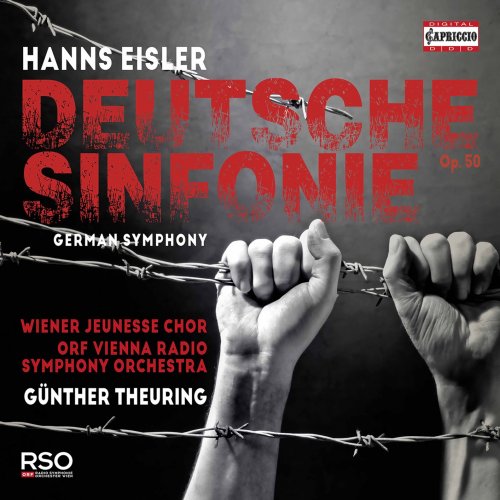
Artist: Wiener Jenesse Chor, ORF Vienna Radio Symphony Orchestra, Günther Theuring
Title: Eisler: Deutsche Sinfonie, Op. 50
Year Of Release: 2021
Label: CapriccioNR
Genre: Classical
Quality: FLAC (tracks) / 24bit-48kHz FLAC (tracks+booklet)
Total Time: 66:28
Total Size: 266 / 645 MB
WebSite: Album Preview
Tracklist:Title: Eisler: Deutsche Sinfonie, Op. 50
Year Of Release: 2021
Label: CapriccioNR
Genre: Classical
Quality: FLAC (tracks) / 24bit-48kHz FLAC (tracks+booklet)
Total Time: 66:28
Total Size: 266 / 645 MB
WebSite: Album Preview
01. Deutsche Sinfonie, Op. 50: No. 1, Präludium (7:25)
02. Deutsche Sinfonie, Op. 50: No. 2, An die Kämpfer in den Konzentrationslagern (3:31)
03. Deutsche Sinfonie, Op. 50: No. 3, Etüde für Orchester (3:02)
04. Deutsche Sinfonie, Op. 50: No. 4, Erinnerung (3:34)
05. Deutsche Sinfonie, Op. 50: No. 5, In Sonnenburg (2:40)
06. Deutsche Sinfonie, Op. 50: No. 6, Intermezzo für Orchester (5:30)
07. Deutsche Sinfonie, Op. 50: No. 7, Begräbnis des Hetzers im Zinksarg (5:40)
08. Deutsche Sinfonie, Op. 50: No. 8a, Bauernkantate. Missernte (1:18)
09. Deutsche Sinfonie, Op. 50: No. 8b, Bauernkantate. Sicherheit (1:58)
10. Deutsche Sinfonie, Op. 50: No. 8c, Bauernkantate. Flüstergespräche (2:58)
11. Deutsche Sinfonie, Op. 50: No. 8d, Bauernkantate. Bauernliedchen (1:41)
12. Deutsche Sinfonie, Op. 50: No. 9, Arbeiterkantate (15:53)
13. Deutsche Sinfonie, Op. 50: No. 10, Allegro für Orchester (10:26)
14. Deutsche Sinfonie, Op. 50: No. 11, Epilog (0:59)
Of particular importance to Eisler was the principle of synthesis, working with a variety of musical aesthetics, and merging them to an autonomous whole… albeit always with an eye to also wanting to “change the world” with his music. The October Revolution of 1917 and the assumption of power by the Bolsheviks in Russia shaped young Hanns Eisler already for the rest of his life. Later on, in the 1930s after all, there was no topic that preoccupied him more, during the years of exile, than the sustained protest against National Socialism. Eisler wanted to make a musical stance against Fascism with his Opus 50; he wanted to show – together with his collaborating librettist Brecht – that there was not just a Germany Nazis but another, better Germany… driven into Exile or interned in concentration camps. The Deutsche Sinfonie is arguably Eisler's most important composition; she is unique in its ingenious combination of symphony, cantata, and oratorio.

![Jeff Colella and Putter Smith - Between Friends (2026) [Hi-Res]](https://www.dibpic.com/uploads/posts/2026-08/1787301600_dax5t0cldnakl_600.jpg "Jeff Colella and Putter Smith - Between Friends (2026) [Hi-Res]")
![Duesund - Under overflaten (2026) [Hi-Res]](https://img.israbox.com/img/2026-08/23/k02uc3gso89jmrqasrcueuwpa.jpg "Duesund - Under overflaten (2026) [Hi-Res]")