Steven Kanoff - Trios for Clarinet (2021)
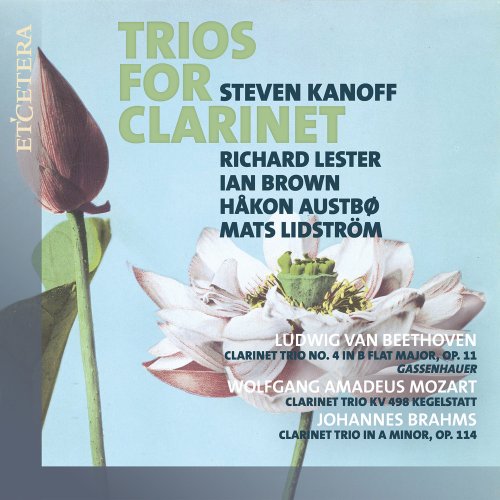
Artist: Steven Kanoff
Title: Trios for Clarinet
Year Of Release: 2021
Label: Etcetera
Genre: Classical
Quality: flac lossless
Total Time: 01:08:41
Total Size: 285 mb
WebSite: Album Preview
TracklistTitle: Trios for Clarinet
Year Of Release: 2021
Label: Etcetera
Genre: Classical
Quality: flac lossless
Total Time: 01:08:41
Total Size: 285 mb
WebSite: Album Preview
01. Clarinet Trio No. 4 in B Flat Major, Op. 11 Gassenhauer: I. Allegro Con Brio
02. Clarinet Trio No. 4 in B Flat Major, Op. 11 Gassenhauer: II. Adagio
03. Clarinet Trio No. 4 in B Flat Major, Op. 11 Gassenhauer: III. Tema: Prio ch'io l'impegno-Allegretto
04. Clarinet Trio Kv. 498 Kegelstatt: I. Andante
05. Clarinet Trio Kv. 498 Kegelstatt: II. Menuetto-Trio
06. Clarinet Trio Kv. 498 Kegelstatt: III. Rondo allegretto
07. Clarinet Trio In A Minor Op. 114: I. Allegro
08. Clarinet Trio In A Minor Op. 114: II. Adagio
09. Clarinet Trio In A Minor Op. 114: III. Andantino grazio
10. Clarinet Trio in A Minor Op. 114: IV. Allegro
It must have been an exceptionally eager Euterpe who steered Richard Mühlfeld on the path of Johannes Brahms in 1891. The clarinetist of the Meiningen court orchestra impressed the almost 60 year-old, retired symphonist to such an extent that the latter arose from his creative lethargy, went back to work and composed several pieces featuring the clarinet that same year. We catch a glimpse of Brahms’ beguilement through the pages of the first Mühlfeld-inspired creation: the Trio opus 114. Throughout its four parts, Brahms makes the most of the clarinet’s registers: the upper echelon combining power with brilliance, the lower boasting a range of ambers suited to grand melodic gestures, the middle harboring an energy with potential for vigorous figuration, rhythmic vitality and dance-like dash. The Trio is a prime exponent of Brahms’ late style, balancing thematic complexity with textural clarity, a warm, romantic tone, ingenious polyphony and moments of unrestrained lyricism. In the opening Allegro organic melodic lines feed into artful counterpoint, leaving ample space for rhetoric and emotion. The Adagio springs from a handful of motifs and (perhaps even more so) from an exploration of the subdued colors resulting from the layering of instruments, registers and dynamics. While the Andante grazioso sways from waltz to Ländler and back, the final Allegro hints to the traditional roots of the clarinet by brushing against the Hungarian Dances that - about ten years earlier - had made their composer a celebrity.
![VA - The Art of HiFi Vol. 3: Percussion (2023) [DSD256]](https://www.dibpic.com/uploads/posts/2026-08/1787844328_oct0043.jpg "VA - The Art of HiFi Vol. 3: Percussion (2023) [DSD256]")
![Enneads - Enneads (2026) [Hi-Res]](https://img.israbox.com/img/2026-08/28/cvc7jurwq9gdrnuxuzyxtvgcv.jpg "Enneads - Enneads (2026) [Hi-Res]")
![Wyclef Jean - Q Theory - Quantum Leap, Vol. 2 (2026) [Hi-Res]](https://img.israbox.com/img/2026-08/31/qe5stsxpf31pb0ptahgpqaq78.jpg "Wyclef Jean - Q Theory - Quantum Leap, Vol. 2 (2026) [Hi-Res]")
![Jared Schonig - Big Band: Live at Dizzy's (Live) (2026) [Hi-Res]](https://img.israbox.com/img/2026-08/28/v4zdhqwm35azwr9dp57rfb7y1.jpg "Jared Schonig - Big Band: Live at Dizzy's (Live) (2026) [Hi-Res]")
![Yoko Miwa, Mikayla Shirley - The Midnight Hour (2026) [Hi-Res]](https://img.israbox.com/img/2026-08/28/9g7f1wmzq37imcszk7f1h4z38.jpg "Yoko Miwa, Mikayla Shirley - The Midnight Hour (2026) [Hi-Res]")