Diogenes Quartet - Bruch: Complete String Quartets (2016)
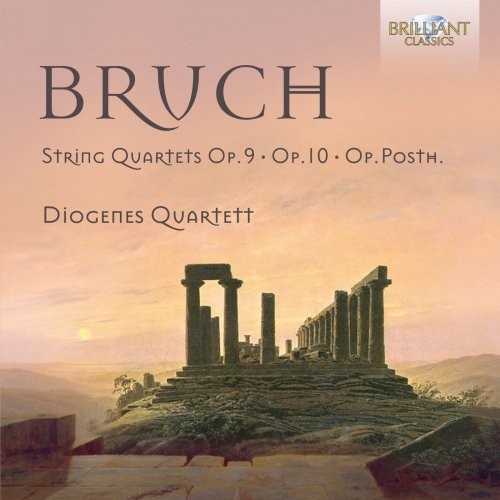
Artist: Diogenes Quartet
Title: Bruch: Complete String Quartets
Year Of Release: 2016
Label: Brilliant Classics
Genre: Classical
Quality: flac lossless
Total Time: 01:19:55
Total Size: 382 mb
WebSite: Album Preview
TracklistTitle: Bruch: Complete String Quartets
Year Of Release: 2016
Label: Brilliant Classics
Genre: Classical
Quality: flac lossless
Total Time: 01:19:55
Total Size: 382 mb
WebSite: Album Preview
01. String Quartet in C Minor, Op. Posth.: I. Adagio ma non troppo - Allegro molto
02. String Quartet in C Minor, Op. Posth.: II. Adagio
03. String Quartet in C Minor, Op. Posth.: III. Scherzo. Allegro molto
04. String Quartet in C Minor, Op. Posth.: IV. Finale. Presto agitato
05. String Quartet No. 1 in C Minor, Op. 9: I. Andante - Allegro ma non troppo
06. String Quartet No. 1 in C Minor, Op. 9: II. Adagio
07. String Quartet No. 1 in C Minor, Op. 9: III. Allegro molto energico
08. String Quartet No. 1 in C Minor, Op. 9: IV. Molto vivace
09. String Quartet No. 2 in E Major, Op. 10: I. Allegro maestoso
10. String Quartet No. 2 in E Major, Op. 10: II. Andante quasi adagio
11. String Quartet No. 2 in E Major, Op. 10: III. Vivace non troppo - Un poco meno vivo
12. String Quartet No. 2 in E Major, Op. 10: IV. Finale. Vivace
The two opus-numbered quartets of Max Bruch were first recorded only in 1993 by an Italian ensemble, and the recognised expertise of the Diogenes Quartet in music of this style and era makes their new recording the obvious first choice, but their album is further enhanced by the inclusion of a C minor quartet which was rediscovered as recently as 2013, in a box in the archives of the Mozart-Stiftung in Frankfurt. Further research revealed that this was an unpublished work by Bruch, composed in 1852 at the age of 14, in application for a scholarship from the foundation. Louis Spohr, in approving the application, was fulsome in his praise: ‘I am very interested to learn more about him, as I prophesy a brilliant career for him.’
This youthful effort is clearly influenced by the estimable models of Beethoven and Schubert, but its composer’s melodic gift is already revealed by the slow movement, an enchanting Notturno of great expressive strength. This is a subtle, finely balanced movement, woven with precocious sophistication by the teenage Bruch into an intricate fabric of voices, which cushions the sensitive melody, as it were, on a bed of roses. Four years later – and still only 18 – he referred back to elements of the quartet in his first acknowledged work in the genre, designated Op.9
The tunefulness of all three quartets will come as no surprise to anyone familiar with his best-known (only known?) work, the First Violin Concerto, and efforts have been made from time to time to expand the recognition outside his native Germany of a broad oeuvre in all the major genres, but with limited success. The string quintets have achieved a fragile toehold on the repertoire, but perhaps thanks to the Diogenes’ spirited advocacy, the quartets will join them.
![Alex Puddu - Francia Meccanica (2026) [Hi-Res]](https://www.dibpic.com/uploads/posts/2026-08/1787747698_gu9noh3dd4obl_600.jpg "Alex Puddu - Francia Meccanica (2026) [Hi-Res]")
![Fania All Stars - Fania All Stars Live In Japan 1976 (Remastered 2026) (2026) [Hi-Res]](https://img.israbox.com/img/2026-08/30/fx6f4l5motbsy457ouy6qnxft.jpg "Fania All Stars - Fania All Stars Live In Japan 1976 (Remastered 2026) (2026) [Hi-Res]")
![Klöve - Klöve (2026) [Hi-Res]](https://www.dibpic.com/uploads/posts/2026-08/1787743956_592x592bb.jpg "Klöve - Klöve (2026) [Hi-Res]")
![Jared Schonig - Big Band: Live at Dizzy's (Live) (2026) [Hi-Res]](https://img.israbox.com/img/2026-08/28/v4zdhqwm35azwr9dp57rfb7y1.jpg "Jared Schonig - Big Band: Live at Dizzy's (Live) (2026) [Hi-Res]")
![Alicia Witt - Between Heaven and Earth (2026) [Hi-Res]](https://img.israbox.com/img/2026-08/29/vdfub0as4sebuz9ep06t3j7q4.jpg "Alicia Witt - Between Heaven and Earth (2026) [Hi-Res]")