Bournemouth Symphony Orchestra, Kirill Karabits - Khachaturian: Spartacus & Gayaneh (Excerpts) (2010) CD-Rip
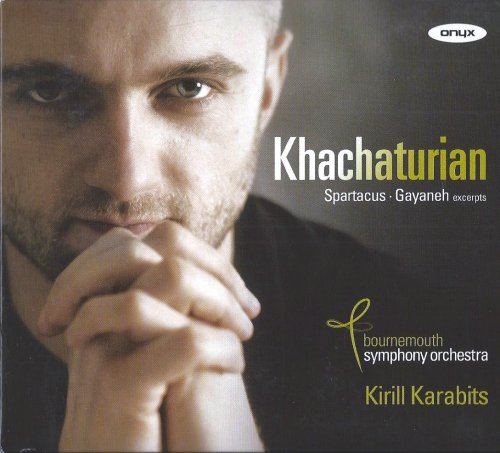
Artist: Bournemouth Symphony Orchestra, Kirill Karabits
Title: Khachaturian: Spartacus & Gayaneh (Excerpts)
Year Of Release: 2010
Label: Onyx Classics
Genre: Classical
Quality: FLAC (tracks)
Total Time: 72:49
Total Size: 350 Mb
WebSite: Album Preview
Tracklist: Title: Khachaturian: Spartacus & Gayaneh (Excerpts)
Year Of Release: 2010
Label: Onyx Classics
Genre: Classical
Quality: FLAC (tracks)
Total Time: 72:49
Total Size: 350 Mb
WebSite: Album Preview
01. Spartacus (excerpts): Introduction - Dance of the Nymphs
02. Adagio of Aegina and Harmodius
03. Variation of Aegina and Bacchanalia
04. Scene and Dance with Crotala
05. Adagio of Spartacus and Phrygia
06. Dance of the Gaditanian Maidens
07. Gayaneh (excerpts): Dance of Friends
08. Carpet embroidery scene
09. Lezginka
10. Uzundara
11. Dance of the Girls
12. Scene and Dance
13. Aysha and Gayane
14. Ayshas monologue
15. Dance of the mountaineers
16. Sword dance
17. Hopak
Performers:
Bournemouth Symphony Orchestra
Kirill Karabits - conductor
Sometimes there is a perfect match between repertoire, conductor, and orchestra: this album is one such example. Featuring the music from two ballets by Armenian composer Aram Khachaturian, it is very accessible to those who claim they do not like classical music, as its 20th century tonalities and film score-like qualities completely draw the listener in. The first track is dramatic and grand, worthy of a gladiator like Spartacus, and it leads into an adagio that is ethereal with cellos and harps. Conductor Karabits gets a lush expressiveness from the Bournemouth Symphony Orchestra, teasing out long, sweeping lines in the violins and creating extremes in mood and emotion. Expansive musical moments are indeed expansive, and poignant moments are appropriately lyrical and tender. Some of the tone color is reminiscent of Ravel's orchestral works, and there are strong dynamic contrasts that keep the listener attentive. It does not take a great stretch of the imagination to visualize the dancers playfully leaping in a bacchanal here, posing in an arabesque there, or even Baryshnikov pirouetting and tumbling. In Gayaneh, Khachaturian's interest in folk music is more evident (like Bartók, he drew on folk melodies for inspiration). Khachaturian fans may recognize the tune from the B section of "Sabre Dance" (which actually appears in its entirety later in the album), which is from an Armenian folk melody. The album concludes with a regal-sounding procession that is indeed a fitting ending, but it surprises the listener by letting loose into a carnivalesque romp that ends rather suddenly, almost unresolved. One could argue that there is an abundance of beauty and emotion in this album -- dare one go so far as to say schmaltz? -- much like in the music of Hollywood films in their golden age of the 1930s and '40s. But sometimes the world needs that abundance, especially when it is played so movingly by a musically sensitive orchestra and conductor.
![David Champagne - Come Before Winter (2026) [Hi-Res]](https://img.israbox.com/img/2026-10/15/m2fyz4ydrktx40yl47863sgw9.jpg "David Champagne - Come Before Winter (2026) [Hi-Res]")
![Omasta - Hits Different (2026) [Hi-Res]](https://img.israbox.com/img/2026-10/16/35dc1kesnb7c9utlhu68v4n8x.jpg "Omasta - Hits Different (2026) [Hi-Res]")


![Bert Kaempfert - Dancing In Wonderland (Remastered) (2021) [Hi-Res]](https://www.dibpic.com/uploads/posts/2026-10/1792086054_lu1wbv8zm6e8a_600.jpg "Bert Kaempfert - Dancing In Wonderland (Remastered) (2021) [Hi-Res]")
![Gotts Street Park - Somewhere Between (2026) [Hi-Res]](https://www.dibpic.com/uploads/posts/2026-10/1791979653_folder.jpg "Gotts Street Park - Somewhere Between (2026) [Hi-Res]")
![Yokaï - Humboldt (2026) [Hi-Res]](https://img.israbox.com/img/2026-10/16/t0uqt57ultes1ubzchnrwdno6.jpg "Yokaï - Humboldt (2026) [Hi-Res]")
![Douglas J. Cuomo, Joe Lovano & The Overlook - Seven Limbs (2026) [Hi-Res]](https://img.israbox.com/img/2026-10/17/7edimgulaz4yv3f8x95cxo2wr.jpg "Douglas J. Cuomo, Joe Lovano & The Overlook - Seven Limbs (2026) [Hi-Res]")