Chandraveena S Balachander - Raga Shukla Bilawal - Raga Alapana and Pallavi (2021)
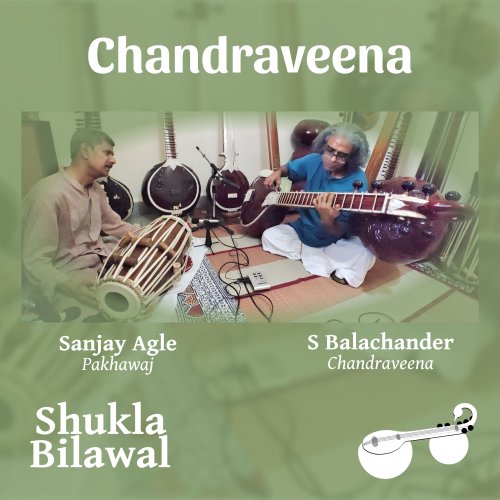
Artist: Chandraveena S Balachander
Title: Raga Shukla Bilawal - Raga Alapana and Pallavi
Year Of Release: 2021
Label: Horus Music Limited
Genre: Classical
Quality: flac lossless
Total Time: 01:34:43
Total Size: 407 mb
WebSite: Album Preview
TracklistTitle: Raga Shukla Bilawal - Raga Alapana and Pallavi
Year Of Release: 2021
Label: Horus Music Limited
Genre: Classical
Quality: flac lossless
Total Time: 01:34:43
Total Size: 407 mb
WebSite: Album Preview
01. Raga Shukla Bilawal-Raga Alapana
02. Raga Shukla Bilawal-Pallavi in Chautala
In this session, I present Raga Shukla Bilawal on Chandraveena. Shukla Bilawal is a morning Raga and belongs to the Bilawal family of Ragas. This is what is called a Bhashanga Raga - one which uses a note from outside the main Raga family. The beauty of this Raga lies in the vakra (zig-zag) use of the “outside” note, namely, Komal Nishad. Here, I explore the Raga extensively in Alap, Jod and Jhala, and conclude with a Pallavi in Chautala (12 beats). I am privileged to be accompanied by Pandit Sanjay Agle for the Pallavi session.
Pandit Sanjay Agle is a master Pakhawaj player coming from a family and tradition of Pakhawaj players. His grandfather Ambadas Agle was a legendary pakhawaj player. Sanjay Agle learnt from his father Kalidas Agle, and another renowned pakhawaj player Swami Pagaldas. His sister Chitrangana is also a very well known Pakhawaj player.
Pallavi also known as Bandish, Gat, Kriti or composition is a melodic line (or lines) bound by a Tala or rhythmic cycle. In some cases, lyrics are set to a melody in the chosen Raga and Tala, whereas in other cases it is just a melodic line with no lyrical or literary meaning, called Swarajati or Gat. Many instrumental compositions use the latter format, to make the most of “playing with the rhythm”.
In this particular composition, the Pallavi takes off on the 7th beat (making the 7th beat the Uthao or Eduppu) and ends on the 1st beat of the next cycle (the Sama). Try to follow the composition with this in mind and observe how melodic phrases are created approaching the Sama. While most of the melodic patterns are off-beat, yet the final phrase comes on the Sama with a subtle intonation. This can be quite challenging for the both the artists (the melodic artist and the percussionist), since even small errors on their parts could result in getting out of sync at the Sama.

![Giuseppe Guarrella Niwas Quartet - New Call (2026) [Hi-Res]](https://www.dibpic.com/uploads/posts/2026-10/1791051038_o5muqiwiwd99g_600.jpg "Giuseppe Guarrella Niwas Quartet - New Call (2026) [Hi-Res]")

![Sarah Pillow - Wanderer (2026) [Hi-Res]](https://www.dibpic.com/uploads/posts/2026-10/1791165914_o32vet9lf6ema_600.jpg "Sarah Pillow - Wanderer (2026) [Hi-Res]")