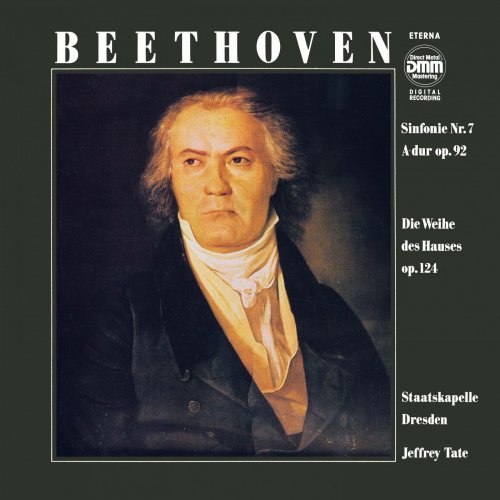
1. Sinfonie No. 7, Op. 92: I. Poco sostenuto : Vivace (Remastered)
2. Sinfonie No. 7, Op. 92: II. Allegretto (Remastered)
3. Sinfonie No. 7, Op. 92: III. Presto (Remastered)
4. Sinfonie No. 7, Op. 92: IV. Allegretto con brio (Remastered)
5. Die Weihe des Hauses, Op. 124 (Remastered)
The seventh and eighth symphonies of Beethoven are in a very similar relationship to each other in terms of time of origin and content orientation as the fifth and sixth: they were conceived almost simultaneously and yet are opposites that could hardly be imagined in a more extreme way. Right from the start, the eighth in the music world’s appraisal was overshadowed by the powerful seventh because of its more modest internal and external format. When Beethoven presented this work to the Viennese audience in a large concert on December 8, 1813 - it had already been completed a good year earlier - together with the battle symphony “Wellington's Victory or the Battle of Vittoria”, he experienced the greatest triumph of his artistic career . “The outbursts of jubilation during the A major symphony” - as his friend Anton Schindler reported - “exceeded everything that had been experienced in the concert hall up to then.” If you want to explain this unusually stormy success, you have to take a look at the historical situation into which the work had an impact.
A few weeks earlier, in October 1813, Napoleon Bonaparte had been defeated by the allied Prussian, Austrian and Russian armies in the Battle of Leipzig; With this, after many sacrificed struggles, the great period of the Wars of Liberation came to an end with the liberation of the European peoples from the yoke of Napoleonic foreign rule. The listeners of that concert undoubtedly experienced the Seventh Symphony as a mirror of these tremendous events, as a great manifestation of a combative will for freedom, and Beethoven had certainly designed it as such. It is the work with which he challenged the once so revered, then all the more despised usurper in his place, in the spirit of the proud statement with which he commented on Napoleon's victory at Jena and Auerstedt: “It's a shame that I have them I don't understand the art of war as the art of music: I would defeat it. ”It is of no small importance that the symphony was created at a time when the victory over Napoleon was by no means achieved, in fact, could not even be foreseen. Because in 1812, when Beethoven was working on it, Napoleon was marching with the largest army that existed in world history, just to Russia, where he would experience a devastating defeat the following winter. Beethoven's work is therefore an appeal and an appeal, admittedly also, in the tremendous jubilation of the final movement, a prophetic anticipation of victory. The fact that the audience at the premiere spontaneously understood it that way was undoubtedly an exhilarating experience for Beethoven, and in an address of thanks to the performers he emphatically acknowledged such an interpretation: “Nothing fulfilled us all but the pure feeling of love for the country and joy Sacrifice of our strength for those who have sacrificed so much. ”When Richard Wagner, ignorant of these contexts, called the Seventh Symphony an“ apotheosis of dance ”, he certainly did not characterize it perfectly. But this formula at least points to the unheard-of rhythmic forces that are unleashed in this work and that primarily shape its character. A rhythmic formula is almost omnipresent in every movement, and this dominance of the rhythmic gives the music its captivating, propulsive verve that no listener can escape. This time Beethoven put a slow introduction in front of the first movement, which he had omitted in the two preceding symphonies. It is assigned the task of developing the impulses of movement from the onerous tension, which then drive the following rapid main part, or, to put it in physical terms: to convert the potential energy into kinetic. Above all, ascending scales serve this purpose, gradually bringing the musical events into flux. An important role in this process of activation is played by a marching melody that is intoned by the woodwinds piano, as if from a distance. After that, however, the characteristic dotted six-eighth rhythm develops in the last bars of the introduction, which then pulsates through the Vivace part almost without any interruption. Beethoven apparently copied the main theme of the movement from a folk song from the Lower Rhine, which he had apparently been familiar with since childhood. The second movement is one of the strangest compositions by Beethoven, unforgettable in its solemn movement and sublime seriousness. Again the entire piece is carried by a rhythmic formula, this time it has a dactylic character. It suggests to the listener the idea of a heavy and burdensome funeral procession passing by, and in fact Beethoven may have thought of those “who sacrificed us so much” when composing the composition. It deserves interest that the Meister recorded the main idea of the sentence as early as 1806 and that, as his pupil Karl Czerny passed down, it should be based on a Russian folk song. It was probably originally intended for the third of the string quartets, Op. 59, dedicated to the Russian Count Andrei Rasumovsky. He appears four times in succession, each shifted up an octave, and from the first repetition, first in the violas and cellos, a plaintive melody joins him, which from now on always remains connected with him. The combination of this cantilena with the rigid and relentless pace of the main theme creates a truly unheard-of intensity of expression. After this haunting, albeit always restrained, lamentation, in the two following movements the impetuous movement, driven by the most extreme energies, wins the upper hand again. A lyrical middle section contrasts with the fiery, stormy Scherzo, the melody of which is said to be close to a Lower Austrian pilgrimage song. The finale immediately pulls the listener into a rapid vortex of unheard of vitality. The main theme receives its character from the obstinate repetition of the same motif and the hairy emphasis on the “weak” parts of the beat - both are characteristics of Slavic folk music. It does not seem to be by any means a coincidence that Beethoven here once again shows relationships to the music of the Eastern European peoples, as in the slow movement: perhaps this was intended to be a reminder of the events of the time. In the further course of the movement, marching intonations can be heard clearly; The development also drives into wild chord repetitions hammered with extreme force in dotted rhythm, in which the image of a stormy rider attack appears almost inevitably. The passage is almost identical to a section from a composition “Triumph der Republik” by the French revolutionary musician Francois Gossec and is an impressive testimony to the sources from which Beethoven received the strength for such a victorious music. Beethoven's last overture, “The Consecration of the House” op. 124, was created within a few days in 1822 as a commission for the opening of the theater in Josephstadt in Vienna, which took place on October 3rd. In keeping with the occasion, the composer refrained from presenting a specific programmatic idea as in his other overtures and instead concentrated on the general expression of the solemn and festive. But he achieved this primarily by orienting himself towards the example of George Frideric Handel, whose works he was particularly interested in at this time. In relation to this overture, Beethoven said to his secretary Anton Schindler that he had “found two motifs, one of which is to be worked out in the free, the other in the strict, in the Handel style.” In fact, it is in this one for him Composition succeeded in melting elements of the strict, ie contrapuntal, style into the symphonic form. The overture begins with a solemn, march-like part, which is mainly voiced by the winds, leads over to an intermediate movement opened by blaring trumpet fanfares and ends in the unusually broad main part, which begins in the manner of a Handelian double fugue, but continues in its further course also includes homophonic parts in which the main motif of the fugue theme develops in many variations. (Wolfgang Marggraf (1987)
Staatskapelle Dresden
Jeffrey Tate, conductor
Digitally remastered

![Duckworth & Duprez - Fuerza (2026) [Hi-Res]](https://img.israbox.com/img/2026-09/20/30jcdmum9zh3t7wtkjwprcsbk.jpg "Duckworth & Duprez - Fuerza (2026) [Hi-Res]")
![Kaoru Watanabe - The Arch (2026) [Hi-Res]](https://img.israbox.com/img/2026-09/17/smetaus871im09t0otcz370ce.jpg "Kaoru Watanabe - The Arch (2026) [Hi-Res]")
![Motohiko Hino - Toko Flash (1977) [2017]](https://www.dibpic.com/uploads/posts/2026-09/1789913925_ff.jpg "Motohiko Hino - Toko Flash (1977) [2017]")