Bruno Walter - Brahms: Symphony No. 2 (1960) [2016] Hi-Res
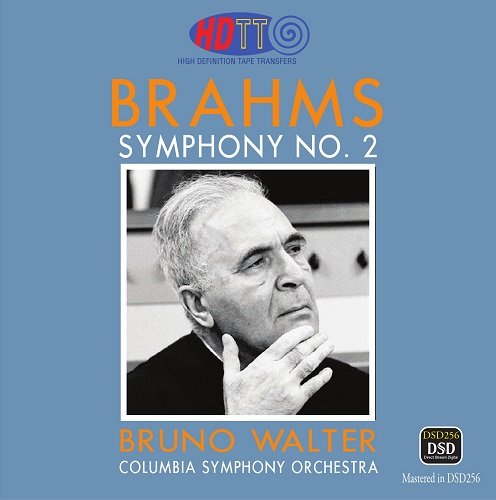
Artist: Bruno Walter
Title: Brahms: Symphony No. 2
Year Of Release: 1960 [2016]
Label: HDTT [HDTT4360]
Genre: Classical
Quality: FLAC (Tracks) | 24 Bit/192 kHz
Total Time: 00:41:05
Total Size: 1,7 GB (+3%rec.)
WebSite: Album Preview
Johannes Brahms composed his Symphony No. 2 in the summer of Title: Brahms: Symphony No. 2
Year Of Release: 1960 [2016]
Label: HDTT [HDTT4360]
Genre: Classical
Quality: FLAC (Tracks) | 24 Bit/192 kHz
Total Time: 00:41:05
Total Size: 1,7 GB (+3%rec.)
WebSite: Album Preview
1877, less than a year after the premiere of his Symphony No. 1 (Op.
68 in C minor) -- an astonishing fact given that the former had
taken him fifteen years to complete. Finally confident in his abilities
as a symphonist, and less troubled by the looming shadow of Beethoven, Brahms created a much more spontaneous work that was
well received by both critics and audiences. When compared with the
works of his contemporaries, this piece is conservative in both
orchestration and formal structure. But it is by no means reactionary.
Rather, Brahms revised and expanded upon the eighteenth century
model, largely replacing thematic contrast with transformation and
variation, and adding his distinctive richness of harmony and rhythm.
There is both unity and variety in this symphony: Brahms manages
to combine the light and dark, the lyrical and forceful, the extroverted
and introspective -- all the while growing the piece organically from
the "seed" of the very first three notes (D-C sharp-D, heard in the
cellos and the double basses). This compositional economy is
instinctively apparent to the ear, and helps to make the entire work
intelligible without sacrificing interest or spontaneity.
Brahms's orchestration is full, rich, and often ingenious. He chooses
to make the ensemble one unified voice, and has introduced his
entire spectrum of instrumental colors after only 40 bars; however,
one never gets the sense that he is overusing the orchestra. Instead
he creates a texture in constant flux, shifting the focus of the ear,
and extracting individual colors to great effect.
The piece opens with the three-note germinating cell and a simple
horn melody; we are then introduced to two subjects in turn, the
first announced by the violins, and the second by the cellos and
violas in a luxurious duet. After developing both themes, Brahms
creates an interesting recapitulation by briefly combining the initial
horn melody and the first subject, and then dwelling extensively on
the second subject. A short coda is attached to the end.
Two bassoons color the second movement's opening cello theme
with a dark counterpoint, creating an immediate contrast to the first
movement. It is here that we begin to see the more introspective
side of Brahms, although this is by no means a brooding movement; there a surprising variety of expression within the slow
prevailing tempo.
With the third movement, Brahms for the first time departs from a
string-dominated texture, and allows a solo oboe to introduce the
opening theme, while pizzicato cellos and a woodwind choir provide
accompaniment. Full of rhythmic interest, this movement has
frequent meter changes, expectant fermatas, and Brahms' distinctive
cross-rhythms.
The moody and unpredictable finale oscillates between manic
energy and somberness; Brahms is constantly changing direction,
sometimes so abruptly as to pull the rug out from beneath your
feet. The motion never stops, and when the final D major fanfare
arrives, one has the sense of having been on a wild ride.
Tracks:
I - Allegro Non Troppo 15:09
II - Adgio Non Troppo 10:39
III - Allegretto Grazioso 5:34
IV - Allegro Con Spirito 9:37
Personnel:
Bruno Walter
The Columbia Symphony Orchestra
![Bruno Walter - Brahms: Symphony No. 2 (1960) [2016] Hi-Res](https://www.dibpic.com/uploads/posts/2021-10/1633886345_back.jpg)
![Duckworth & Duprez - Fuerza (2026) [Hi-Res]](https://img.israbox.com/img/2026-09/20/30jcdmum9zh3t7wtkjwprcsbk.jpg "Duckworth & Duprez - Fuerza (2026) [Hi-Res]")
![Kaoru Watanabe - The Arch (2026) [Hi-Res]](https://img.israbox.com/img/2026-09/17/smetaus871im09t0otcz370ce.jpg "Kaoru Watanabe - The Arch (2026) [Hi-Res]")
![Motohiko Hino - Toko Flash (1977) [2017]](https://www.dibpic.com/uploads/posts/2026-09/1789913925_ff.jpg "Motohiko Hino - Toko Flash (1977) [2017]")