Diana Damrau - Arie di Bravura: Mozart, Salieri, Righini (2007) CD-Rip
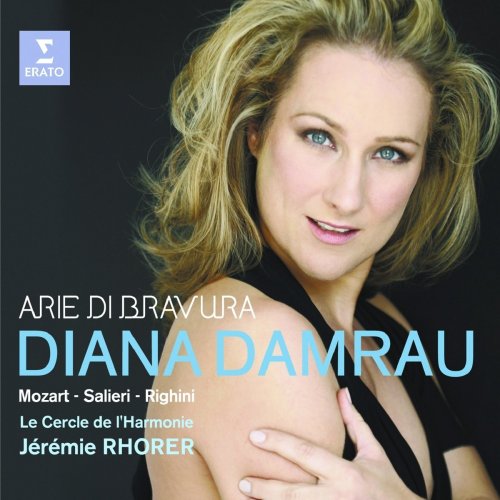
Artist: Diana Damrau
Title: Arie di Bravura: Mozart, Salieri, Righini
Year Of Release: 2007
Label: Virgin Classics
Genre: Classical
Quality: FLAC (tracks+.cue,log,scans)
Total Time: 67:36
Total Size: 388 Mb
WebSite: Album Preview
Tracklist:Title: Arie di Bravura: Mozart, Salieri, Righini
Year Of Release: 2007
Label: Virgin Classics
Genre: Classical
Quality: FLAC (tracks+.cue,log,scans)
Total Time: 67:36
Total Size: 388 Mb
WebSite: Album Preview
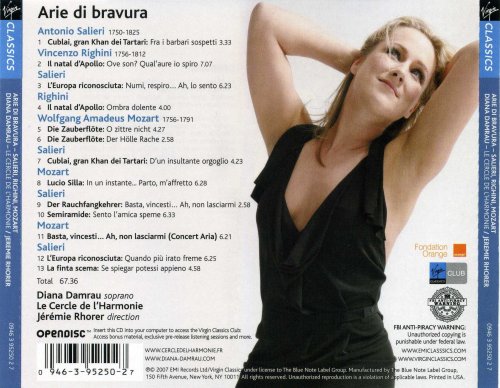
Salieri: Cublai, gran Khan dei Tartari
01. Fra i barbari sospetti (03:37)
Righini: Il natal d'Apollo
02. Ove son? Qual'aure io spiro (07:09)
Salieri: L'Europa riconosciuta
03. Numi, respiro? Ah, lo sento (06:26)
Righini: Il natal d'Apollo
04. Ombra dolente (04:04)
Mozart: Zauberflöte
05. O zittre nicht (04:31)
06. Der Hölle Rache (03:01)
Salieri: Cublai, gran Khan dei Tartari
07. D'un insultante orgoglio (04:29)
Mozart: Lucio Silla
08. In un instante... Parto, m'affretto (06:32)
Salieri: Der Rauchfangkehrer
09. Basta, vincesti... Ah non lasciarmi (03:03)
Salieri: Semiramide
10. Sento l'amica speme (06:39)
Mozart: Konzertarie KV 295a
11. Basta, vincesti ... Ah, non lasciarmi (06:26)
Salieri: L'Europa riconosciuta
12. Quando piu irato freme (06:34)
Salieri: La finta scema
13. Se spiegar potessi appieno (05:00)
Performers:
Diana Damrau, soprano
Le Cercle de l'Harmonie
Conductor: Jeremie Rhorer
Diana Damrau first made her mark as a sensational Queen of the Night – a part she has just relinquished – and has garnered rave reviews in roles such as Konstanze, Zerbinetta and Rossini’s Rosina. One or two other coloratura sopranos today can match her diamantine brilliance and agility, but few, if any, command such fullness in the middle and lower ranges. The Queen of the Night’s two showpieces are both superlatively sung and sharply characterised. In the first aria Damrau suggests an over-the-top pathos and feigned tenderness, before revealing the Queen’s true nature in the hard, increasingly feverish glitter of the Allegro. She is also one of the rare singers to banish mechanical doll associations in the spitfire coloratura of “Der Hölle Rache”.
Damrau powerfully catches Giunia’s anguish in an aria from Mozart’s early Lucio Silla, and softens her naturally bright, penetrating tone as the grieving Dido in the concert aria “Ah, non lasciarmi”. She offers two arias, including a touching, Gluckian ombra scene, by Mozart’s Bolognese contemporary Vincenzo Righini. But seven of the 13 tracks here are devoted to the much-maligned Antonio Salieri, whose indignant or distraught heroines Damrau portrays with as much panache and vocal glamour as did Bartoli on her “Salieri Album” (Decca, 11/03; there are no overlaps, incidentally, between the two discs). Highlights include an aria from Semiramide, where voice and instruments vie in a sinfonia concertante, à la Mozart’s “Martern aller Arten”, and two coruscating numbers from L’Europa riconosciuta, one of which takes the soprano up to a vertiginous F sharp, capping the Queen of the Night’s top F. If some ears might detect an occasional harshness in Damrau’s upper register, criticism is all but silenced by her virtuosity and histrionic flair, evident even without the benefit of her vivid stage presence. Under Jérémie Rhorer’s alert direction, the Parisian period orchestra match the singer all the way in style and gusto.
Damrau powerfully catches Giunia’s anguish in an aria from Mozart’s early Lucio Silla, and softens her naturally bright, penetrating tone as the grieving Dido in the concert aria “Ah, non lasciarmi”. She offers two arias, including a touching, Gluckian ombra scene, by Mozart’s Bolognese contemporary Vincenzo Righini. But seven of the 13 tracks here are devoted to the much-maligned Antonio Salieri, whose indignant or distraught heroines Damrau portrays with as much panache and vocal glamour as did Bartoli on her “Salieri Album” (Decca, 11/03; there are no overlaps, incidentally, between the two discs). Highlights include an aria from Semiramide, where voice and instruments vie in a sinfonia concertante, à la Mozart’s “Martern aller Arten”, and two coruscating numbers from L’Europa riconosciuta, one of which takes the soprano up to a vertiginous F sharp, capping the Queen of the Night’s top F. If some ears might detect an occasional harshness in Damrau’s upper register, criticism is all but silenced by her virtuosity and histrionic flair, evident even without the benefit of her vivid stage presence. Under Jérémie Rhorer’s alert direction, the Parisian period orchestra match the singer all the way in style and gusto.
![The Brooks - Live in Brazil (2026) [Hi-Res]](https://www.dibpic.com/uploads/posts/2026-10/1791017380_cover.jpg "The Brooks - Live in Brazil (2026) [Hi-Res]")



![Christy Doran - Disambiguation (2026) [Hi-Res]](https://img.israbox.com/img/2026-10/01/2wtxc0e2kr1trngdtszftosvy.jpg "Christy Doran - Disambiguation (2026) [Hi-Res]")