Ensemble Officium, Instrumenta Musica, Wilfried Rombach - Cifra: The Loreto Vespers (2011)
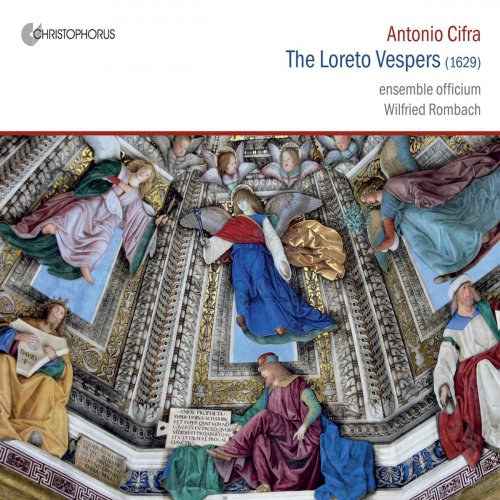
Artist: Ensemble Officium, Instrumenta Musica, Wilfried Rombach
Title: Cifra: The Loreto Vespers
Year Of Release: 2011
Label: Christophorus
Genre: Classical
Quality: flac lossless (tracks) +Booklet
Total Time: 01:07:05
Total Size: 311 mb
WebSite: Album Preview
TracklistTitle: Cifra: The Loreto Vespers
Year Of Release: 2011
Label: Christophorus
Genre: Classical
Quality: flac lossless (tracks) +Booklet
Total Time: 01:07:05
Total Size: 311 mb
WebSite: Album Preview
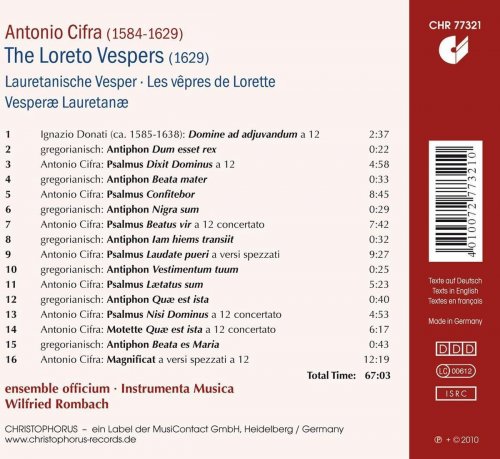
01. Salmi boscarecci concertati: Domine ad adjuvandum
02. Dum esset rex [Offizium zum Fest Maria Verkundigung]
03. Loreto Vespers: Dixit Dominus
04. Beata Mater
05. Loreto Vespers: Confitebor
06. Nigra Sum
07. Loreto Vespers: Beatus vir
08. Iam Hiems Transiit
09. Loreto Vespers: Laudate pueri
10. Vestimentum Tuum
11. Loreto Vespers: Laetatus sum
12. Quae Est Ista
13. Loreto Vespers: Nisi Dominus
14. Loreto Vespers: Quae est ista
15. Beata es Maria
16. Loreto Vespers: Magnificat
Antonio Cifra was born probably in Gaeta, south of Rome, in 1584. From 1605 to 1607 he was maestro at the Roman Seminary, and from 1608 to 1609 he held the same position at the German College in Rome. In 1609 he was hired as maestro di cappella at Santa Casa in Loreto, where he remained for the rest of his life. Cultural connections between Loreto and Rome were close (since Loreto was a pilgrimage destination), and he maintained contact with the composers in Rome during this period Cifra was a prolific composer, with 45 separate publications to his credit: they included psalms, motets, litanies, "Scherzi sacri," masses, polychoral motets, and sacred songs, as well as secular music including madrigals in both the Renaissance a cappella and Baroque concertato forms. Stylistically, Cifra's music varies between masses in the Palestrina style, with much use of homophony (as desired by the Counter-Reformation Council of Trent, which had required that polyphonic elaboration be minimised), and more progressive works in the Venetian style. He was also one of the few composers to be influenced by the extreme chromaticism of Carlo Gesualdo. The psalms and motets for 12 voices, published in Venice in the year of his death, and presented in this recording as Vesperae Lauretanae, reveal Cifra’s mature late style.
![RYMDEN - Today May Be Tomorrow (2026) [Hi-Res]](https://www.dibpic.com/uploads/posts/2026-09/1790081236_folder.jpg "RYMDEN - Today May Be Tomorrow (2026) [Hi-Res]")
![Hyperion Knight - Gershwin by Knight (2015) [DSD]](https://www.dibpic.com/uploads/posts/2026-09/1789942172_wilson9231.jpg "Hyperion Knight - Gershwin by Knight (2015) [DSD]")
![Achim Seifert Project - Woven Strings (2026) [Hi-Res]](https://img.israbox.com/img/2026-09/24/7zcwxc6d08s8v9e6b1hq4wve2.jpg "Achim Seifert Project - Woven Strings (2026) [Hi-Res]")