Trevor Pinnock, The English Concert - Händel: Belshazzar (1991)
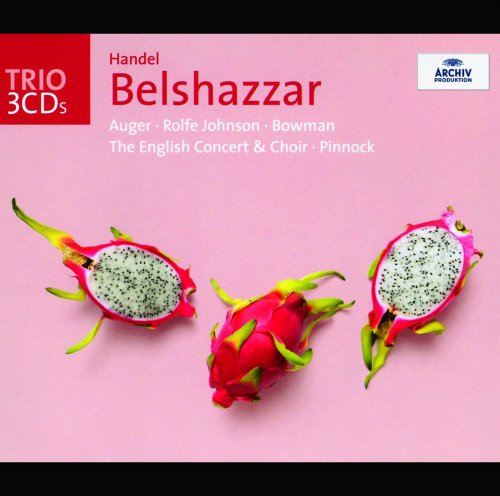
Artist: Trevor Pinnock, The English Concert
Title: Händel: Belshazzar
Year Of Release: 1991
Label: Archiv Produktion
Genre: Classical
Quality: FLAC (tracks) / MP3 320 Kbps
Total Time: 02:50:43
Total Size: 867 / 436 Mb
WebSite: Album Preview
Tracklist: Title: Händel: Belshazzar
Year Of Release: 1991
Label: Archiv Produktion
Genre: Classical
Quality: FLAC (tracks) / MP3 320 Kbps
Total Time: 02:50:43
Total Size: 867 / 436 Mb
WebSite: Album Preview
CD 1
Belshazzar, HWV 61 (Georg Friedrich Händel)
1 OvertureThe English Concert 04:38
Belshazzar, HWV 61 / Act 1 (Georg Friedrich Händel)
2 "Vain, fluctuating state of human empire"Arleen Auger 05:06
3 "Thou, God most high, and Thou alone"Arleen Auger 03:59
4 "The fate of Babylon, I fear, is nigh"Arleen Auger 01:14
5 "Lament not thus, oh Queen, in vain!"James Bowman 04:54
6 "Behold, by Persia's hero made"The English Concert 02:48
7 "Well may they laugh" / "Oh memory! Still bitter to my soul!"David Wilson-Johnson 01:19
8 "Opprest with never-ceasing grief"David Wilson-Johnson 03:32
9 "Dry those unavailing tears"Catherine Robbin 02:12
10 "Be comforted: safe though the tyrant seem" / "Methought, as on the bank of deep Euphrates"Catherine Robbin 02:35
11 "Now, tell me, Gobrias"Catherine Robbin 01:14
12 "Behold the monstrous human beast"David Wilson-Johnson 03:15
13 "Can you then think it strange"Catherine Robbin 00:16
14 "Great God! who, yet but darkly known"Catherine Robbin 03:49
15 "My friends, be confident"Catherine Robbin 00:41
16 "All empires upon God depend"The English Concert 03:15
17 "Oh sacred oracles of Truth!"James Bowman 05:13
18 "Rejoice, my countrymen" / "Thus saith the Lord to Cyrus"James Bowman 02:59
19 "Sing, oh ye heav'ns!"The English Concert 04:10
CD 2
Belshazzar / Act 1 (Georg Friedrich Händel)
1 "Let festal joy triumphant reign!"Anthony rolfe Johnson 05:03
2 "For you, my friends"Anthony rolfe Johnson 00:53
3 "The leafy honours of the field"Arleen Auger 07:33
4 "It is the custom, I may say, the law"Anthony rolfe Johnson 01:23
5 "Recall, oh king! thy rash command"The English Concert 03:53
6 "They tell you true"Arleen Auger 01:22
7 "Oh dearer than my life, forebear!"Arleen Auger 07:15
8 "By slow degrees the wrath of God"The English Concert 04:15
Belshazzar / Act 2 (Georg Friedrich Händel)
9 "See, from his post Euphrates flies!"The English Concert 06:27
10 "You see, my friends, a path"Catherine Robbin 00:45
11 "Amaz'd to find the foe so near"Catherine Robbin 04:23
12 "To arms, to arms! no more delay!"The English Concert 00:34
13 "Ye tutelar gods of our empire"The English Concert 02:58
14 "Let the deep bowl thy praise confess"Anthony rolfe Johnson 02:38
15 "Where is the God of Judah's boasted pow'r?"Anthony rolfe Johnson 02:41
16 "Call all my Wise Men"Anthony rolfe Johnson 00:25
CD 3
Belshazzar / Act 2 (Georg Friedrich Händel)
1 A SinfonyThe English Concert 01:43
2 "Ye sages! welcome always to your king" / "Alas! too hard a task the king imposes"Anthony rolfe Johnson 01:05
3 "Oh misery! - oh terror! - hopeless grief!"The English Concert 01:49
4 "Oh king, live for ever!"Arleen Auger 01:39
5 "No! to thyself thy trifles be"James Bowman 01:30
6 "Yet, to obey his dread command"James Bowman 03:13
7 "Oh sentence too severe!" / "Regard, oh son, my flowing tears"Arleen Auger 06:57
8 "Oh God of Truth! oh faithful guide!"Catherine Robbin 04:37
9 "You, Gobrias, lead directly to the palace"Catherine Robbin 01:02
10 "Oh glorious prince!"The English Concert 04:40
Belshazzar / Act 3 (Georg Friedrich Händel)
11 "Alternate hopes and fears"Arleen Auger 04:28
12 "Fain would I hope"Arleen Auger 00:23
13 "Can the black Aethiop change his skin?"James Bowman 02:26
14 "My hopes revive"Arleen Auger 01:51
15 "Bel boweth down!"The English Concert 01:30
16 "I thank thee, Sesach"Anthony rolfe Johnson 01:37
17 A Martial SymphonyThe English Concert 00:39
18 "To pow'r immortal my first thanks"David Wilson-Johnson 02:44
19 "Be it thy care, good Gobrias" / "Destructive War, thy limits know"Catherine Robbin 02:54
20 "Great victor, at your feet I bow"Arleen Auger 03:58
21 "Say, venerable prophet"Catherine Robbin 00:55
22 "Tell it out among the heathen"Julia Gooding 01:37
23 "Yes, I will build thy city"Catherine Robbin 02:21
24 "I will magnify thee"Arleen Auger 05:28
Performers:
Arleen Auger (soprano)
David Wilson-Johnson (bass)
Anthony Rolfe Johnson (tenor)
Julia Gooding (soprano)
Richard Wistreich (bass)
James Bowman (contralto)
Catherine Robbin (contralto)
Nicolas Robertson (tenor)
Nigel Short (alto)
The English Concert
The English Concert Choir
Trevor Pinnock
Handel’s “Belshazzar” is one of the top five compositions by one of the top five composers of all time, which means that any serious music lover needs to become acquainted with the work. While his “Messiah” is more famous, “Belshazzar” is actually more representative of what Handel was doing after he grudgingly switched over from opera to un-staged musical dramas in English; he was still setting full-scale stories, with characters and plot conflicts. A little more than half of these works had their origins in the Old Testament or the Apocrypha, and that fact, combined with the success of “Messiah,” played a role in the long-lived historical misapprehension that Handel was essentially a religious composer. “Belshazzar” is a dramatic tale of how a powerful and arrogant civilization can suddenly collapse when its ruler is unable to read the handwriting on the wall, in this case offering the literal origin of that metaphor. The work still offers plenty of piety, given that the title character’s mother and the Persian whose cunning plan aims to capture Babylon show almost as much reverence for the Jewish God as the exiled Israelites whose long captivity is about to end. It’s a grand tale with vivid characters and expressive choruses representing three distinct nations.
So, since any real fan of musical drama needs to know “Belshazzar,” the crucial question for any recording is whether it does justice to the beauty and power of the work. In this case the answer is an unconditional “Yes!” The choir is superb, the conducting insightful, the soloists top-notch. I would rate it just a hair below the splendid recording of the work by Nicolaus Harnoncourt, but the two are so closely matched that the slightest change in one’s personal preferences would tip the scales the other way. In sheer vocalism Pinnock’s choir surpasses its rival—his choristers have a stunningly beautiful sound—but Harnoncourt’s Swedish singers provide more distinct characterization of the three different nations they represent. In fact, the sheer beauty of the soprano sound by Pinnock’s choristers in their Persian personas made me wonder for moment how that campaigning army managed to amass so many lovely-voiced camp followers. But it is obviously not much of a criticism to describe a choir as “too beautiful.”
My reasons for preferring Felicity Palmer as queen Nitocris to the always-wonderful Arlene Auger, and Harnoncourt’s Maureen Lehane as Cyrus over the excellent Catherine Robbin are equally subtle: I think the extra heft of their voices makes the one seem more maternal, the other a more convincing general, than their lighter-voiced counterparts on this recording. The counter-tenors on the two recordings battle it out to a draw; Bowman starts with some of his most ravishing singing on record, while rival Esswood sustains his own lovely tone a little longer. Both are so successful as the prophet Daniel that I couldn’t sustain my usual grumbles about conductors who cast counter-tenors in roles Handel wrote for female singers. The tenors who sing the lead roles are also a toss-up—Tear on the Harnoncourt is a tad more emphatic, Rolfe-Johnson more subtle--and both period orchestras more than measure up to the challenge.
So close are the recordings that a choice between them may well come down to price and coupling. At the moment it seems that you must spend an extra six or seven dollars for the Harnoncourt, but for that money you also get his “Jephtha.” If the latter recording was as outstanding as the “Belshazzar” I’d recommend the double set in an instant, but sadly it isn’t. I still remember my disappointment when I first bought the Harnoncourt “Jephtha” after hearing an incredible local performance of the work. I quickly realized that although the conducting was vivid and the orchestral playing superb, the singers on the recording were far inferior to the ones I had heard live. After I got Gardiner’s “Jephtha” I felt no urge to revisit the early recording. So, is it worth seven bucks to get a “Belshazzar” that’s just a tiny tad better than this one, along with a second-tier “Jephtha” with great orchestral playing and disappointing solo singing? Real fans will probably get both—after all, one’s appreciation of any masterpiece deepens with exposure to alternate interpretations--but for anyone trying to build a basic Handel collection within a reasonable budget Pinnock’s recording is the obvious choice. You’ll be choosing a tad more beauty and a touch less personality, but at this price that’s hardly a huge compromise.
So, since any real fan of musical drama needs to know “Belshazzar,” the crucial question for any recording is whether it does justice to the beauty and power of the work. In this case the answer is an unconditional “Yes!” The choir is superb, the conducting insightful, the soloists top-notch. I would rate it just a hair below the splendid recording of the work by Nicolaus Harnoncourt, but the two are so closely matched that the slightest change in one’s personal preferences would tip the scales the other way. In sheer vocalism Pinnock’s choir surpasses its rival—his choristers have a stunningly beautiful sound—but Harnoncourt’s Swedish singers provide more distinct characterization of the three different nations they represent. In fact, the sheer beauty of the soprano sound by Pinnock’s choristers in their Persian personas made me wonder for moment how that campaigning army managed to amass so many lovely-voiced camp followers. But it is obviously not much of a criticism to describe a choir as “too beautiful.”
My reasons for preferring Felicity Palmer as queen Nitocris to the always-wonderful Arlene Auger, and Harnoncourt’s Maureen Lehane as Cyrus over the excellent Catherine Robbin are equally subtle: I think the extra heft of their voices makes the one seem more maternal, the other a more convincing general, than their lighter-voiced counterparts on this recording. The counter-tenors on the two recordings battle it out to a draw; Bowman starts with some of his most ravishing singing on record, while rival Esswood sustains his own lovely tone a little longer. Both are so successful as the prophet Daniel that I couldn’t sustain my usual grumbles about conductors who cast counter-tenors in roles Handel wrote for female singers. The tenors who sing the lead roles are also a toss-up—Tear on the Harnoncourt is a tad more emphatic, Rolfe-Johnson more subtle--and both period orchestras more than measure up to the challenge.
So close are the recordings that a choice between them may well come down to price and coupling. At the moment it seems that you must spend an extra six or seven dollars for the Harnoncourt, but for that money you also get his “Jephtha.” If the latter recording was as outstanding as the “Belshazzar” I’d recommend the double set in an instant, but sadly it isn’t. I still remember my disappointment when I first bought the Harnoncourt “Jephtha” after hearing an incredible local performance of the work. I quickly realized that although the conducting was vivid and the orchestral playing superb, the singers on the recording were far inferior to the ones I had heard live. After I got Gardiner’s “Jephtha” I felt no urge to revisit the early recording. So, is it worth seven bucks to get a “Belshazzar” that’s just a tiny tad better than this one, along with a second-tier “Jephtha” with great orchestral playing and disappointing solo singing? Real fans will probably get both—after all, one’s appreciation of any masterpiece deepens with exposure to alternate interpretations--but for anyone trying to build a basic Handel collection within a reasonable budget Pinnock’s recording is the obvious choice. You’ll be choosing a tad more beauty and a touch less personality, but at this price that’s hardly a huge compromise.
![Caris Hermes & WDR Big Band - Rise (2026) [Hi-Res]](https://img.israbox.com/img/2026-10/02/ct6otvb6u0yeg5dy1vlodhnzd.jpg "Caris Hermes & WDR Big Band - Rise (2026) [Hi-Res]")

![Marilena Paradisi & Natalino Marchetti - Blue Prelude (2026) [Hi-Res]](https://img.israbox.com/img/2026-10/02/3jtywd7r1aq1n7mt9gkgpynjq.jpg "Marilena Paradisi & Natalino Marchetti - Blue Prelude (2026) [Hi-Res]")