Dejan Lazić - Beethoven: Piano Concerto No. 4, Sonates (2011) [Hi-Res]
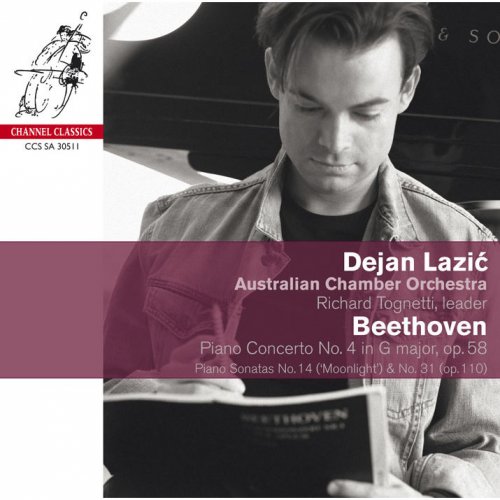
Artist: Australian Chamber Orchestra, Richard Tognetti, Dejan Lazić
Title: Piano Concerto No. 4, Sonates
Year Of Release: 2011
Label: Channel Classics Records
Genre: Classical
Quality: FLAC (tracks, booklet) [192kHz/24bit]
Total Time: 1:09:40
Total Size: 3.31 GB
WebSite: Album Preview
Tracklist:Title: Piano Concerto No. 4, Sonates
Year Of Release: 2011
Label: Channel Classics Records
Genre: Classical
Quality: FLAC (tracks, booklet) [192kHz/24bit]
Total Time: 1:09:40
Total Size: 3.31 GB
WebSite: Album Preview
1. Piano Concerto No. 4 in G Major, Op. 58: I. Allegro moderato (Cadenza: Dejan Lazić) (19:03)
2. Piano Concerto No. 4 in G Major, Op. 58: II. Andante Con Moto (05:30)
3. Piano Concerto No. 4 in G Major, Op. 58: III. Rondo. Vivace (Cadenza: Dejan Lazić) (11:22)
4. Piano Concerto No. 4 in G Major, Op. 58: IV. Applause (00:27)
5. Piano Sonata No. 14 in C-Sharp Minor, Op. 27 No. 2 "Moonlight": I. Adagio Sostenuto (05:03)
6. Piano Sonata No. 14 in C-Sharp Minor, Op. 27 No. 2 "Moonlight": II. Allegretto (02:39)
7. Piano Sonata No. 14 in C-Sharp Minor, Op. 27 No. 2 "Moonlight": III. Presto Agitato (07:14)
8. Piano Sonata No. 31 In A Flat Major, Op. 110: I. Moderato Cantabile, Molto Espressivo (05:47)
9. Piano Sonata No. 31 In A Flat Major, Op. 110: II. Allegro Molto (02:06)
10. Piano Sonata No. 31 In A Flat Major, Op. 110: III. Adagio Ma Non Troppo (Recitativo; Arioso Dolente) - Fuga: Allegro Ma Non Troppo (10:20)
In purely musical terms, this ‘outcome’, with the Australian Chamber Orchestra directed by Richard Tognetti, is a mixed form or combination, in which the well-known version for piano and (symphony) orchestra, performed as usual with a conductor, is brought together with the newly discovered chamber version for piano and string quintet. … In Beethoven’s time it was customary that the soloist, who was often a composer as well, improvised the cadenzas. Beethoven personally challenged the young Franz Liszt not only to compose more, but also generally to improvise more at the cadenzas. I have therefore taken the liberty of writing my own cadenzas for the first and last movements. … In both sonatas, Beethoven writes the menuetto/scherzo as second movement, instead of as third as was customary. Generally speaking, the term romantic irony links the two sonatas to the piano concerto. Around 1800, Friedrich Schlegel had already formulated his concept of romantic irony, and Ludwig van Tieck employed it slightly later in his literary comedies. From: liner notes by Dejan Lazic
![Giuseppe Guarrella Niwas Quartet - New Call (2026) [Hi-Res]](https://www.dibpic.com/uploads/posts/2026-10/1791051038_o5muqiwiwd99g_600.jpg "Giuseppe Guarrella Niwas Quartet - New Call (2026) [Hi-Res]")

![Devin Gray - El Bronco (2026) [Hi-Res]](https://img.israbox.com/img/2026-10/03/qoc2ofs1gq0k1vl1olpi81tkv.jpg "Devin Gray - El Bronco (2026) [Hi-Res]")