Pat Metheny Group - Live In Concert (1977) LP
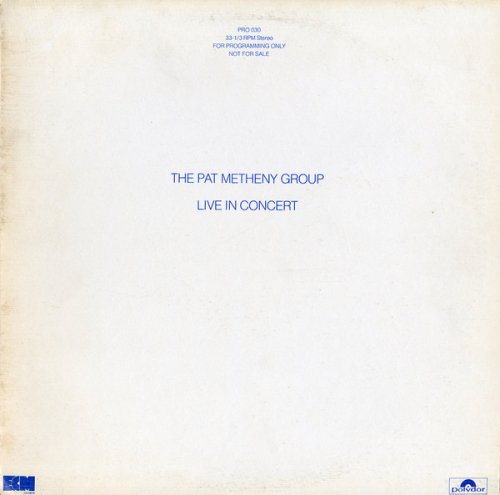
Artist: Pat Metheny Group
Title: Live In Concert
Year Of Release: 1977
Label: ECM Records - PRO 030
Genre: Jazz fusion
Quality: FLAC (tracks+.cue) 24/192
Total Time: 00:34:36
Total Size: 1.31 GB
WebSite: Album Preview
Tracklist:Title: Live In Concert
Year Of Release: 1977
Label: ECM Records - PRO 030
Genre: Jazz fusion
Quality: FLAC (tracks+.cue) 24/192
Total Time: 00:34:36
Total Size: 1.31 GB
WebSite: Album Preview
Side 1
A1 - Phase Dancer - 8:45
A2 - Watercolors - 7:32
Side 2
B1 - San Lorenzo - 10:44
B2 - Wrong Is Right - 6:18
Here’s a remarkable little artifact I salvaged from the dusty back bins of the local record store…
This is a relatively rare ECM radio-only promo pressing of the Pat Metheny Group tearing it up live in concert in San Francisco and Seattle in 1977. This pressing was for radio broadcast only and has never been commercially released in any format.
The Pat Metheny Group is an American jazz fusion group founded in 1977 in Missouri. The core members of the group are guitarist, composer and bandleader Pat Metheny; and keyboardist and composer Lyle Mays, who was in the group at its inception
Founder Pat Metheny first emerged on the jazz scene in the mid-1970s with a pair of solo albums. First was Bright Size Life, released in 1976, a trio album with bass guitarist Jaco Pastorius and drummer Bob Moses. The next album, released in 1977, was Watercolors, featuring Eberhard Weber on bass, pianist Lyle Mays, and drummer Danny Gottlieb.
Despite the common description of Metheny’s music as “fusion,” it was always his intention to create improvised music that had a greater emphasis on bringing out harmony than anything common to what was called “fusion” of the time. Pastorius, with whom Metheny struck up a friendship while the two attended the University of Miami and later toured in Joni Mitchell’s backing band during her transition from her earlier folk rock compositions to those with more jazz influence, had at the same time explored melodic lines for his instrument within the melodies normally heard, rather than just providing a simple bassline, revolutionizing the way the bass guitar was viewed by the musical establishment. The two friends would talk into the late evening during the early 1970s and discuss the new possibilities their instruments held.
At the same time, Jaco and I were both really on a mission to find a way to play and find a way to present our instruments in an improvisational environment that expressed our dissatisfaction with the status quo at the time. — Pat Metheny
In 1977, bassist Mark Egan joined Metheny, Mays, and Gottlieb to form the Pat Metheny Group. They released the self-titled album “Pat Metheny Group” in 1978 on the ECM label, which featured several songs co-written by Metheny and Mays. The group’s second album, American Garage in 1979, was a breakout hit, reaching #1 on the Billboard Jazz chart and crossing over to the pop charts as well, largely on the strength of the up-tempo opening track “(Cross the) Heartland” which would become a signature tune for the group. The group built upon its success with lengthy tours in the USA and Europe.
The group featured a unique sound, particularly due to Metheny’s Gibson ES-175 guitar coupled to two digital delay units and Mays’ Oberheim synthesizer and Yamaha Organ. The group played in a wide range of styles from experimental to grassroots music. Later on, Metheny began working with the Roland GR300 guitar synthesizer and a Synclavier System, while Mays expanded his setup with a Prophet 5 synthesizer designed by Sequential Circuits, and later with many other synthesizers.
This is a relatively rare ECM radio-only promo pressing of the Pat Metheny Group tearing it up live in concert in San Francisco and Seattle in 1977. This pressing was for radio broadcast only and has never been commercially released in any format.
The Pat Metheny Group is an American jazz fusion group founded in 1977 in Missouri. The core members of the group are guitarist, composer and bandleader Pat Metheny; and keyboardist and composer Lyle Mays, who was in the group at its inception
Founder Pat Metheny first emerged on the jazz scene in the mid-1970s with a pair of solo albums. First was Bright Size Life, released in 1976, a trio album with bass guitarist Jaco Pastorius and drummer Bob Moses. The next album, released in 1977, was Watercolors, featuring Eberhard Weber on bass, pianist Lyle Mays, and drummer Danny Gottlieb.
Despite the common description of Metheny’s music as “fusion,” it was always his intention to create improvised music that had a greater emphasis on bringing out harmony than anything common to what was called “fusion” of the time. Pastorius, with whom Metheny struck up a friendship while the two attended the University of Miami and later toured in Joni Mitchell’s backing band during her transition from her earlier folk rock compositions to those with more jazz influence, had at the same time explored melodic lines for his instrument within the melodies normally heard, rather than just providing a simple bassline, revolutionizing the way the bass guitar was viewed by the musical establishment. The two friends would talk into the late evening during the early 1970s and discuss the new possibilities their instruments held.
At the same time, Jaco and I were both really on a mission to find a way to play and find a way to present our instruments in an improvisational environment that expressed our dissatisfaction with the status quo at the time. — Pat Metheny
In 1977, bassist Mark Egan joined Metheny, Mays, and Gottlieb to form the Pat Metheny Group. They released the self-titled album “Pat Metheny Group” in 1978 on the ECM label, which featured several songs co-written by Metheny and Mays. The group’s second album, American Garage in 1979, was a breakout hit, reaching #1 on the Billboard Jazz chart and crossing over to the pop charts as well, largely on the strength of the up-tempo opening track “(Cross the) Heartland” which would become a signature tune for the group. The group built upon its success with lengthy tours in the USA and Europe.
The group featured a unique sound, particularly due to Metheny’s Gibson ES-175 guitar coupled to two digital delay units and Mays’ Oberheim synthesizer and Yamaha Organ. The group played in a wide range of styles from experimental to grassroots music. Later on, Metheny began working with the Roland GR300 guitar synthesizer and a Synclavier System, while Mays expanded his setup with a Prophet 5 synthesizer designed by Sequential Circuits, and later with many other synthesizers.
![Ilugdin Trio - My Story (2021) [Hi-Res]](https://www.dibpic.com/uploads/posts/2021-05/1621956595_folder.jpg "Ilugdin Trio - My Story (2021) [Hi-Res]")
![Melissa Weikart - Contact (2026) [Hi-Res]](https://img.israbox.com/img/2026-10/23/arb6jeplsndm5k27koduixaug.jpg "Melissa Weikart - Contact (2026) [Hi-Res]")
![Sarah Vaughan - Sarah Vaughan à Paris (Remastered, Stereo Version) (2013) [Hi-Res]](https://www.dibpic.com/uploads/posts/2026-10/1792764218_cover.jpg "Sarah Vaughan - Sarah Vaughan à Paris (Remastered, Stereo Version) (2013) [Hi-Res]")