Smetana Trio - Ravel and Shostakovich: Piano Trios (2014)
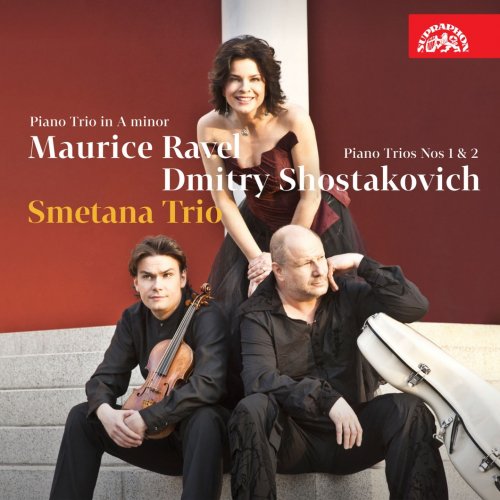
Artist: Smetana Trio
Title: Ravel and Shostakovich: Piano Trios
Year Of Release: 2014
Label: Supraphon a.s.
Genre: Classical
Quality: flac lossless (tracks)
Total Time: 01:08:10
Total Size: 246 mb
WebSite: Album Preview
TracklistTitle: Ravel and Shostakovich: Piano Trios
Year Of Release: 2014
Label: Supraphon a.s.
Genre: Classical
Quality: flac lossless (tracks)
Total Time: 01:08:10
Total Size: 246 mb
WebSite: Album Preview
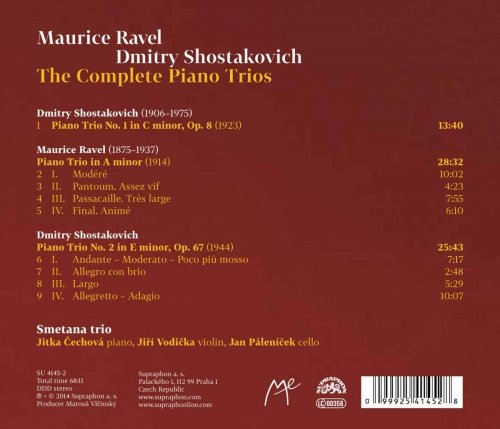
01. Piano Trio No. 1 in C Minor, Op. 8
02. Piano Trio in A Minor, M. 67: I. Modéré
03. Piano Trio in A Minor, M. 67: II. Pantoum. Assez vif
04. Piano Trio in A Minor, M. 67: III. Passacaille. Très large
05. Piano Trio in A Minor, M. 67: IV. Final. Animé
06. Piano Trio No. 2 in E Minor, Op. 67: Andante-Moderato-Poco piu mosso
07. Piano Trio No. 2 in E Minor, Op. 67: Allegro con brio
08. Piano Trio No. 2 in E Minor, Op. 67: Largo
09. Piano Trio No. 2 in E Minor, Op. 67: Allegretto-Adagio
"Complete Piano Trios" is an odd title for this Czech release: Ravel wrote only one trio, and the completeness is hardly the point. There, however, the doubts end; this is an extraordinary performance that both contributes original interpretations and draws illuminating connections. The ultra-romantic Piano Trio No. 1 in C minor, Op. 8, by Shostakovich was a student work, and it's comparatively rarely played. But putting it next to Ravel's Piano Trio in A minor makes perfectly clear why Shostakovich liked it, submitted it as a conservatory entrance exam, and thought it was worth publishing: it has a strong Impressionist component, and the composer thought, with some justification, that he was merging the French and Russian styles. All three works are beautifully performed by the Smetana Trio. The Ravel has the seemingly nonchalant but actually aching lyricism that only French groups are supposed to be capable of, and some of that lyricism is transferred to the first movement of the Shostakovich Piano Trio in E minor, Op. 67, a product of the World War II years that, almost alone among compositions of that time, reflected what was happening to the Jews and that ranks among Shostakovich's profoundest works. The beauty of the first movement makes the tragic slow movement and the dance-of-death finale all the more intense. A 20th century chamber recital of the first order.
![David Virelles, Reggie Workman & Andrew Cyrille - Creative Inspirations (2026) [Hi-Res]](https://www.dibpic.com/uploads/posts/2026-09/1790276939_ffnipjoqjp1h5_600.jpg "David Virelles, Reggie Workman & Andrew Cyrille - Creative Inspirations (2026) [Hi-Res]")
![Constanza Pellicci & Ana Gamboa - Secreto desorden de los sentidos (2026) [Hi-Res]](https://img.israbox.com/img/2026-09/26/xi5951dowc7dyrb7terbkcn0i.jpg "Constanza Pellicci & Ana Gamboa - Secreto desorden de los sentidos (2026) [Hi-Res]")
![Jimetta Rose - MettaSun (2026) [Hi-Res]](https://img.israbox.com/img/2026-09/25/wazvmdr6r986fj2clok7djxp6.jpg "Jimetta Rose - MettaSun (2026) [Hi-Res]")
![Audrey Powne - Bodies of Water (2026) [Hi-Res]](https://www.dibpic.com/uploads/posts/2026-09/1790174071_1.jpg "Audrey Powne - Bodies of Water (2026) [Hi-Res]")

![木飞伞 Flywood - 问手 Seeking Hands (2026) [Hi-Res]](https://www.dibpic.com/uploads/posts/2026-09/1790055166_cover.jpg "木飞伞 Flywood - 问手 Seeking Hands (2026) [Hi-Res]")