Leopold Stokowski - Strauss: Till Eulenspiegel, Salome, Don Juan (1959) [2013] Hi-Res
- 05 May, 23:29
- change text size:
Facebook
Twitter
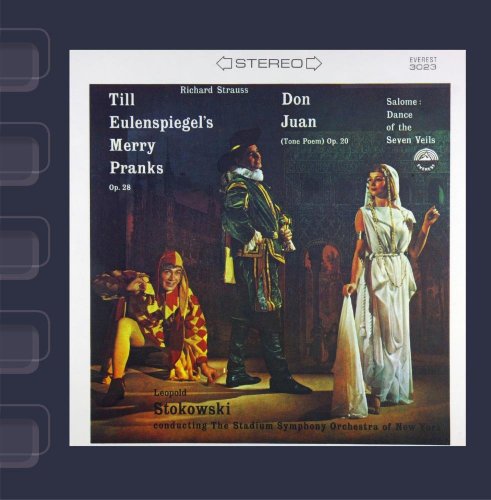
Artist: Leopold Stokowski
Title: Strauss: Till Eulenspiegel, Salome, Don Juan
Year Of Release: 1959 [2013]
Label: Everest [SDBR-3023]
Genre: Classical
Quality: FLAC (Tracks) | 24 Bit/192 kHz
Total Time: 00:39:50
Total Size: 1,4 GB (+3%rec.)
WebSite: Album Preview
Title: Strauss: Till Eulenspiegel, Salome, Don Juan
Year Of Release: 1959 [2013]
Label: Everest [SDBR-3023]
Genre: Classical
Quality: FLAC (Tracks) | 24 Bit/192 kHz
Total Time: 00:39:50
Total Size: 1,4 GB (+3%rec.)
WebSite: Album Preview

Some notes on the history of Everest
Records
When Everest Records was founded by Harry
Belock in 1958 as a division of Belock Instrument Corp., the aim was to produce a catalogue of stereo recordings of the highest possible technical standard, with interesting and
innovative classical repertoire played by some
of the best artists and orchestras.
For the first Everest recording sessions in
1958, an Ampex 300-3 half-inch threechannel recorder was used. Later on the label
moved to use a Westrex 35mm 3-track magnetic film recorder, which had a wider possible
dynamic range, less print-through, less tape
stretch and less ‘wow and flutter’, and which
was the basis for the highly acclaimed typical
“Everest-sound”.
…from the original LP release:
“The remarkable EVEREST sound on this
record is the result of a revolutionary new
method of magnetic recording developed by
EVEREST utilizing 35 mm magnetic film.
Below is a graphic representation of this new
material. What you see here, your ears will
quickly verify when you listen to an EVEREST recording.
Notice that now EVEREST engineers have
over 3 times the normal space available
[than] on ¼” tape. This means distortion free,
perfect sound. 35 mm magnetic film allows
EVEREST engineers to make recordings with
• No distortion from print through
• No distortion from lack of channel width
• Absolute minimum of “wow or flutter”
• Highest possible signal to noise ratio
• Greatest quality and dynamic range ever
recorded
With 35 mm magnetic film, the base material on which the magnetic oxide is coated
is five times thicker than conventional tape
and is similar to the film used for motion pictures. This thickness permits the recording of
extremely high sound intensities without the
danger of layer-to-layer “print-through”. The
width of 35 mm magnetic film is such that
it can accommodate three channels, each of
which is as wide as the standard ¼” recording tape. Because of this great channel width,
it is possible to produce stereo recordings in
which the usual background noise is inaudible. Another similarity of magnetic film to
motion picture is that it has sprocket holes
cut along each edge. The drive mechanism is
also similar to motion picture cameras in that
sprocket gears engage these sprocket holes
affording a smoothness of motion that reduces
“wow and flutter” to an absolute minimum.
The film has another advantage in its great
tensile strength which effectively eliminates
pitch changes due to “tape stretch”, a condition heretofore almost impossible to control.
Drawing on the extensive experience in the
motion picture sound field BELOCK INSTRUMENT (of which EVEREST is a division),
requested Westrex Corporation to build special equipment to EVEREST’S exacting
specifications in order to accomplish these
advantages. This equipment includes the use
of special recording heads which afford complete wide band frequency response beyond
that normally specified in any present-day
motion picture recording. It is of interest to
note, that when soundtracks of great motion
pictures originally recorded on 35 mm magnetic film are released as phonograph records,
that normal technique is to re-record the
sound from 35 mm magnetic film to conventional tape. EVEREST, through its advanced
processes and equipment, is the only record
company able to transfer all Master Records
directly from the 35 mm magnetic film to the
recording heads.
To assure maintaining the high quality of
EVEREST sound on every EVEREST recording, the same equipment that is used in the
BELOCK Recording studios is utilized for
recordings made anywhere in the world. By
utilizing specially designed portable versions
of EVEREST 35 mm equipment, EVEREST
engineers are able to make recordings and
maintain the rigid standards and excellence
of quality available in the Studios.
The advanced engineering and special equipment, in addition to meticulous attention
to detail, results in the EVEREST sound, a
sound that has been acclaimed as superb by
critics and record enthusiasts throughout the
world.
Records
When Everest Records was founded by Harry
Belock in 1958 as a division of Belock Instrument Corp., the aim was to produce a catalogue of stereo recordings of the highest possible technical standard, with interesting and
innovative classical repertoire played by some
of the best artists and orchestras.
For the first Everest recording sessions in
1958, an Ampex 300-3 half-inch threechannel recorder was used. Later on the label
moved to use a Westrex 35mm 3-track magnetic film recorder, which had a wider possible
dynamic range, less print-through, less tape
stretch and less ‘wow and flutter’, and which
was the basis for the highly acclaimed typical
“Everest-sound”.
…from the original LP release:
“The remarkable EVEREST sound on this
record is the result of a revolutionary new
method of magnetic recording developed by
EVEREST utilizing 35 mm magnetic film.
Below is a graphic representation of this new
material. What you see here, your ears will
quickly verify when you listen to an EVEREST recording.
Notice that now EVEREST engineers have
over 3 times the normal space available
[than] on ¼” tape. This means distortion free,
perfect sound. 35 mm magnetic film allows
EVEREST engineers to make recordings with
• No distortion from print through
• No distortion from lack of channel width
• Absolute minimum of “wow or flutter”
• Highest possible signal to noise ratio
• Greatest quality and dynamic range ever
recorded
With 35 mm magnetic film, the base material on which the magnetic oxide is coated
is five times thicker than conventional tape
and is similar to the film used for motion pictures. This thickness permits the recording of
extremely high sound intensities without the
danger of layer-to-layer “print-through”. The
width of 35 mm magnetic film is such that
it can accommodate three channels, each of
which is as wide as the standard ¼” recording tape. Because of this great channel width,
it is possible to produce stereo recordings in
which the usual background noise is inaudible. Another similarity of magnetic film to
motion picture is that it has sprocket holes
cut along each edge. The drive mechanism is
also similar to motion picture cameras in that
sprocket gears engage these sprocket holes
affording a smoothness of motion that reduces
“wow and flutter” to an absolute minimum.
The film has another advantage in its great
tensile strength which effectively eliminates
pitch changes due to “tape stretch”, a condition heretofore almost impossible to control.
Drawing on the extensive experience in the
motion picture sound field BELOCK INSTRUMENT (of which EVEREST is a division),
requested Westrex Corporation to build special equipment to EVEREST’S exacting
specifications in order to accomplish these
advantages. This equipment includes the use
of special recording heads which afford complete wide band frequency response beyond
that normally specified in any present-day
motion picture recording. It is of interest to
note, that when soundtracks of great motion
pictures originally recorded on 35 mm magnetic film are released as phonograph records,
that normal technique is to re-record the
sound from 35 mm magnetic film to conventional tape. EVEREST, through its advanced
processes and equipment, is the only record
company able to transfer all Master Records
directly from the 35 mm magnetic film to the
recording heads.
To assure maintaining the high quality of
EVEREST sound on every EVEREST recording, the same equipment that is used in the
BELOCK Recording studios is utilized for
recordings made anywhere in the world. By
utilizing specially designed portable versions
of EVEREST 35 mm equipment, EVEREST
engineers are able to make recordings and
maintain the rigid standards and excellence
of quality available in the Studios.
The advanced engineering and special equipment, in addition to meticulous attention
to detail, results in the EVEREST sound, a
sound that has been acclaimed as superb by
critics and record enthusiasts throughout the
world.
Tracks:
01. Till Eulenspiegel’s Merry Pranks, Op. 28
02. Salome, Op. 54
03. Don Juan, Op. 20
Personnel:
Stadium Symphony Orchestra of New York
Leopold Stokowski, Conductor



![Lucy Khanyan - Armed with Love (2026) [Hi-Res]](https://img.israbox.com/img/2026-06/18/q9fhm8a8v4sqbetzw52acnfzt.jpg "Lucy Khanyan - Armed with Love (2026) [Hi-Res]")