Sibylle Ehlert, Jochen Kupfer, Anne Buter and Reinild Mees - Franz Schreker: Complete Songs For Voice And Piano Vol. 2 (2000)
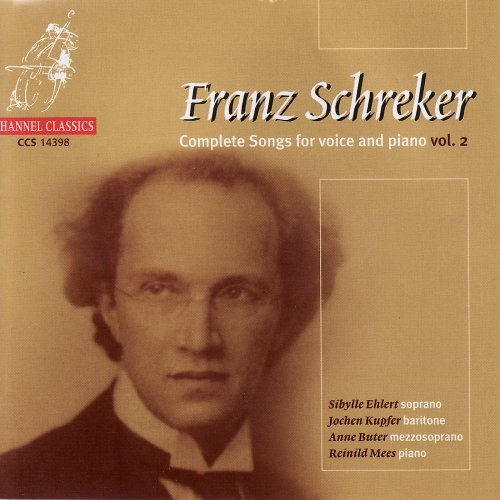
Artist: Sibylle Ehlert, Jochen Kupfer, Anne Buter, Reinild Mees
Title: Franz Schreker: Complete Songs For Voice And Piano Vol. 2
Year Of Release: 2000
Label: Channel Classics Records
Genre: Classical
Quality: FLAC (tracks + booklet)
Total Time: 1:01:46
Total Size: 231 MB
WebSite: Album Preview
Tracklist:Title: Franz Schreker: Complete Songs For Voice And Piano Vol. 2
Year Of Release: 2000
Label: Channel Classics Records
Genre: Classical
Quality: FLAC (tracks + booklet)
Total Time: 1:01:46
Total Size: 231 MB
WebSite: Album Preview
1. Drei Lieder von Vincenz Zusner (1899): I. Ein Rosenblatt (02:11)
2. Drei Lieder von Vincenz Zusner (1899): II. Noch dasselbe Keimen (01:24)
3. Drei Lieder von Vincenz Zusner (1899): III. Vernichtet is mein Lebensglück (03:08)
4. Zwei Lyrische Gesänge (1923) [text by Walt Whitman] (04:59)
5. Zwei Lyrische Gesänge (1923) [text by Walt Whitman] (12:08)
6. Ave Maria (1902) (02:38)
7. Ave Maria (1909) (02:58)
8. Und Wie Mag Die Liebe (01:34)
9. Lied Der Fiorina (01:30)
10. Waldeinsamkeit (03:11)
11. Überwunden (02:21)
12. Die Glühende Krone eine Ballade from Ferne Klang (arr. Alban Berg) (05:10)
13. Entführung (03:06)
14. Das Feurige Männlein (01:37)
15. Fünf Gesänge für tiefe Stimme (1909) (02:07)
16. Fünf Gesänge für tiefe Stimme (1909) (02:41)
17. Fünf Gesänge für tiefe Stimme (1909) (02:34)
18. Fünf Gesänge für tiefe Stimme (1909) (02:31)
19. Fünf Gesänge für tiefe Stimme (1909) (03:50)
This two-cd survey of Franz Schreker’s forty-eight completed songs concludes with a selection that provides a sweeping overview of his lyric accomplishment, from prize-winning early efforts as a student at the Vienna Conservatory to a crowning masterpiece, written at the height of his international fame. Although by their number Lieder do not loom large in his creative output (that place is given to his operas, and secondarily to his orchestral works) Schreker’s songs nonetheless document each stage of his stylistic development and contain some of his finest music. Songs are among Schreker’s earliest surviving works, and among these first scores is the “Lied der Fiorina”, completed on 12 August 1896, when the composer was 18 years old. The manuscript itself is torn in such as way as to obscure both the source and portions of the text, as well as four measures of the vocal line, which, however, can be reconstructed with reasonable assurance. The setting is relatively straightforward although one can already observe Schreker’s penchant for melodic and harmonic modal inflections. Two songs from the following year (“Waldeinsamkeit” and “berwunden”, both dated April 1897) reveal still greater harmonic freedom and an expanded range of rhythmic and accompanimental resources. The curious final measures of “berwunden” seem to combine allusions to Saint-Sans’ Delilah and the Liszt piano sonata, a particularly striking example of the composer’s gradual and sometimes awkward assimilation of a range of influences…….


![Santana - Marathon (1979) [Vinyl]](https://www.dibpic.com/uploads/posts/2026-08/1787322035_0074643615426_600.jpg "Santana - Marathon (1979) [Vinyl]")