Leonhard Völlm & Johannes Wedeking - Pater Noster (2022) [Hi-Res]
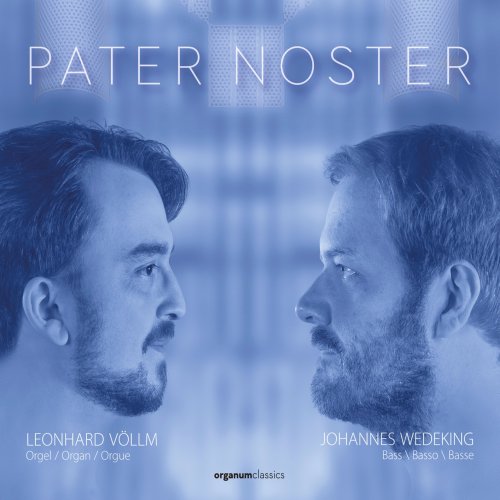
Artist: Leonhard Völlm, Johannes Wedeking
Title: Pater Noster
Year Of Release: 2022
Label: Organum Classics
Genre: Classical
Quality: flac lossless (tracks) / flac 24bits - 48.0kHz +Booklet
Total Time: 01:00:18
Total Size: 265 / 585 mb
WebSite: Album Preview
TracklistTitle: Pater Noster
Year Of Release: 2022
Label: Organum Classics
Genre: Classical
Quality: flac lossless (tracks) / flac 24bits - 48.0kHz +Booklet
Total Time: 01:00:18
Total Size: 265 / 585 mb
WebSite: Album Preview
01. Pachelbe Ciacona in f-Moll · F minor · fa mineur
02. Punsmann Du wirst nur mit der Tat erfasst
03. Cornelius Vater unser, der du bist im Himmel, op. 2 Nr. 1
04. Cornelius Geheiliget werde dein Name, op. 2 Nr. 2
05. Cornelius Zu uns komme dein Reich, op. 2 Nr. 3
06. Cornelius Dein Wille geschehe, op. 2 Nr. 4
07. Cornelius Unser taglich Brot gib uns heute, op. 2 Nr. 5
08. Cornelius Vergib uns unsre Schuld, op. 2 Nr. 6
09. Cornelius Also auch wir vergeben unsern Schuldigern, op. 2 Nr. 7
10. Cornelius Fuhre uns nicht in Versuchung, op. 2 Nr. 8
11. Cornelius Erlose uns vom Ubel, op. 2 Nr. 9
12. Vollm Nekropolis - Gesprach mit Gebeinen
13. Vierne Finale aus der 1. Sinfonie fu?r Orgel, op. 14
14. Beethoven Heiliger Dankgesang eines Genesenen an die Gottheit, in der lydischen Tonart
The present album is the first recording with the new Klais organ and the cantor at St. Martin’s church in Stuttgart-Möhringen, Leonhard Völlm. The recording focuses on the Nine Sacred Songs op. 2 by the Romantic poet and composer Peter Cornelius, entitled ”Vater unser“ (”Our Father“, Pater noster) for solo voice and piano – here in an orchestral arrangement for the organ. At this point, the organ appears as a virtuoso chamber music instrument in an extended manner with characteristically haunting sounds. Organ works from the Baroque period to the present and another song composition form a programme with interrelated dramaturgical accents that bring to sound the special features of this modern instrument with historical references. The singer Johannes Wedeking and the organist Leonhard Völlm met during their studies of church music. Early on, they discovered their shared weakness for vocal music and making as chamber music partners. Both artists share the ambition to constantly open up new repertoire and in doing so, to also launch rarely performed works. Both performers aim to combine historically informed, stylistically confident musicmaking with contemporary contexts. On this album, organist Leonhard Völlm fills a dual role as performer and composer respectively arranger.
A recourse to the earliest tonal models of the new Klais organ is the Ciacona in f by Johann Pachelbel (1653–1706). The equally simple and concentrated art song ”Du wirst nur mit der Tat erfasst“ (”When I go toward you“) to a poem by Rainer Maria Rilke (1875–1926), composed by Frederik Punsmann (b. 1993), introduces the singing voice in the program of this album. Together with Punsmann’s setting, which tends to be oriented retrospectively, Rilke’s late Romantic poetry can be seen as a prologue to the song cycle Vater unser. Neun geistliche Lieder op. 2 (”Our Father. Nine sacred songs“) by Peter Cornelius (1824–1874). In his cycle he precedes all nine song movements with the Gregorian setting of the Latin articles of the Lord’s Prayer, which are then interpreted and illustrated in free poetry. On a musical level, these Gregorian melodic particles form leitmotifs in the individual songs and are modified in accordance with the song text. The four-movement suite Nekropolis – Gespräch mit Gebeinen (Necropolis – Conversation with Bones) by Leonhard Völlm, born 1985, was written under the impressions of a visit to an ossuary in the foundation of the Tübingen Collegiate Church. The composition refers to the weekly hymns for the Sunday of Laetare as specified in the pericope order of the protestant regional church in Württemberg, on which the first performance took place: ”Jesu, meine Freude“ (”Jesus, my Joy“, EG 396) and ”Korn, das in die Erde, in den Tod versinkt“ (”Now the green blade rises“, EG 98). Here the organ of the Martinskirche Möhringen presents itself in the apparel of modernity. Traditional organ recitals often end with the Finale from the 1st Symphony for Organ op. 14 by Louis Vierne (1870–1937). The festive service for the inauguration of the Klais organ was also concluded with this brilliant music. Ludwig van Beethoven (1770–1827) wrote his String Quartet No. 15 in A minor, op. 132 in 1825. This late composition comprises a total of five movements. The middle movement is entitled ”Heiliger Dankgesang eines Genesenen an die Gottheit, in der lydischen Tonart“ (”Holy song of thanksgiving of a convaleszent to the Godhead in the Lydian key“). An autobiographical reference to a serious illness that forced Beethoven to interrupt his compositional work. The arrangement by Leonhard Völlm recorded here comprises only the introduction of the very slow and intimate 3rd movement (Molto adagio – feeling new energy ...). The lyrical I from the song cycle by Peter Cornelius has found peace in ”Hope eternal“ (No. IX). Beethoven’s ”Heiliger Dankgesang“ may be a reminiscence of the Cornelius song ”Vergib uns unsere Schuld“ (”Forgive us our trespasses“) and forms the epilogue to the programme of this album. Performed on the organ, this music by Beethoven impressively evokes the association of the “great calm after the storm“; by the choice of a tempo that is hardly realisable for strings in this recording, an essential specific feature of the instrument organ comes to bear: the potential infinity of sound.
Leonhard Völlm, organ
Johannes Wedeking, bass
![Frank Wess - Moodsville, Volume 8 (Remastered 2026) (1960) [Hi-Res]](https://www.dibpic.com/uploads/posts/2026-09/1789660919_cover.jpg "Frank Wess - Moodsville, Volume 8 (Remastered 2026) (1960) [Hi-Res]")
![Seth MacFarlane - Seth MacFarlane Sings The Muppets (2026) [Hi-Res]](https://www.dibpic.com/uploads/posts/2026-09/1789554685_1.jpg "Seth MacFarlane - Seth MacFarlane Sings The Muppets (2026) [Hi-Res]")
![Christos Barbas, Nabil Naïr - Fam (2026) [Hi-Res]](https://img.israbox.com/img/2026-09/17/x4xf24y0f2ujen7i6goxkoek6.jpg "Christos Barbas, Nabil Naïr - Fam (2026) [Hi-Res]")
![re#encounter - Angels & demons at play (2026) [Hi-Res]](https://img.israbox.com/img/2026-09/19/wo1caqpkz78cxiv5c248mo3j9.jpg "re#encounter - Angels & demons at play (2026) [Hi-Res]")
![Bob James - One (1974) [2021 DSD64]](https://www.dibpic.com/uploads/posts/2021-09/1632427901_folder.jpg "Bob James - One (1974) [2021 DSD64]")