L'Amaltea Instrumental Ensemble, Romano Vettori - Lodovico Viadana - Vespri perl'Assunzione della Beata Vergine (1993)
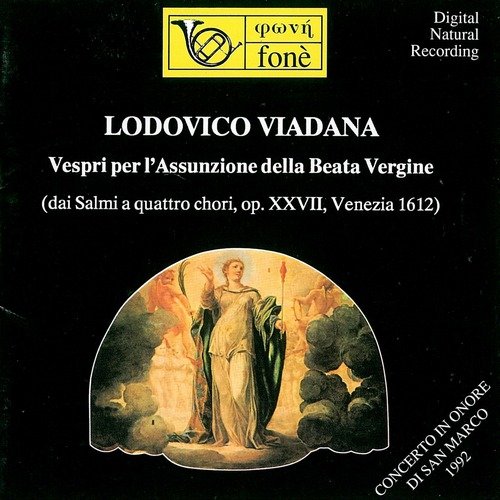
Artist: L'Amaltea Instrumental Ensemble, Romano Vettori
Title: Lodovico Viadana - Vespri perl'Assunzione della Beata Vergine
Year Of Release: 1993
Label: Fone
Genre: Classical, Sacred
Quality: FLAC (image+.cue,log,scans)
Total Time: 70:40
Total Size: 360 Mb
WebSite: Album Preview
Tracklist: Title: Lodovico Viadana - Vespri perl'Assunzione della Beata Vergine
Year Of Release: 1993
Label: Fone
Genre: Classical, Sacred
Quality: FLAC (image+.cue,log,scans)
Total Time: 70:40
Total Size: 360 Mb
WebSite: Album Preview
01. Toccata Prima
02. Deus In Adjutorium/Domine Ad Adjuvandum
03. Assumpta Est Maria In Coelum
04. Dixit Dominus
05. Assumpta Est Maria In Coelum
06. Maria Virgo Assumpta Est
07. Laudate Pueri
08. Ricercar Primo
09. In Odorem Unguentorum
10. Laetatus Sum
11. In Odorem Unguentorum
12. Benedicta Filia Tua
13. Nisi Dominus
14. Fuga Del 9 Tono
15. Pulchra Es Et Decora
16. Lauda Ierusalem
17. Pulchra Es Et Decora
18. Ave Maris Stella
19. Plaudat Nunc Organis Maria
20. Magnificat
21. Canzon (IV)
22. Salve Regina
Performers:
S.Pozzer, soprano
C.Cavina, alto
U.Muller Adam & J.Clement, tenors
S.Foresti, bass
Vox Hesperia - Coro dell'Accademia Roveretana di Musica Antica – L'Amaltea
Chorus, Cappella Musicale di San Marco & L'Amaltea Instrumental Ensemble
Adriano Dallapè, organista
N. Schaap, maestro di concerto
Romano Vettori, direttore
Modern scholars began to investigate possible links between polychoral techniques and the practice of spatial positioning of performaers after realizing the extent to which composers in the 1600s were influenced by the architectural spaces they were coposing for, and by the concept of space in terms of an actual physical dimension whose every detail they could explore and relate to.
Lodovico Grossi da Viadana (usually Lodovico Viadana, though his family name was Grossi; c. 1560 – 2 May 1627) was an Italian composer, teacher, and Franciscan friar of the Order of Friars Minor Observants. He was the first significant figure to make use of the newly developed technique of figured bass, one of the musical devices which was to define the end of the Renaissance and beginning of the Baroque eras in music. He was born in Viadana, a town in the province of Mantua (Italy). According to a document dating from about 150 years after his death, he was a member of the Grossi family but took the name of his birth city, Viadana, when he entered the order of the Minor Observants prior to 1588 (Mompellio 2001). Though there is no contemporary evidence, it has been claimed that he studied with Costanzo Porta (Mompellio 2001), becoming choirmaster at the cathedral in Mantua by 1594. In 1597 he went to Rome, and in 1602 he became choirmaster at the cathedral of San Luca in Mantua. He held a succession of posts at various cathedrals in Italy, including Concordia (near Venice), and Fano, on the east coast of Italy, where he was maestro di cappella from 1610 to 1612 (Mompellio 2001). For three years, from 1614 to 1617, he held a position in his religious order which covered the entire province of Bologna (including Ferrara, Mantua and Piacenza).
Lodovico Grossi da Viadana (usually Lodovico Viadana, though his family name was Grossi; c. 1560 – 2 May 1627) was an Italian composer, teacher, and Franciscan friar of the Order of Friars Minor Observants. He was the first significant figure to make use of the newly developed technique of figured bass, one of the musical devices which was to define the end of the Renaissance and beginning of the Baroque eras in music. He was born in Viadana, a town in the province of Mantua (Italy). According to a document dating from about 150 years after his death, he was a member of the Grossi family but took the name of his birth city, Viadana, when he entered the order of the Minor Observants prior to 1588 (Mompellio 2001). Though there is no contemporary evidence, it has been claimed that he studied with Costanzo Porta (Mompellio 2001), becoming choirmaster at the cathedral in Mantua by 1594. In 1597 he went to Rome, and in 1602 he became choirmaster at the cathedral of San Luca in Mantua. He held a succession of posts at various cathedrals in Italy, including Concordia (near Venice), and Fano, on the east coast of Italy, where he was maestro di cappella from 1610 to 1612 (Mompellio 2001). For three years, from 1614 to 1617, he held a position in his religious order which covered the entire province of Bologna (including Ferrara, Mantua and Piacenza).
DOWNLOAD FROM ISRA.CLOUD
Viadana- Vespri per l'Assunzione - Vox Hesperia, Romano Vettori.rar - 364.3 MB
Viadana- Vespri per l'Assunzione - Vox Hesperia, Romano Vettori.rar - 364.3 MB

![RYMDEN - Today May Be Tomorrow (2026) [Hi-Res]](https://www.dibpic.com/uploads/posts/2026-09/1790081236_folder.jpg "RYMDEN - Today May Be Tomorrow (2026) [Hi-Res]")
![Maria Emrik - I Fall In Love Too Easily (2023) [Hi-Res]](https://www.dibpic.com/uploads/posts/2026-09/1789815017_cover.jpg "Maria Emrik - I Fall In Love Too Easily (2023) [Hi-Res]")

![Andronikos - Short Stories (2026) [Hi-Res]](https://img.israbox.com/img/2026-09/20/9ntr0fr573okxunc3qwq6j4n6.jpg "Andronikos - Short Stories (2026) [Hi-Res]")