Emilie De Voght, Pieter-Jan Verhoyen - Joseph Ryelandt (2022)
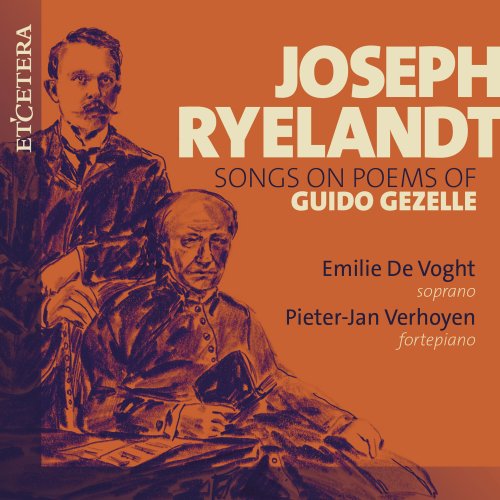
Artist: Emilie De Voght, Pieter-Jan Verhoyen
Title: Joseph Ryelandt
Year Of Release: 2022
Label: Etcetera
Genre: Classical
Quality: flac lossless (tracks)
Total Time: 00:43:18
Total Size: 178 mb
WebSite: Album Preview
TracklistTitle: Joseph Ryelandt
Year Of Release: 2022
Label: Etcetera
Genre: Classical
Quality: flac lossless (tracks)
Total Time: 00:43:18
Total Size: 178 mb
WebSite: Album Preview
01. Avondstemmen Op. 8 No. 4, From Zes Vlaamse Liederen
02. 'k en Hoore U Nog Niet Op. 46 No. 1, From Vier Vlaamse Liederen
03. Ego Flos Op. 77
04. Vijf Geestelijke Liederen Op. 44: de Goede Herder
05. Vijf Geestelijke Liederen Op. 44: Gij Badt Op Eenen Berg
06. Vijf Geestelijke Liederen Op. 44: Stella Matutina
07. Vijf Geestelijke Liederen Op. 44: Heer, Ontferm U
08. Vijf Geestelijke Liederen Op. 44: de Levensbaan
09. Liederenkrans Op. 38: Wiegelied
10. Liederenkrans Op. 38: Groeningeveld
11. Liederenkrans Op. 38: de Mandel
12. Liederenkrans Op. 38: de Hoornen
13. Liederenkrans Op. 38: Weemoed
14. Eerste Communielied
15. Smeeklied Op. 68, No. 3, From Drie Liederen
16. Zielzuchten Op. 34: O, Mocht Ik ...
17. Zielzuchten Op. 34: Gaat van Mij
18. Zielzuchten Op. 34: Heer God
19. Zielzuchten Op. 34: O, Dierbaar Kruise
20. Zielzuchten Op. 34: Armoede Lief
21. Zielzuchten Op. 34: Brandt Los
The composer Joseph Ryelandt (1870-1965) published Guido Gezelle, étude littéraire in 1920 with the intention of making the Flemish priest and poet better known in the French-speaking world. Ryelandt considered Gezelle (1830-1899) to have been one of the greatest poets of his time; he had indeed been one of the composer’s principal points of reference during WWI.
Joseph Ryelandt was born, bred, and lived in the city of Bruges and knew Guido Gezelle well. They never became close friends because of the difference in their ages, but there was no lack of respect for each other’s work and personality. Gezelle was the elder of the two and had achieved his greatest success in the 1890s, creating his public image of an affable priest and poet whose ceaseless contemplation of creation resulted in poetic reflections on the mysteries of human existence. Guido Gezelle later came to be regarded as one of the greatest Flemish Catholic poets of his time, particularly after his death in 1899, and his texts were set to music by dozens of Flemish and other composers. Today he is considered as one of the most important Belgian poets of the 19th century.
Ryelandt’s love for and fascination with Gezelle’s work may come as a surprise. Joseph Ryelandt was Flemish and very much appreciated the Flemish language, but French was the language that was principally spoken in Ryelandt’s home. He knew Flemish — he wrote and spoke it excellently — but he went to a French-speaking secondary school, his wife was French-speaking, and the Catholic elite in Bruges during the 1900s mainly spoke French. Joseph Ryelandt was a scion of a prominent Bruges family and lived mainly from the family fortune until 1924; he therefore stands in great contrast to Guido Gezelle, who grew up in a very modest environment.
The fact that Joseph Ryelandt’s essay on Gezelle was published in 1920 makes it difficult to separate it from the experiences of the First World War. Ryelandt portrayed Gezelle as a contented old priest with a beatific smile and a charitable view of the world. His sincere modesty and resigned restraint made him, in Ryelandt’s eyes, a modern St. Francis of Bruges who still loved to hear birds singing. Ryelandt’s view of Gezelle was in line with the Catholic conception of Gezelle after 1900, although this was a myth that had been shaped by the writings of his nephew César Gezelle and others. Ryelandt’s contribution is in the same vein. The poet of the Catholic ideal was then himself exalted as a paragon of humanity and artistry.
![Etienne Manchon - Musique du temps présent (2026) [Hi-Res]](https://img.israbox.com/img/2026-09/28/g93hl3u98bk7wcp1pgr8tycng.jpg "Etienne Manchon - Musique du temps présent (2026) [Hi-Res]")
![Fausto Papetti & The Mood Mosaic - Escándalo (2206) [Hi-Res]](https://www.dibpic.com/uploads/posts/2026-10/1790865582_cover.jpg "Fausto Papetti & The Mood Mosaic - Escándalo (2206) [Hi-Res]")
![Maria Reich - CARE WORKS (2026) [Hi-Res]](https://img.israbox.com/img/2026-10/01/h0akmhkbxqr4zl93n37mpy014.jpg "Maria Reich - CARE WORKS (2026) [Hi-Res]")