Duncan Honeybourne - Piano and Chamber Music by Jessy Reason (1878-1938) (2024) Hi-Res
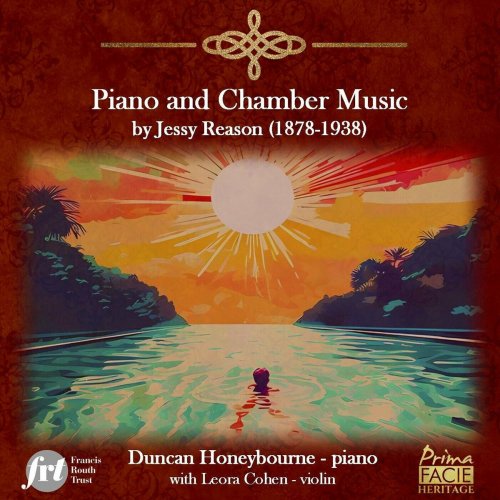
Artist: Duncan Honeybourne
Title: Piano and Chamber Music by Jessy Reason (1878-1938)
Year Of Release: 2024
Label: ASC Records / Prima Facie
Genre: Classical
Quality: FLAC (tracks) / FLAC 24 Bit (44,1 KHz / tracks)
Total Time: 78:12 min
Total Size: 235 / 590 MB
WebSite: Album Preview
Tracklist:Title: Piano and Chamber Music by Jessy Reason (1878-1938)
Year Of Release: 2024
Label: ASC Records / Prima Facie
Genre: Classical
Quality: FLAC (tracks) / FLAC 24 Bit (44,1 KHz / tracks)
Total Time: 78:12 min
Total Size: 235 / 590 MB
WebSite: Album Preview
01. Asterisk No. 1
02. Asterisk No. 2
03. Asterisk No. 3
04. Three Poems for Violin and Piano, No. 1
05. Three Poems for Violin and Piano, No. 2
06. Three Poems for Violin and Piano, No. 3
07. Five Landscapes: No. 1, The Road Across the Hills
08. Five Landscapes: No. 2, Forest Shades
09. Five Landscapes: No. 3, Dewdrops
10. Five Landscapes: No. 4, The Solitary Place
11. Five Landscapes: No. 5, The Sunlit Stream
12. Sonata for Piano
13. Piece for Solo Piano
This album restores to the world the solo piano and chamber music of a long-forgotten, enigmatic fgure.
Jessy Lilian Reason, nee Wolton, born in London in 1878, was the daughter of a wealthy hop merchant. In 1902, in Cornwall, she married a gentleman of private means twenty years her senior, with whom she settled frstly in Devon and later in Tonbridge, Kent. In the late 1920s the couple made a fnal move, to Reading, where Jessy died in 1938. In May 1992 the writer Alan Poulton discovered a large haul of manuscripts in a Leicester junk shop. He purchased the collection and took it home in two suitcases. In the 2020 Covid lockdown, now retired and with time on his hands, he set about exploring and cataloguing the manuscripts, and researching the life of the woman who had penned the 70 handwritten works in the early decades of the twentieth century.
Reason's oeuvre ranges from a signifcant output of songs and piano pieces, through chamber music to full orchestral and choral compositions. The paperwork accompanying the collection reveals that Mrs Reason studied composition with the renowned composer and conductor Eugene Goossens, some ffteen years her junior. How much of Reason's music was performed during her lifetime is unclear: all that has come to light as yet is a performance of a single song at London's Wigmore Hall and a song cycle given at a minor concert in West London, all in the early 1920s.
This disc presents Reason's complete solo piano output, together with a sequence of three Poems for violin and piano. All demonstrate her distinctive impressionistic style: richly romantic; passionately lyrical; densely chromatic; intensely perfumed. Reason, clearly, was a highly gifted woman: long forgotten, whose mysterious tale presents us with more questions than answers but whose music speaks to us across the decades with an irresistible fervour and sincerity.
Jessy Lilian Reason, nee Wolton, born in London in 1878, was the daughter of a wealthy hop merchant. In 1902, in Cornwall, she married a gentleman of private means twenty years her senior, with whom she settled frstly in Devon and later in Tonbridge, Kent. In the late 1920s the couple made a fnal move, to Reading, where Jessy died in 1938. In May 1992 the writer Alan Poulton discovered a large haul of manuscripts in a Leicester junk shop. He purchased the collection and took it home in two suitcases. In the 2020 Covid lockdown, now retired and with time on his hands, he set about exploring and cataloguing the manuscripts, and researching the life of the woman who had penned the 70 handwritten works in the early decades of the twentieth century.
Reason's oeuvre ranges from a signifcant output of songs and piano pieces, through chamber music to full orchestral and choral compositions. The paperwork accompanying the collection reveals that Mrs Reason studied composition with the renowned composer and conductor Eugene Goossens, some ffteen years her junior. How much of Reason's music was performed during her lifetime is unclear: all that has come to light as yet is a performance of a single song at London's Wigmore Hall and a song cycle given at a minor concert in West London, all in the early 1920s.
This disc presents Reason's complete solo piano output, together with a sequence of three Poems for violin and piano. All demonstrate her distinctive impressionistic style: richly romantic; passionately lyrical; densely chromatic; intensely perfumed. Reason, clearly, was a highly gifted woman: long forgotten, whose mysterious tale presents us with more questions than answers but whose music speaks to us across the decades with an irresistible fervour and sincerity.
![Happy Blue - happy happy jævla blå (2026) [Hi-Res]](https://img.israbox.com/img/2026-10/17/cbpyv9stujfobe1nprk5rg27m.jpg "Happy Blue - happy happy jævla blå (2026) [Hi-Res]")
![Dean Kalaitzidis - Bright Tree (2026) [Hi-Res]](https://img.israbox.com/img/2026-10/18/obltgczcjevcnwjxn6aeyfq09.jpg "Dean Kalaitzidis - Bright Tree (2026) [Hi-Res]")