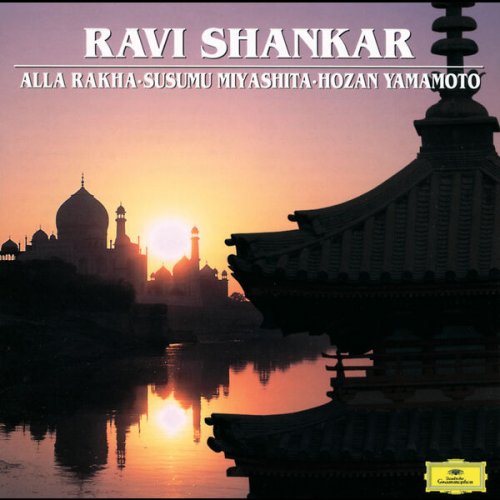
Artist:
Hozan Yamamoto, Ravi Shankar, Susumu Miyashita, Ustad Alla Rakha
Title:
East Greets East
Year Of Release:
1978
Label:
Universal Music LLC
Genre:
Indian classical, Japanese traditional, world music, fusion
Quality:
FLAC 16/44100
Total Time: 00:45:44
Total Size: 212 MB
WebSite:
Album Preview
East Greets East (1978) brings together renowned Eastern musicians—Hozan Yamamoto (koto), Ravi Shankar (sitar), Susumu Miyashita (shakuhachi), and Ustad Alla Rakha (tabla). Released by Deutsche Grammophon, the album presents a unique cultural dialogue between Indian and Japanese musical traditions. Featuring compositions by Ravi Shankar inspired by Japanese music alongside interpretations of classic Japanese pieces, including the famous 17th-century work "Rokudan," the album highlights the art of improvisation and the shared modal and rhythmic roots of Eastern music. The artists skillfully blend Indian ragas with Japanese melodies, creating vibrant, richly textured performances filled with mutual respect and the joy of collaboration.
The main link one finds between the music of different countries of the East, which includes the Middle East and Southeast Asia, as well as some Southern and Eastern European music, is that they are all based on modal structures. Indian music had a similar origin in various modes, but since about 2000 years ago there has emerged and developed a highly sophisticated system of melody-forms known as ragas, which are the foundation upon which a musician improvises. These ragas, which number into the thousands, should not be mistaken for a scale, key, melody or composition. Though each raga is based on one of the 72 full-octave parent scales, it must have its own ascending (arohana) and descending (avarohana) structure, its own usage of a pattern of notes, its recognizable feature: the most important note, and, finally, the use of microtones (or shrutis) — there are 22 intervals (shrutis) within an octave, including the usual 12 semitones. In addition, andola (swing or sway) and gamaka (types of special glissandi) and other embellishments bring prana and make the raga alive. These final accomplishments are secrets which the disciple acquires from his guru through oral tradition after many years of training and hard work. Improvisation plays a leading role in Indian classical music. Taking a raga as the melodic base one can improvise in any manner and length of time one wishes — either in slow, medium or fast tempo, with or without drum accompaniment.
Next to raga, tala is the most important element in Indian music. Talas are rhythmic cycles. The drum accompanies the singer when he starts a "song composition" or the instrumentalist starting a gat composition on which they improvise. These compositions can be in any cycle or tala and in any tempo.
In addition to my career as a performer of classical Indian music, I have always admired different forms of music in the East and the West. I have enjoyed performing my own compositions with some outstanding musicians, particularly in the West. The koto and shakuhachi music inspired me to write the two pieces for the wonderful musicians Hozan Yamamoto and Susumu Miyashita. These compositions are based on an old Indian classical format. I chose old ragas which use five notes and are similar to modes used in Japanese music. Even when they are not exactly alike, they use the same notes with the tonic changed or modulated. With this in mind, I have chosen an old raga for my own sitar number.
For the ensemble number I decided to use an old Japanese classic and that’s how I chose the theme from Rokudan, the 17th-century composition for koto. We all improvised on this theme except in the closing piece which I composed. I hope that this interpretation of Rokudan will not be a shock-dan for Japanese listeners. We had great fun and joy in playing it.
My special thanks to my friend Prof. Koizumi for all the help he gave me for this recording. I also thank Taeko Kusano.
Tracklist:
1-1 Susumu Miyashita - Padhasapa [8:40]
1-2 Ustad Alla Rakha - Kaharwa [4:59]
1-3 Ravi Shankar;Ustad Alla Rakha;Hozan Yamamoto;Susumu Miyashita - Improvisation On The Theme Of "Rokudan" [10:46]
1-4 Ustad Alla Rakha;Hozan Yamamoto - Namaha Shivaya [7:59]
1-5 Ravi Shankar;Ustad Alla Rakha - Tribute To Nippon [13:20]

![Lee Ritenour - Live At Ronnie Scott's (2026) [Hi-Res]](https://www.dibpic.com/uploads/posts/2026-10/1792495594_folder.jpg "Lee Ritenour - Live At Ronnie Scott's (2026) [Hi-Res]")