Itzhak Perlman, Bruno Canino, Samuel Sanders, Pinchas Zukerman - Works by Mozart, Debussy and others: BBC Music Magazine September 2025 (vol.33 no.12) (2025)
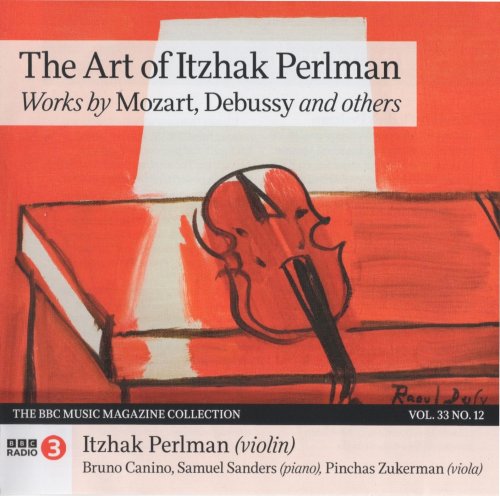
Artist: Itzhak Perlman, Bruno Canino, Samuel Sanders, Pinchas Zukerman
Title: Works by Mozart, Debussy and others: BBC Music Magazine September 2025 (vol.33 no.12)
Year Of Release: 2025
Label: BBC
Genre: Classical
Quality: FLAC (image+.cue,log,scans)
Total Time: 1:03:14
Total Size: 326 MB
WebSite: Album Preview
Tracklist:Title: Works by Mozart, Debussy and others: BBC Music Magazine September 2025 (vol.33 no.12)
Year Of Release: 2025
Label: BBC
Genre: Classical
Quality: FLAC (image+.cue,log,scans)
Total Time: 1:03:14
Total Size: 326 MB
WebSite: Album Preview
Wolfgang Amadeus Mozart
Violin Sonata No 26 in Bb major, K378
1. I Allegro moderato
2. II Andantino sostenuto e cantabile
3. III Rondeau. Allegro
Pablo Sarasate
4. Introduction & Tarantelle, Op 43
Claude Debussy
Sonata in G minor
5. I Allegro vivo
6. II Intermède: Fantasque et léger
7. III Finale Très animé
Antonio Bazzini
8. La Ronde des lutins
Fritz Kreisler
9. Liebeslied
Ottokar Novácek
10. Perpetuum mobile
Giuseppe Tartini arr. Kreisler
11. Variations on a Theme by Corelli
Niccoló Paganini
12. Sonata No 12 in E minor Op 3 No 6: I Andantino innocentemente
Robert Schumann
13. Romance in A major Op 94 No 2
Johan Halvorsen
14. Passacaglia for Violin and Viola (after GF Handel's Keyboard Suite, HWV 432)
For many, Perlman’s most iconic recording was as soloist on John Williams’s score for Schindler’s List – a film for which music played a hugely important role. Throughout the years, leading directors have also chosen to feature existing pieces of classical music in their films, and in so doing have produced some of the most marvellously memorable scenes. On page 48, we pick 12 of our favourite examples. Do you agree with our choices?
Elsewhere in this issue, Claire Jackson examines how composers have embedded coded messages in their music – many of which remain a mystery to this day. We also focus on a composer who's something of a national treasure in Britain - and, it turns out, far beyond. Though many may think of John Rutter as being the most British of choral composers and conductors, his huge popularity in fact spreads right across the globe, as Andrew Green explores.
To Russia, next. In the late 1980s, British pianist James Kirby braved cold, hunger and totalitarian rule to study in Moscow. He shares his memories with Anthony Cheng on page 38. And pianist Alexander Melnikov tells John-Pierre Joyce how he has found inspiration at the home of Rachmaninov.
Our Composer of the Month is the visionary, spiritual Arvo Pärt. From serialism to the hypnotic tintinnabuli, the 90-year-old Estonian’s world has shifted radically over the years, as Paul Hillier explains. And our Building a Library choice is Dvořák's lyrical, passionate, poignant Cello Concerto. A yearning for his homeland and the devastating loss of a beloved friend give the Czech’s work an almost unbearable pathos, explains Jo Talbot.
Elsewhere in this issue, Claire Jackson examines how composers have embedded coded messages in their music – many of which remain a mystery to this day. We also focus on a composer who's something of a national treasure in Britain - and, it turns out, far beyond. Though many may think of John Rutter as being the most British of choral composers and conductors, his huge popularity in fact spreads right across the globe, as Andrew Green explores.
To Russia, next. In the late 1980s, British pianist James Kirby braved cold, hunger and totalitarian rule to study in Moscow. He shares his memories with Anthony Cheng on page 38. And pianist Alexander Melnikov tells John-Pierre Joyce how he has found inspiration at the home of Rachmaninov.
Our Composer of the Month is the visionary, spiritual Arvo Pärt. From serialism to the hypnotic tintinnabuli, the 90-year-old Estonian’s world has shifted radically over the years, as Paul Hillier explains. And our Building a Library choice is Dvořák's lyrical, passionate, poignant Cello Concerto. A yearning for his homeland and the devastating loss of a beloved friend give the Czech’s work an almost unbearable pathos, explains Jo Talbot.