Harald Vogel - Arp Schnitger and the Hamburg Organ Tradition (2019) [Hi-Res]
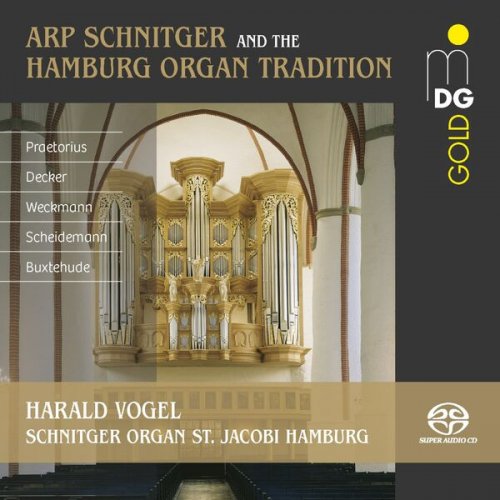
Artist: Harald Vogel
Title: Arp Schnitger and the Hamburg Organ Tradition
Year Of Release: 2019
Label: Musikproduktion Dabringhaus und Grimm
Genre: Classical Organ
Quality: flac 24bits - 96.0kHz +Booklet
Total Time: 00:42:55
Total Size: 752 mb
WebSite: Album Preview
TracklistTitle: Arp Schnitger and the Hamburg Organ Tradition
Year Of Release: 2019
Label: Musikproduktion Dabringhaus und Grimm
Genre: Classical Organ
Quality: flac 24bits - 96.0kHz +Booklet
Total Time: 00:42:55
Total Size: 752 mb
WebSite: Album Preview
01. Prelude in C Major, BuxWV 137
02. Te lucis ante terminum: I. First Verse
03. Te lucis ante terminum: II. Second Verse
04. Melodeyen Gesangbuch: Vater unser im Himmelreich
05. Vater unser im Himmelreich: I. First Verse
06. Vater unser im Himmelreich: II. Second Verse
07. Vater unser im Himmelreich: III. Third Verse
08. Vater unser im Himmelreich: IV. Fourth Verse
09. Vater unser im Himmelreich: V. Fifth Verse
10. Vater unser im Himmelreich: VI. Sixth Verse
11. Vater unser im Himmelreich: VII. Seventh Verse
12. Gott sei gelobet und gebenedeiet
13. Praeambulum in C Major
14. Praeambulum in D Minor
The grand Arp Schnitger organ in St. Jacobi (Church of St James) in Hamburg is remarkable in several respects. This instrument with four manuals boasts of the largest extant inventory of original pipes from thensixteenth and seventeenth centuries, and the Trompete 16’ in the great organ is the very oldest of its kind.
Harald Vogel, the Nestor of the Northern German organ tradition and the recent recipient of the Buxtehude Prize of the Hansa City of Lübeck, presents this magnificently restored organ in conjunction with an unusual Hamburg “family reunion”.
This recording features compositions by Hieronymus and Jacob Praetorius, Joachim Decker, Matthias Weckmann, Heinrich Scheidemann, and Dietrich Buxtehude - they all were closely associated with St. Jacobi and its organ and stood for the towering significance of Hamburg’s music culture over several generations.
As luck would have it, Arp Schnitger, certainly the most important organ builder of the Northern German school, refrained from renovating some qualitatively superb stops by his predecessors Scherer and Fritzsche.
Consequently, the development of the Northern German style can also be traced with special authenticity in the sound dimension.
![Sen Morimoto - Time Is On Your Side (2026) [Hi-Res]](https://www.dibpic.com/uploads/posts/2026-10/1792841010_ib8j6tuzd1vdz_600.jpg "Sen Morimoto - Time Is On Your Side (2026) [Hi-Res]")
![Dom Salvador - The Dom Salvador Samba Jazz Big Band (2026) [Hi-Res]](https://img.israbox.com/img/2026-10/22/983kebl585utbxvo8cdkesqhm.jpg "Dom Salvador - The Dom Salvador Samba Jazz Big Band (2026) [Hi-Res]")