Kola Owolabi - Sacred Expressions: 20th-Century Music for Organ (1950 Holtkamp Organ, Crouse College, Syracuse University) (2016)
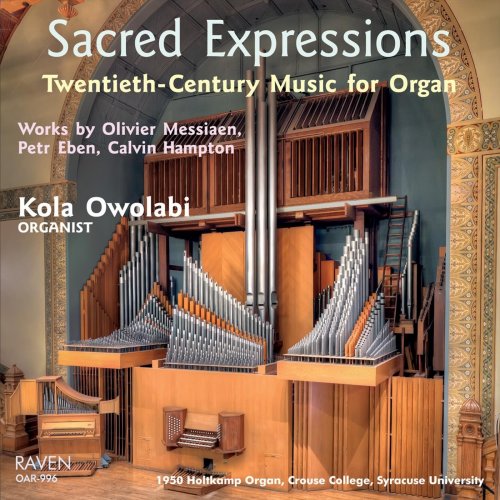
Artist: Kola Owolabi
Title: Sacred Expressions: 20th-Century Music for Organ (1950 Holtkamp Organ, Crouse College, Syracuse University)
Year Of Release: 2016
Label: Raven
Genre: Classical
Quality: FLAC (tracks)
Total Time: 1:07:19
Total Size: 264 MB
WebSite: Album Preview
Tracklist:Title: Sacred Expressions: 20th-Century Music for Organ (1950 Holtkamp Organ, Crouse College, Syracuse University)
Year Of Release: 2016
Label: Raven
Genre: Classical
Quality: FLAC (tracks)
Total Time: 1:07:19
Total Size: 264 MB
WebSite: Album Preview
1. Kola Owolabi – Prelude and Variations on Old Hundredth (17:54)
2. Kola Owolabi – L'Ascension: Majesté du Christ demandant sa gloire à son Père (05:10)
3. Kola Owolabi – L'Ascension: Alléluias sereins d'une âme qui desire le ciel (05:54)
4. Kola Owolabi – L'Ascension: Transport de joie d'une âme devant la gloire du Christ qui est la sienne (04:10)
5. Kola Owolabi – L'Ascension: Prière du Chirst montant vers son Père (07:52)
6. Kola Owolabi – Four Biblical Dances: I. The Dance of David Before the Ark of the Covenant (06:46)
7. Kola Owolabi – Four Biblical Dances: II. The Dance of the Shulamite (05:16)
8. Kola Owolabi – Four Biblical Dances: III. The Dance of Jephtha's Daughter (08:10)
9. Kola Owolabi – Four Biblical Dances: IV. The Wedding in Cana (06:02)
In choosing a program for this recording, I decided to feature two rarely recorded works by significant twentieth-century composers and play them on an iconic instrument that was pivotal in the development of mid-20th-century American organ building. I have chosen major works by Calvin Hampton and Petr Eben, presenting them alongside Olivier Messiaen’s L’Ascension, a staple of 20th-century organ repertoire. Each of these composers has a distinctive musical voice and all found inspiration in sacred themes from the Christian tradition: while Eben’s music gives us programmatic descriptions of biblical stories, Messiaen explores the mystical side of Roman Catholic spirituality, and Calvin Hampton provides a set of variations on a very popular tune from the Genevan Psalter.
I have a great affinity for the music of these three composers and was gratified to discover that Calvin Hampton gave frequent performances of Messiaen’s organ works on his recital programs, including numerous complete performances of the early cycles, La Nativité, L’Ascension, and Les corps glorieux. In 1972, Hampton performed L’Ascension at Calvary Episcopal Church in New York City on the four Sundays in February, accompanied by seven dancers in the nave.
This recording opens with music of Calvin Hampton (1938-1984), who studied with Arthur Poister on the Holtkamp organs at Syracuse University, receiving his master’s degree in organ performance in 1961. Hampton’s career was based in New York City, where he was organist at Calvary Episcopal Church, performing a free organ recital every Friday evening at midnight, from 1972 to 1982. As a composer, he was known for his eclecticism, writing works such as his Concerto for Saxophone Quartet, Strings and Percussion, which was performed by the New York Philharmonic in 1977. He also was very interested in theatre organs and silent film accompaniment, and belonged to a spiritual rock band called Sevenfold Gifts. He wrote numerous choral works for his choir at Calvary Church and published many hymn tunes, several of which were written for rock ensembles.
The Prelude and Variations on Old Hundredth was published in 1975. It was performed by the composer on his midnight organ recital series, and then later that year received its European premiere by Cherry Rhodes at the International Organ Festival in St. Alban’s England. Calvin Hampton writes, “The Doxology [Old Hundredth] is perhaps the most often played chorale of all time but has been the least dealt with by the great organ composers of the past generation. It is my intention to correct this oversight in one giant, eclectic stroke.” Originally consisting of a prelude and nine variations, Hampton later inserted three additional variations, composed for Cherry Rhodes. Hampton acknowledges that his variations were modeled on music composed by 20th-century composers of sets of variations for organ, including Max Reger, Johann Nepomuk David, Sigfrid Karg-Elert, Charles Tournemire and Marcel Dupré.
I have a great affinity for the music of these three composers and was gratified to discover that Calvin Hampton gave frequent performances of Messiaen’s organ works on his recital programs, including numerous complete performances of the early cycles, La Nativité, L’Ascension, and Les corps glorieux. In 1972, Hampton performed L’Ascension at Calvary Episcopal Church in New York City on the four Sundays in February, accompanied by seven dancers in the nave.
This recording opens with music of Calvin Hampton (1938-1984), who studied with Arthur Poister on the Holtkamp organs at Syracuse University, receiving his master’s degree in organ performance in 1961. Hampton’s career was based in New York City, where he was organist at Calvary Episcopal Church, performing a free organ recital every Friday evening at midnight, from 1972 to 1982. As a composer, he was known for his eclecticism, writing works such as his Concerto for Saxophone Quartet, Strings and Percussion, which was performed by the New York Philharmonic in 1977. He also was very interested in theatre organs and silent film accompaniment, and belonged to a spiritual rock band called Sevenfold Gifts. He wrote numerous choral works for his choir at Calvary Church and published many hymn tunes, several of which were written for rock ensembles.
The Prelude and Variations on Old Hundredth was published in 1975. It was performed by the composer on his midnight organ recital series, and then later that year received its European premiere by Cherry Rhodes at the International Organ Festival in St. Alban’s England. Calvin Hampton writes, “The Doxology [Old Hundredth] is perhaps the most often played chorale of all time but has been the least dealt with by the great organ composers of the past generation. It is my intention to correct this oversight in one giant, eclectic stroke.” Originally consisting of a prelude and nine variations, Hampton later inserted three additional variations, composed for Cherry Rhodes. Hampton acknowledges that his variations were modeled on music composed by 20th-century composers of sets of variations for organ, including Max Reger, Johann Nepomuk David, Sigfrid Karg-Elert, Charles Tournemire and Marcel Dupré.
![Ancient Infinity Orchestra - It's Always About Liberation (2026) [Hi-Res]](https://www.dibpic.com/uploads/posts/2026-07/1784644511_folder.jpg "Ancient Infinity Orchestra - It's Always About Liberation (2026) [Hi-Res]")
![Phil Woods with Strings - The Thrill is Gone (2003) [2014 SACD]](https://img.israbox.com/uploads/posts/2017-09/1505578459_vensa0041-large.jpg "Phil Woods with Strings - The Thrill is Gone (2003) [2014 SACD]")