Matthias Bartolomey, Ariane Haering - Hommage (2025) [Hi-Res]
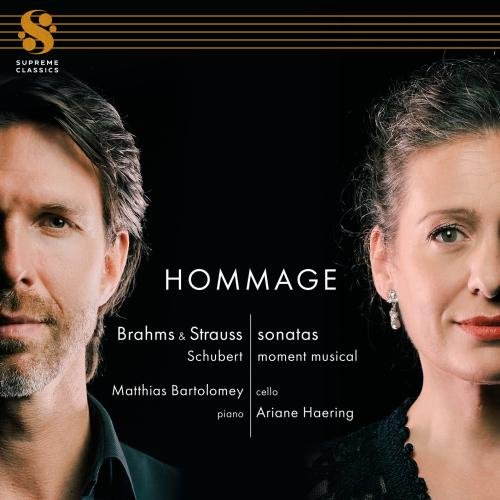
Artist: Matthias Bartolomey, Ariane Haering
Title: Hommage
Year Of Release: 2025
Label: Supreme Classics
Genre: Classical
Quality: flac lossless (tracks) / flac 24bits - 96.0kHz
Total Time: 00:52:30
Total Size: 224 / 898 mb
WebSite: Album Preview
TracklistTitle: Hommage
Year Of Release: 2025
Label: Supreme Classics
Genre: Classical
Quality: flac lossless (tracks) / flac 24bits - 96.0kHz
Total Time: 00:52:30
Total Size: 224 / 898 mb
WebSite: Album Preview
01. Cello Sonata No. 1 in E Minor, Op. 38: I. Allegro non troppo
02. Cello Sonata No. 1 in E Minor, Op. 38: II. Allegretto quasi menuetto
03. Cello Sonata No. 1 in E Minor, Op. 38: III. Allegro
04. Cello Sonata in F Major, Op. 6, TrV 115: I. Allegro con brio
05. Cello Sonata in F Major, Op. 6, TrV 115: II. Andante ma non troppo
06. Cello Sonata in F Major, Op. 6, TrV 115: III. Allegro vivo
07. 6 Moments musicaux, Op. 94, D. 780: No. 3, Allegro moderato (Arr. for Cello & Piano by Matthias Bartolomey)
In February 2001, Franz Bartolomey, principal cellist of the Vienna Philharmonic Orchestra, recorded Johannes Brahms' famous First Sonata for Cello and Piano, Op. 38 in E minor, and an early work, Richard Strauss' Sonata in F major, in the Grand Broadcasting Hall of the RadioKulturhaus. Twenty-five years later, two years after his father's death, his son, cellist Matthias Bartolomey, together with pianist Ariane Haering, now presents the album Hommage with the same programme, supplemented by an arrangement of Schubert's Moment Musical, Op. 3.
For Matthias Bartolomey, his father's recording, and in particular his interpretation, marks an extremely formative period in his musical career. The sonatas by Brahms and Strauss were part of the soundscape of Matthias's childhood home from his earliest youth. Similar to Richard Strauss's ‘Don Quixote’, he knew every note, every phrasing and every portamento of his father's playing by heart. Hommage was also recorded in the Great Broadcasting Hall of the RadioKulturhaus and raises essential questions that transcend generations between father and son. Where does one end and the other begin? What separates them? What unites them?
![Ennio Morricone - Sai cosa faceva Stalin alle donne? (2025) [Hi-Res]](https://img.israbox.com/img/2026-08/04/fpkny68irwq7t8sqed75pdzfn.jpg "Ennio Morricone - Sai cosa faceva Stalin alle donne? (2025) [Hi-Res]")