Artist:
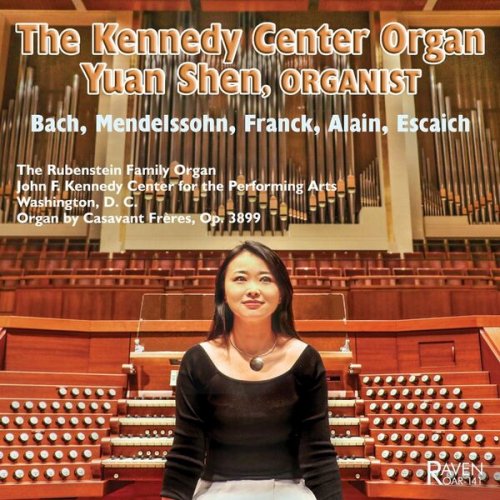
Yuan Shen
Title:
The Kennedy Center Organ
Year Of Release:
2018
Label:
Raven
Genre:
Classical
Quality:
FLAC (tracks)
Total Time: 1:11:47
Total Size: 235 MB
WebSite:
Album Preview
Tracklist:1. Yuan Shen – Fantasy in G Minor, BWV 542 (06:44)
2. Yuan Shen – Fugue in G Minor, BWV 542 (06:05)
3. Yuan Shen – Allegro, Chorale and Fugue in D, MWV W 3 (08:03)
4. Yuan Shen – Chorale No. 2 in B Minor (15:18)
5. Yuan Shen – Trois danses: Joies (08:23)
6. Yuan Shen – Trois danses: Deuils (10:04)
7. Yuan Shen – Trois danses: Luttes (08:27)
8. Yuan Shen – Poèmes: Eaus natales (05:50)
9. Yuan Shen – Poèmes: Vers l'esperance (02:49)
Johann Sebastian Bach‘s Fantasy and Fugue in G Minor, BWV 542, probably was composed in Cöthen around 1720, the year in which Bach traveled to Hamburg, presenting a concert at the Katharinenkirche. Some commentators date the Fugue 1715-1717 and the Fantasy between 1717-1720. This masterpiece evokes North German musical traditions, especially in the Fantasy which largely employs the early baroque stylus fantasticus, somewhat abandoned by Bach’s day but widely practiced by the earlier Hanseatic masters, wherein the composer freely creates with few boundaries of melody or harmony, often producing contrasting and brief episodes of toccata-like and fugal passages. The Fugue subject is based on a Dutch folksong Ik ben gegroet van (I have been greeted).
Bach (1685-1750) was mourning the death in July, 1720, of his wife Maria Barbara when he traveled to Hamburg in November, possibly as a candidate to become organist of the Jakobikirche there and/or possibly to enhance his chances for appointment as cantor of the Hamburg Johanneum and overall musical directorship of the five principal Hamburg churches when that post would be vacated by the ailing incumbent (who died in 1721). For reasons not entirely clear, Bach withdrew his name from consideration at the Jakobikirche. Joachim Hietmann subsequently got the job and paid a fee to be appointed; Bach may have withdrawn when he learned that such a payment was customary in Hamburg. In fact, no documents establish precisely the reason Bach went to Hamburg in 1720. In 1723, Bach took the job in Leipzig as cantor of the Thomaskirche, which also included supervision of music at several other churches.
Some musicologists believe Bach improvised the fugue during his concert at the Katharinenkirche in Hamburg, possibly as homage to the highly regarded organist of that church, Johann Adam Reincken, who was Dutch and 97 years old, still working! Reincken was present at Bach’s concert and highly praised Bach’s performance. Reincken’s comments from 1720 were so significant as to have been published 30 years later in Bach’s obituary.
The work quickly became popular among musicians who wrote copies of the piece, probably via access to Bach’s manuscript and subsequently from others who had copied it. Among those who owned early copies of the work were several of Bach’s students, including Johann Peter Kellner and Johann Ludwig Krebs. The Fantasy and the Fugue were first published, separately, in 1833, some 83 years after Bach’s death, and were first published together in 1844 (only about ten percent of Bach’s music known today was published during his life). Johann Mattheson reports in his General-Baß-Schule that on October 24, 1725, he required candidates who were auditioning for the organist’s post at the Hamburg Cathedral, where Mattheson was music director, to improvise on the Fugue theme. He writes, “I knew well where this theme originated, and who worked it artfully on paper.”
After the death of Bach and the shift in musical fashion toward rococo, classical and early romantic styles, Felix Mendelssohn (1809-1847) revived high quality composition for the organ by writing great works, advocating the music of Bach, and restoring strong instrumental technique, especially that of the pedalboard. Virtuosic writing appears clearly in the allegro of the Allegro, Choral and Fugue in D Minor, composed in 1844. The Allegro combines numerous scales for keyboard and pedal with a dramatic theme. It magnificently introduces the majestic central Choral, followed by a beautiful Fugue with a very elaborate counterpoint. Mendelssohn revisits the diptych form of the prelude and fugue he knew in Bach’s music, placing in its center a grandiose chorale.
César Franck (1822-1890) also inserts a freely invented chorale at the heart of each of his Three Chorales. The Choral No. 2 in B begins with a passacaglia wherein the theme recalls the funeral march of Chopin (the third movement of Chopin’s Piano Sonata No. 2 in B-flat Minor, op. 35, published in 1840). Four variations intensify the discourse and lead to the chorale. In three sections, the chorale is interrupted with free musical comments; then, Franck places a powerful recitative that leads to a fugue where, as usual, he superimposes the theme of the passacaglia with that of the chorale. The work ends with the triumphal return of the ostinato theme, this time in the soprano, followed by the return of the chorale theme singing on the Vox Humana stop supported by a serene and soothing accompaniment.
A chorale and an atmosphere of peace introduce the Trois danses composed by Jehan Alain (1911-1940) for piano in 1937 and arranged for organ in 1939. He was scoring the Trois danses for orchestra in 1940 but the manuscript was lost in World War II and Alain was killed on June 20 as a soldier in the French army. The three dances are Joies, Deuils, and Luttes (Joys, Mourning, and Struggles). Joies exposes two themes: a contemplative chorale characteristic of Alain’s style and an ardent dance, contrasting and superimposing them. After a last seizing crescendo, a nostalgic melody appears from the Oboe stop of the organ: “a wind of melancholy melts the highly animated music into a sad, insistent song.”
Deuils (Mourning) bears a subtitle, Funeral dance to honor a heroic memory, in tribute to Jehan’s younger sister, Marie-Odile (1914-1937), who died in a mountain-climbing accident. Deuils opens with a sepulchral theme which is none other than a modification of the initial theme of Joies. This thematic ostinato is transformed through several variations into a scherzando evoking a wild ritual dance, and then triumphs over the tutti of the organ, like a chorale.
Luttes takes up the oppositions and thematic overlays of Joies, but the funeral chorale of Deuils arrives abruptly, so promptly that it explodes like shell fire that would break down the themes of Joies. It is ultimately these bombings that dominate and complete the work.
One cannot help forming a link between this work and the heroic and tragic fate of a young man who was defeated on the field of honor. The organ manuscript of these dances miraculously reached Paris a few weeks before the death of the author.
Successor of Maurice Duruflé at the organ of Saint-Etienne-du-Mont since 1996, the composer, improviser and organist Thierry Escaich (b. 1965) composed in 1998 Trois Motets for 12 mixed voices and organ based on poems by Alain Suied as extracted from the collection Le Pays Perdu (The Lost Country). They were adapted in 2002 for solo organ, under the title Poèmes.
Eaux natales (Birth waters) begins with an uninterrupted and slightly irregular rhythmic sway. The composer explains that “the only two progressions of intensity of the piece come to translate, first, the image of ‘runoff of the natal waters of the universe,’ then, a little later, the slow rise in the ‘Heat of a cry,’ where the initial swing moves in the form of a short organizational toccata before falling back, bloodless, in the silence of the mystery of the Nativity.”
The second poem, Le Masque (The Mask) is an imploration inspired by the text of De profundis (From the depths I cried to you, Lord . . .). Hammered chords and an incantatory melody structure the movement. As usual, the composer deals with these elements in a crescendo that develops and amplifies the two initial ideas.
In the last poem, Vers l’espérance (Toward Hope), the composer expresses a frantic escape before death and a call to the Creator. This breathtaking race played on the full organ concludes this organ recital.


![Re-Orb - The Royal Danish Opera House Studio Sessions Vol. 1 (2026) [Hi-Res]](https://www.dibpic.com/uploads/posts/2026-08/1786332445_1.jpg "Re-Orb - The Royal Danish Opera House Studio Sessions Vol. 1 (2026) [Hi-Res]")
![Rent Romus & Tatsuya Nakatani - Uplift (2025) [Hi-Res]](https://www.dibpic.com/uploads/posts/2026-08/1786534986_cover.jpg "Rent Romus & Tatsuya Nakatani - Uplift (2025) [Hi-Res]")
![The Crusaders - Those Southern Knights (1976) [Vinyl]](https://www.dibpic.com/uploads/posts/2026-08/1786196279_0007673216492_600.jpg "The Crusaders - Those Southern Knights (1976) [Vinyl]")