Roberto Noferini, Chiara Cattani - The Six Sonates for Violin and Harpsichord (2020)
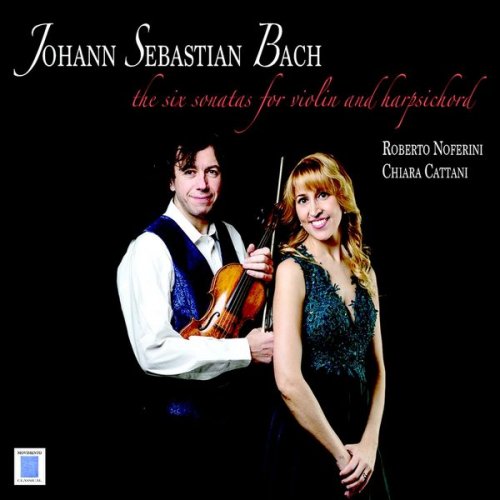
Artist: Roberto Noferini, Chiara Cattani
Title: The Six Sonates for Violin and Harpsichord
Year Of Release: 2020
Label: Movimento Classical
Genre: Classical
Quality: flac lossless (tracks)
Total Time: 01:31:30
Total Size: 575 mb
WebSite: Album Preview
TracklistTitle: The Six Sonates for Violin and Harpsichord
Year Of Release: 2020
Label: Movimento Classical
Genre: Classical
Quality: flac lossless (tracks)
Total Time: 01:31:30
Total Size: 575 mb
WebSite: Album Preview
CD1
01. Violin Sonata in B Minor, BWV 1014: I. Adagio
02. Violin Sonata in B Minor, BWV 1014: II. Allegro
03. Violin Sonata in B Minor, BWV 1014: III. Andante
04. Violin Sonata in B Minor, BWV 1014: IV. Allegro
05. Violin Sonata in A Major, BWV 1015: I. Andante
06. Violin Sonata in A Major, BWV 1015: II. Allegro
07. Violin Sonata in A Major, BWV 1015: III. Andante un poco
08. Violin Sonata in A Major, BWV 1015: IV. Presto
09. Violin Sonata in E Major, BWV 1016: I. Adagio
10. Violin Sonata in E Major, BWV 1016: II. Allegro
11. Violin Sonata in E Major, BWV 1016: III. Adagio ma non tanto
12. Violin Sonata in E Major, BWV 1016: IV. Allegro
CD2
01. Violin Sonata in C Minor, BWV 1017: I. Siciliano. Largo
02. Violin Sonata in C Minor, BWV 1017: II. Allegro
03. Violin Sonata in C Minor, BWV 1017: III. Adagio
04. Violin Sonata in C Minor, BWV 1017: IV. Allegro
05. Violin Sonata in F Minor, BWV 1018: I. Largo
06. Violin Sonata in F Minor, BWV 1018: II. Allegro
07. Violin Sonata in F Minor, BWV 1018: III. Adagio
08. Violin Sonata in E Minor, BWV 1018: IV. Vivace
09. Violin Sonata in G Major, BWV 1019: I. Allegro
10. Violin Sonata in G Major, BWV 1019: II. Largo
11. Violin Sonata in G Major, BWV 1019: III. Allegro
12. Violin Sonata in G Major, BWV 1019: IV. Adagio
13. Violin Sonata in G Major, BWV 1019: V. Allegro
The six Sonatas à I Cembalo [con}certoto è /Violino solo, col I Basso per Viola da Gamba accompagnata I se piaceN BWV 1014-1019 carne to life in the years that Johann Sebastian Bach spent in Kothen, between theendof 1717 andthe beginning of 1723while servingPrince Leopold.Once hewas completely free from his ecclesiastical duties, Bach was able to dedicate himself to instrumental music. lt was in this period that the composer wrote the Brandenburg Concertos too Many years later, however, some of his Sonatas were reworked: the fifth was altered in part butthegreatestoverhaul was in theSixth,thechangesof which willbe analysed here. Despite admitting that the modifications were carri ed out at a later date, Bach considered these Sonatas as a collection and this is seen in its global conception which encompasses them all. Although the composer suggests how the pieces can be performed, that is to say, doubling up the part of the bass correspond i ng to the left hand of the harpsichord with the viola da gamba, actually these Sonatas work perfectly without, since they work together as a true Trio Sonata in which the violin and the right hand of the harpsichord are the two soprano voices and the left hand is the bass. The composer's rigorous and impeccably constructed counterpo int treats the three voices equally, in a continuous exchange of ideas. Each element, more or lessthematic, flows in its fullness and awareness of the harmonic depth and at the same time develops its phrasing horizontally. Sometimes the voice of the bass is entrusted with the function of a bearingaxis, making up a harmonic column. The symbiosis that has to be generated between the violin and the harpsichord, two instruments that are ontologically so different, is huge. The task that awaits the performers is one of the most arduous since they must overcome the characteristics and any limitations of each instrument to be able to bond with the other. lt is for precisely this reason that the violin works as a third hand for the harpsichord player, it brings the quality of it s sound close to the plucking of the string, and the harpsichord craves to sing and communicate better with the string instrument.
Johann Sebastian Bach's chamber production is a drop in the ocean of his opera omnia, an estimated 4%, including the Sonatas for viola da gamba and harpsichord and those for flute and harpsichord. Yet, in these Sonatas, Bach manages to unite the past, the present and to anticipate the musical future. lndeed here he admirably creates a sort of compendium of all styles and more generally of the European musical culture t hat preceded him, and of his contemporaries, as well as bringing perceptible novelty. The violin is treated as a solo with great attention and, thanks to these Sonatas, Bach researches and exploits its potential, while, a r eal German violin style did not yet exist. But that is notali. The new type of Sonata that he developed no longer has anything to do with the conception of the melodie instrument accompanied by the keyboard as a figured bass and thus mainly harmonic. The indication of the harpsichord above and beyond the melodie instrument that we find in the title, is therefore a great novelty given the custom of the time and denotes the role of the harpsichord, which is no longer relegated to accompaniment, as established in its own right, a true co-star. This formula was decisive for the future and it led many other composers to try it, firstly with his childre n Cari Philip Emanuel and Johann Chri stian, and later with Mondonville, Rameau, Giardini, Schobert, Sarti, Boccherini and many others. The well -known Sonatas for historical piano and violin by Mozart and Beethoven have their roots right here. Bach also dedicated himself to the composition of someSonatas for violin and figured bass during his stay in Kòthen. From an architectural point ofview of the Sonatas, the first five follow the model of the Church Sonata, wit h the alternation of four agogically different movements (slow, fast, slow, fast): Bach expl ores within them a very high number of compositional forms. Fugue-style movements are prevalent, but there is no shortage of dances, such as the Siciliana (first tempo of Sonata IV), a solo movement for violin with ltalian-style drops (first movement of Sonata lii), Canons (the slow movements of Sonata Il ), a Passacaglia (third movement of Sonata 111) and even a movement in which the harpsichord improvises a fluent demisemiquaver run and the vio lin takes on the role of figured bass (third movement of Sonata V). The opening movement is homogeneous, with the exception of the only dance, the aforementioned Siciliana. The singing voice rings out thanks to the many melismatic bursts. This is where we can let the wonderful, unannounced, unassuming expressivity of the greatest composer shine .
The counterpoint style is evident in the second half, as it gently permeates even the slow movements, characterised as realFugues or Trios in a Fugue style, but in which two types can stili be distinguished: first of all the true Fugues, beginning with the subject enunciated first by one of the two high voices then by the second, and finally moving onto the bass,and the second,the Concerto Allegro, which follows the style of the fastmovements of Antonio Vivaldi's Concertos,withthesimultaneous entry of all the voices, and the alternating sectio ns of all parts with sections of Solo. The third movement is stili characterised by the modification of the tonai system; as we said before, every slow movement is an opportunity for Bach to explore a compositional form.
Again the last movement is a Fugue or a Trio in a Fugue style and it falls into the two types described for the second movements, although distinguishing it self more forthe dancing performance. The Sonata VI is to be considered separately. Three versions were written, the first belongs to the Kòthen period, the next two to the Leipzig period, one in the early years of Thomaskantor's leadership (the artistic director of Thomanerchor) and one in the last few years of stay in this city. Of the seven manuscripts for this Sonata, four present the third version, to be considered therefore most likely to be the definitive one. Only the first two movements are in common between the first and the last version. Of the remaining three, two, a Cantabile, ma un poco Adagio and an Adagio are replaced by one piece for solo harpsichord and another Adagio, while the last movement is the r epetition of the first, as the manuscript reports the wording Ab initio repetot et claudat. The peculiarity of the second draft is that the piece for solo harpsichord corresponds to the Courante of the Si xth Partita in E minor for harpsichord BWV 830. The last movement , on the other hand, is the reworking of the Gavotte from the same Partita, adapted to the violin accompanied by the harpsichord as the fi gured bass. The presence of a movement for the solo harpsichord within a chamber sonata is a gem in the repertoire of any era; it is characterised by being in the form of a binary dance. The scheme of the ent ire sonata is not attributab l e to that of the Ch urch Sonata, but to the Chamber Sonata: the movements are therefore five and the alternation is fastslow -fast-slow -fast.
![Enzo Favata - Ritornare (2026) [Hi-Res]](https://www.dibpic.com/uploads/posts/2026-09/1789547045_1.jpg "Enzo Favata - Ritornare (2026) [Hi-Res]")
![Vince Guaraldi - It's A Mystery, Charlie Brown (Original Soundtrack Recording) [Guaraldi 75th Anniversary Extended Edition] (2026) [Hi-Res]](https://www.dibpic.com/uploads/posts/2026-08/1787081804_1.jpg "Vince Guaraldi - It's A Mystery, Charlie Brown (Original Soundtrack Recording) [Guaraldi 75th Anniversary Extended Edition] (2026) [Hi-Res]")
![Todd DelGiudice - Mas Alto (2026) [Hi-Res]](https://www.dibpic.com/uploads/posts/2026-09/1789698797_cover.jpg "Todd DelGiudice - Mas Alto (2026) [Hi-Res]")
![Andrew D'Angelo - BCDELUXE (2026) [Hi-Res]](https://www.dibpic.com/uploads/posts/2026-09/1789902103_cover.jpg "Andrew D'Angelo - BCDELUXE (2026) [Hi-Res]")