Artist:
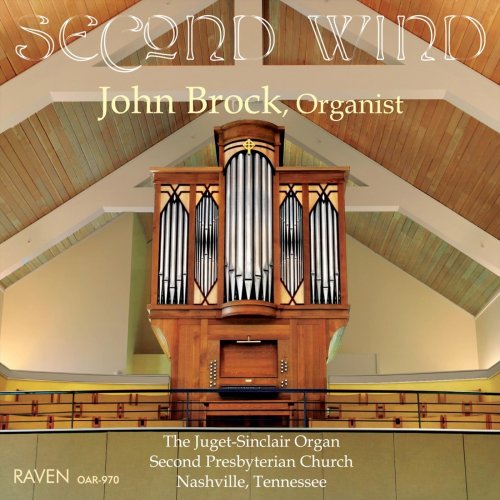
John Brock
Title:
Second Wind
Year Of Release:
2007
Label:
Raven
Genre:
Classical
Quality:
FLAC (tracks)
Total Time: 1:13:24
Total Size: 324 MB
WebSite:
Album Preview
Tracklist:1. John Brock – Praeludium (Fantasia) in D Major (02:45)
2. John Brock – Trio in F Major (02:29)
3. John Brock – Ach, Gott, erhör mein Seufzen (04:22)
4. John Brock – Was Gott tut daß ist wohlgetan (03:55)
5. John Brock – Sonata No. 6 in G Minor: I. Allegro moderato (06:33)
6. John Brock – Sonata No. 6 in G Minor: II. Adagio (04:27)
7. John Brock – Sonata No. 6 in G Minor: III. Allegro (04:40)
8. John Brock – Adagio and Allegro, K. 594 (09:55)
9. John Brock – Noël: Ou sont vont ses gais bergers (05:49)
10. John Brock – Concerto in A Minor, BWV 593, After Vivaldi: I. Allegro (04:12)
11. John Brock – Concerto in A Minor, BWV 593, After Vivaldi: II. Adagio (03:32)
12. John Brock – Concerto in A Minor, BWV 593, After Vivaldi: III. Allegro (04:19)
13. John Brock – Vom Himmel hoch, da komm’ ich her (00:31)
14. John Brock – Jesu, meine Freude (01:00)
15. John Brock – Der Tag, der ist so Freudenreich (00:59)
16. John Brock – Christum wir sollen loben schon (00:35)
17. John Brock – Wir Christenleut’ (00:43)
18. John Brock – Puer natus in Bethlehem (00:38)
19. John Brock – Das neugeborne Kindelein (00:43)
20. John Brock – Lobt Gott, ihr Christen, allzugleich (00:44)
21. John Brock – In Dulci Jubilo (00:28)
22. John Brock – Ich steh’ an deiner Krippe hier (01:04)
23. John Brock – A Tryptich of Fugues: II. Slowly, expressively (05:19)
24. John Brock – Fanfare (03:30)
Repertoire for part of this program has been selected from what organists often think of as the period “nach Bach” (i.e., after Bach). For several generations after the death of J. S. Bach in 1750, the organ suffered from a crisis of non-popularity among leading composers, who were focusing their primary attention on newer musical media like the symphony, the string quartet, and the fortepiano. But Bach left a legacy of students and admirers, many of them lesser-known figures, who continued to write for the instrument. It is works by some of these composers, supplemented with one by Mozart, that have been chosen to illustrate the sounds of this era. A work by Bach himself, two mid-20th century American works, and one selection from the 19th century round out the program.
Johann Christian Kittel, Johann Ludwig Krebs, and Carl Phillip Emanuel Bach were all students of J. S. Bach; Johann Peter Kellner was acquainted with Bach and was important in disseminating the latter’s compositions. Their music shows definite influences from the great master, but they all gravitate toward the newer rococo style, characterized by simpler harmonic structure, a less contrapuntal approach, and more emphasis on melody.
Kittel’s Praeludium in D Major comes from his collection of Sixteen Preludes in all the keys, from C Major through G Major, no doubt inspired by Bach’s Well-Tempered Clavier but evidently left unfinished. Although all of the preludes are of modest length, they comprise a significant collection of pieces in a musical style not commonly associated with the organ.
Krebs was, according to his teacher, “the best crab (Krebs) in the brook (Bach).” His organ works include large preludes and fugues modeled after those of Bach, some trios and miscellaneous pieces, and a number of chorale preludes. His chorale prelude on “Ach Gott, erhör mein Seufzen” (O God, hear my sighing) is notable for its sighing motives, the use of chromaticism to depict sorrow (a baroque concept), and the frequent occurrence of the then-novel sonority of the augmented sixth chord.
Kellner’s cheerful setting of the chorale “What God Ordains Is Always Good,” with the surprise triplets near the end, is based on a ritornello that reappears between each chorale phrase.
The six organ sonatas of C. P. E. Bach (J. S. Bach’s second son) are major works from this era. Written during the composer’s Berlin period (1754-59), they were commissioned by Princess Amalie of Prussia, a sister of Frederick the Great, who was apparently a talented keyboard player but was not able to play the organ pedals. As a result, the pieces are written without a pedal part. In spite of this they are substantial works that demonstrate the composer’s affinity for Sturm und Drang (storm and stress), accomplished primarily through contrasting forte and piano registrations and dramatic pauses. The first and third movements of Sonata VI are cast in sonata-allegro form, another of the important musical developments in the rococo period.
Although Mozart evidently played the organ quite well and even earned his living as an organist for a time, his compositional output for the instrument is rather limited, as there was not much need for composed organ pieces in the Austrian church services. But, Mozart was commissioned by Count Josef Deym to write three pieces for automatic player organs that provided music for his art museum in Vienna. One of these, the Andante, K. 616, was written for a small flute clock. The other two, the Adagio and Allegro heard here, and its companion piece, the Fantasia, K. 608, were evidently written for a somewhat larger instrument with several stops, with an effect not unlike a modest church organ. Nowadays these pieces are arranged so as to be playable with two hands and two feet, resulting in outstanding additions to the organ’s repertoire from the late 18th century.
French composer Louis-Claude Balbastre’s Noëls seem to share a certain similarity of style with the music of Viennese masters. Noëls (variations on Christmas carols) were extremely popular at Christmas Eve services in French churches owing to their lighthearted and uncomplicated nature and the fact that the melodies on which they were based were quite familiar. This piece makes use of the organ’s reed stops and the Cornet (a combination of flute stops at 8’, 4’, 2’, 2’, and 1’ pitches).
J. S. Bach made five arrangements of orchestral concerti for the organ, four from the works of Vivaldi and one from one of his employers, Duke Johann Ernst. Vivaldi’s Concerto in A Minor was originally scored for two solo violins and orchestra, but Bach’s masterful arrangement makes the piece seem like an original organ work. Bach recreates the contrasting tutti and solo effects of the original concerto through the use of dialogues between the two manuals of the organ.
California composer Rayner Brown was a church organist for 45 years and a member of the faculty at Biola University in Los Angeles for 30 years. His extensive catalog of works for all musical media includes well over two hundred pieces for the organ. The Ten Chorales are delightful miniatures – imaginative settings, or in some cases what we might call “impressions,” of traditional Lutheran chorales associated with the Christmas season. The pieces were dedicated to various friends of his.
Gerald Near’s A Tryptich of Fugues is a three-movement work composed of fugues in contrasting moods. The slow, expressive second movement is somewhat unusual for a fugue, since fugues are most often more lively, and because it makes excellent use of the organ’s string stops. Near, one of America’s leading composers of organ and choral music for the church, resides in New Mexico.
Belgian organist Jaak Nikolaas (or Jacques Nicolas) Lemmens is best known for his Ecole d’Orgue (Organ Method, 1862), in which he published for the first time techniques underlying the modern legato approach to organ playing. The Fanfare, arguably his most well known composition, was included in that publication. It is a lively, full-organ toccata, marked staccato throughout, that has been a favorite of organ students ever since.

![Nightmares On Wax vs Adrian Sherwood - In A Space Outta Dub (2026) [Hi-Res]](https://www.dibpic.com/uploads/posts/2026-04/1775047945_a2947907623_10.jpg "Nightmares On Wax vs Adrian Sherwood - In A Space Outta Dub (2026) [Hi-Res]")
![Michael Garrick Sextet - Prelude to Heart Is a Lotus (2013) [Hi-Res]](https://img.israbox.com/img/2026-08/05/jhr3f76brbnzpgoc9j19bdid8.jpg "Michael Garrick Sextet - Prelude to Heart Is a Lotus (2013) [Hi-Res]")