La Petite Bande, Sigiswald Kuijken - J.S. Bach: Cantatas for the Complete Liturgical Year Vol. 16 - "Pfingst-Kantaten" (2013) [SACD]
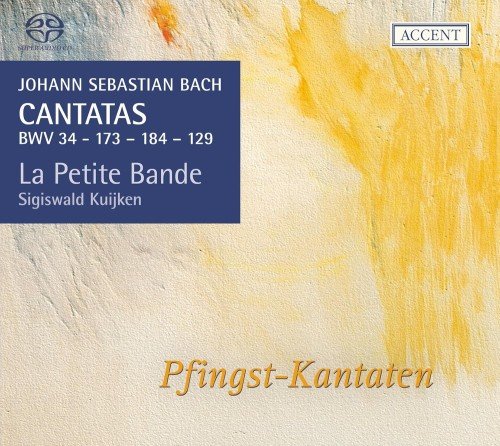
Artist: La Petite Bande, Sigiswald Kuijken
Title: J.S. Bach: Cantatas for the Complete Liturgical Year Vol. 16 - "Pfingst-Kantaten"
Year Of Release: 2013
Label: Accent: ACC25316
Genre: Classical
Quality: DSD64 image (*.iso) / 2.0, 5.0 (2,8 MHz/1 Bit)
Total Time: 70:07
Total Size: 3.3 GB
WebSite: Album Preview
Tracklist:Title: J.S. Bach: Cantatas for the Complete Liturgical Year Vol. 16 - "Pfingst-Kantaten"
Year Of Release: 2013
Label: Accent: ACC25316
Genre: Classical
Quality: DSD64 image (*.iso) / 2.0, 5.0 (2,8 MHz/1 Bit)
Total Time: 70:07
Total Size: 3.3 GB
WebSite: Album Preview
Pentecost Sunday
Cantata BWV34 'O ewiges Feuer, o Ursprung der Liebe'
1. Chorus: O Ewiges Feuer, O Ursprung Der Liebe 7:37
2. Recitative: Herr, Unsre Herzen Halten Dir 0:40
3. Aria: Wohl Euch, Ihr Auserwählten Seelen 5:09
4. Recitative: Erwählt Sich Gott Die Heilgen Hütten 0:32
5. Choral: Friede über Israel 2:10
Second day of Pentecost
Cantata BWV173 'Erhöhtes Fleisch und Blut'
6. Recitative: Erhöhtes Fleisch Und Blüt 0:41
7. Aria: Ein Geheiligtes Gemüte 3:56
8. Aria: Gott Will, O Ihr Menschenkinder 1:51
9. Aria: So Hat Gott Die Welt Geliebt 3:36
10. Recitative: Unendlichster, Den Man Doch Vater Nennt 1:11
11. Chorus: Rühre, Höchster, Unsern Geist 2:26
Third day of Pentecost
Cantata BWV184 'Erwünschtes Freudenlicht'
12. Recitative: Erwünschtes Freudenlicht 3:18
13. Aria: Gesegnete Christen, Glückselige Herde 7:54
14. Recitative: So Freuet Euch, Ihr Auserwählten Seelen! 2:01
15. Aria: Glück Und Segen Sind Bereit 3:32
16. Choral: Herr, Ich Hoff Je 1:11
17. Chorus: Guter Hirte, Trost Der Deinen 2:37
Trinity
Cantata BWV129 'Gelobet sei der Herr, mein Gott'
18. Chorus: Gelobet Sei Der Herr 4:05
19. Aria: Gelobet Sei Der Herr 4:13
20. Aria: Gelobet Sei Der Herr 4:16
21. Aria: Gelobet Sei Der Herr 5:04
22. Choral: Dem Wird Das Heilig Itzt! 1:34
Recordings of the Bach cantatas come in all shapes and sizes, and Sigiswald Kuijken has established his position as a leading artist in this repertoire. He has preferred to group the works by reference to the church’s year, and to perform them with a smaller instrumental ensemble and a strict ‘one voice to a part’ allocation.
This issue is Volume 16 in Kuijken’s series, and the chosen liturgical reference is Pentecost. In the ensemble movements there is drama in abundance, which with this approach is delivered with clear textures and plenty of attack and dancing rhythms. Not everyone will care for the lack of ensemble voices beyond the chosen four-part texture, but these artists believe in what they are doing and their performances reflect that. For example, the opening chorus of BWV34 is particularly lively, the only caveat being whether the balancing of voices and instruments somewhat favours the latter.
In the well-produced accompanying booklet Kuijken justifies his approach with scholarship which inevitably includes a degree of interpretation; but it is carefully thought through and eloquently articulated. If the number of voices is made so important, what then of the types of voice? Surely we should have boys rather than women. That point made, there are few problems with these performers, and the singers acquit themselves with distinction. In terms of which approaches work best, Bach remains the most indestructible of composers, and in that sense each new or revisited performance is to be welcomed.
In arias too Kuijken’s chosen tempi always feel right, while the relationship between solo voices and obbligato instruments is articulated to maximum effect.
Three of these Leipzig cantatas are re-workings of secular cantatas from the Köthen years, an approach that was not at all unusual. The newly composed BWV129 is the exception, though the style remains similar.
The acoustic of the Predikherenkerk at Leuven brings a warmly atmospheric sound to the excellent recordings, which are relatively close but never overbearing.
The issue, then, surrounds the number of singers used in the ripieno movements. Not all artists and scholars agree with Kuijken about this, and it is true that a wider variety of vocal music can enrich the listener’s experience. If a smaller ensemble is the option you prefer, these performances would be hard to better.
This issue is Volume 16 in Kuijken’s series, and the chosen liturgical reference is Pentecost. In the ensemble movements there is drama in abundance, which with this approach is delivered with clear textures and plenty of attack and dancing rhythms. Not everyone will care for the lack of ensemble voices beyond the chosen four-part texture, but these artists believe in what they are doing and their performances reflect that. For example, the opening chorus of BWV34 is particularly lively, the only caveat being whether the balancing of voices and instruments somewhat favours the latter.
In the well-produced accompanying booklet Kuijken justifies his approach with scholarship which inevitably includes a degree of interpretation; but it is carefully thought through and eloquently articulated. If the number of voices is made so important, what then of the types of voice? Surely we should have boys rather than women. That point made, there are few problems with these performers, and the singers acquit themselves with distinction. In terms of which approaches work best, Bach remains the most indestructible of composers, and in that sense each new or revisited performance is to be welcomed.
In arias too Kuijken’s chosen tempi always feel right, while the relationship between solo voices and obbligato instruments is articulated to maximum effect.
Three of these Leipzig cantatas are re-workings of secular cantatas from the Köthen years, an approach that was not at all unusual. The newly composed BWV129 is the exception, though the style remains similar.
The acoustic of the Predikherenkerk at Leuven brings a warmly atmospheric sound to the excellent recordings, which are relatively close but never overbearing.
The issue, then, surrounds the number of singers used in the ripieno movements. Not all artists and scholars agree with Kuijken about this, and it is true that a wider variety of vocal music can enrich the listener’s experience. If a smaller ensemble is the option you prefer, these performances would be hard to better.
![La Petite Bande, Sigiswald Kuijken - J.S. Bach: Cantatas for the Complete Liturgical Year Vol. 16 - "Pfingst-Kantaten" (2013) [SACD]](https://www.dibpic.com/uploads/posts/2025-12/1766416015_back.jpg)
![Jacob Gurevitsch - Chapter of Now (EP) (2026) [Hi-Res]](https://www.dibpic.com/uploads/posts/2026-09/1790071729_cover.jpg "Jacob Gurevitsch - Chapter of Now (EP) (2026) [Hi-Res]")

![Madre Vaca - A World That Bears a Question (2026) [Hi-Res]](https://img.israbox.com/img/2026-09/22/13cz0vr8kn1nqklsbk56py6po.jpg "Madre Vaca - A World That Bears a Question (2026) [Hi-Res]")
![Dahveed Behroozi - September Substance (2026) [Hi-Res]](https://img.israbox.com/img/2026-09/18/mekzgnquzxa3j9ld2qtsebler.jpg "Dahveed Behroozi - September Substance (2026) [Hi-Res]")